ISLAMABAD/KABUL — Tensions between Pakistan and Afghanistan have reached a boiling point, transforming long-standing border friction into what Pakistani officials are now describing as an "open war." In a major military escalation, Pakistan has launched a series of widespread airstrikes deep into Afghan territory, targeting alleged hideouts of the Tehreek-e-Taliban Pakistan (TTP). The military operation has triggered fierce retaliatory cross-border attacks from the Afghan Taliban, plunging the volatile region into a deepening security crisis.
The Trigger: Surging Militancy and the TTP Factor
The roots of the current conflagration lie in a dramatic surge of militant violence within Pakistan's borders, particularly in the western provinces of Khyber Pakhtunkhwa and Balochistan. Over the past two years, Islamabad has consistently accused the Taliban-led government in Kabul of providing a safe haven for the TTP—an ideological ally of the Afghan Taliban—allowing them to orchestrate cross-border attacks with impunity.
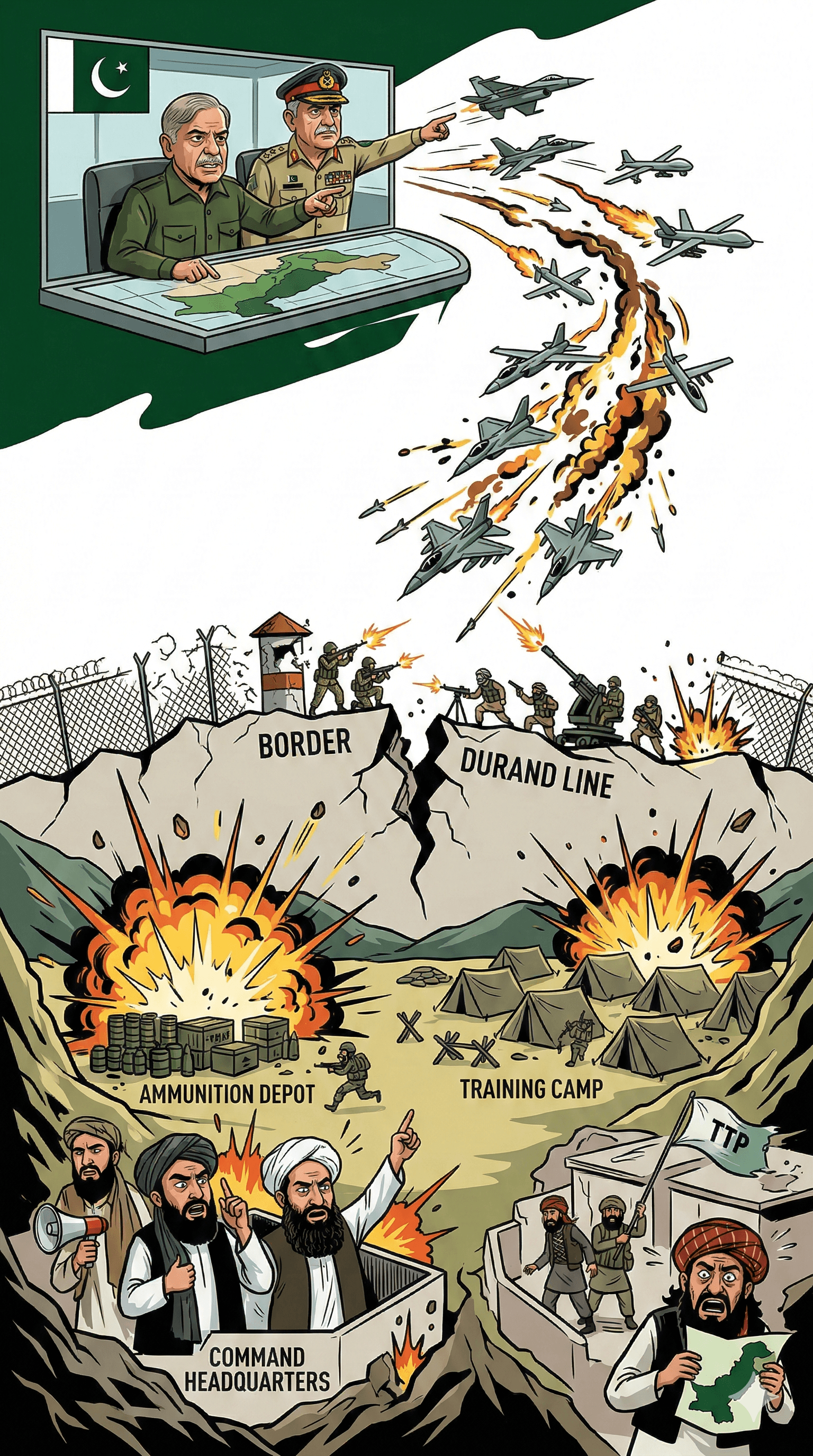
Following a string of deadly terror attacks in late February 2026, including highly coordinated assaults in Islamabad, Bajaur, and Bannu, Pakistan’s patience visibly fractured. Asserting that its diplomatic pleas and demands for action had been repeatedly ignored by Kabul, the Pakistani military launched "Operation Ghazab lil-Haq" (Righteous Fury). These intelligence-based airstrikes were explicitly aimed at dismantling terrorist infrastructure, ammunition depots, and training camps allegedly operated by the TTP and affiliated factions like the Hafiz Gul Bahadur Group.
Kabul, however, vehemently denies harboring anti-Pakistan militants. The Afghan Taliban maintains that the TTP is an internal security and political issue for Pakistan, viewing the unannounced airstrikes as a severe and unacceptable violation of Afghanistan's national sovereignty.
Escalation: Airstrikes and Retaliatory Offensives
The military confrontation escalated rapidly. Initial Pakistani airstrikes focused on the border provinces of Nangarhar, Paktika, and Khost. However, as the conflict intensified and border skirmishes multiplied, Pakistan expanded its aerial campaign to strike targets in major Afghan cities. Reports indicate bombardments hit locations in Kandahar—the spiritual heartland of the Taliban movement—and the capital city, Kabul.
In response, the Afghan Taliban launched a sweeping cross-border offensive along the disputed Durand Line. Afghan defense officials claimed to have captured multiple Pakistani border outposts, destroyed military equipment, and inflicted heavy casualties on Pakistani ground forces. In a notable shift in battlefield tactics, the Afghan military reportedly deployed combat drones to target Pakistani military installations, claiming strikes on facilities in Quetta and Rawalpindi.
The conflict reached another high-stakes flashpoint in early March when Afghan authorities announced they had thwarted a Pakistani airstrike on Bagram Air Base. Afghan forces reportedly utilized anti-aircraft and missile defense systems to repel Pakistani fighter jets from the airspace above the former US military stronghold.
Conflicting Casualty Claims and Humanitarian Toll
As is common in regional conflicts, verifying the human cost remains incredibly difficult due to sharply divergent and unverified narratives from both sides.
Pakistani officials claim their strikes have been highly precise, resulting in the deaths of over 330 militant fighters and the destruction of significant militant infrastructure, including tanks and armored vehicles. Islamabad acknowledges the loss of roughly a dozen of its own soldiers in the localized border skirmishes.
Conversely, the Afghan government accuses Pakistan of indiscriminately targeting civilian areas, including residential homes and migrant construction sites. Kabul reports that dozens of Afghan civilians, including women and children, have been killed in the bombardments. Furthermore, the Taliban claims to have killed over 80 Pakistani soldiers during their border incursions, a figure Islamabad dismisses as inflated propaganda.
Beyond the battlefield casualties, the humanitarian and economic impact is growing rapidly. The fighting has triggered the displacement of civilians living near the porous border. Critical crossings like Torkham and Chaman have faced severe disruptions, stranding travelers, halting millions of dollars in bilateral trade, and choking off the supply of essential goods. Furthermore, the escalation has complicated the plight of Afghan refugees living in Pakistan, who face increased pressure, scrutiny, and deportations amid the deteriorating bilateral relations.
Geopolitical Implications and Regional Stability
The current crisis marks the most severe breakdown in Pakistan-Afghanistan relations since the Taliban regained power in August 2021. Initial geopolitical hopes in Islamabad that a Taliban-controlled Kabul would secure Pakistan's western flank have entirely evaporated, replaced by mutual suspicion, ideological friction, and open hostility over the unrecognised 2,640-kilometer Durand Line.
The international community is watching the escalation with mounting alarm. The United Nations has expressed deep concern over the reported civilian casualties and the use of heavy weaponry in populated areas. Regional powers, including China, Russia, and Iran, have urged both Islamabad and Kabul to exercise maximum restraint and return to diplomatic negotiations, fearing a spillover effect.
Mediation efforts spearheaded by Qatar and Saudi Arabia, which successfully brokered a temporary ceasefire during earlier border clashes in late 2025, have so far failed to halt the current hostilities. Pakistan has publicly rejected immediate dialogue, with officials insisting that negotiations are impossible until Kabul takes concrete, verifiable military action against the TTP network.
Outlook: A Region on the Brink
As artillery fire continues to echo across the mountainous frontier, the immediate outlook remains grim. Neither side appears willing to make the first concession. Pakistan is determined to re-establish a strict deterrence posture against militant attacks to protect its internal security, while the Afghan Taliban is equally determined to assert its sovereign independence and project military strength to its domestic base.
Without a rapid and effective diplomatic intervention, the current "open war" threatens to devolve into a protracted, low-intensity conflict. Such a scenario would not only devastate the vulnerable border communities but also provide a fertile, chaotic breeding ground for transnational terrorist groups like the Islamic State Khorasan Province (ISKP), further destabilizing an already fragile South Asian security architecture.
#news #Pakistan #Afghanistan #TTP #Geopolitics #DurandLine #SouthAsiaSecurity #BorderEscalation #ForeignPolicy #GlobalAffairs #ConflictResolution