There is a particular kind of madness that descends upon the world every few decades — a moment when the headlines read like a fever dream written by a committee of novelists who have never met each other, all submitting chapters to the same book at the same time. This week was that moment.
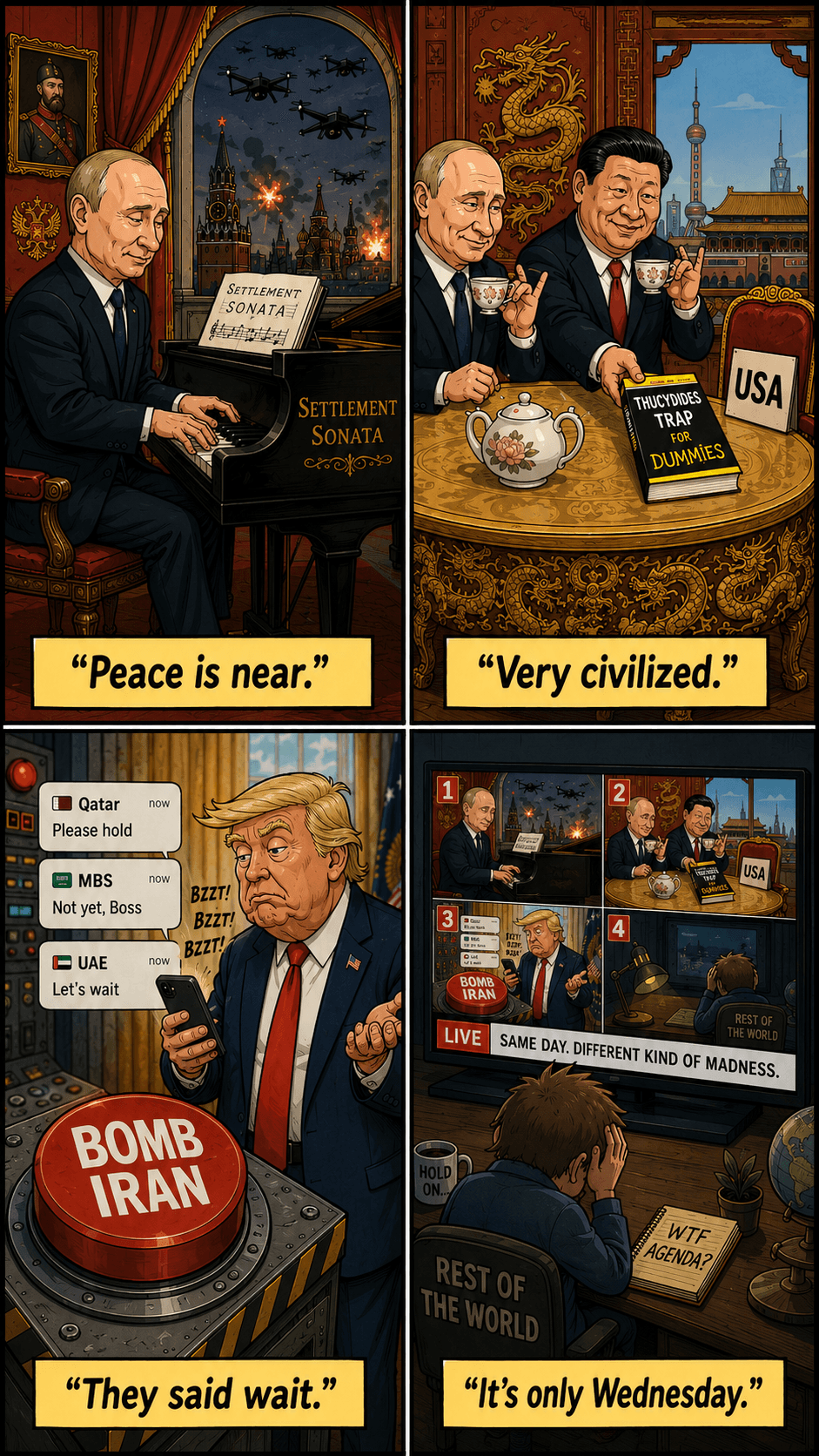
Let us begin in Moscow, where Vladimir Putin — the same man whose tanks rolled into Ukraine over three years ago — stood before the world and declared that the war was heading toward a negotiated settlement. He spoke of peace. He spoke of a "new relationship" with Europe. He referenced diplomacy, dialogue, and the kind of warm, cooperative future that sounds wonderful when read off a podium.
Outside his window, Ukrainian drones were flying toward the Kremlin.
This is not metaphor. This is Tuesday.
Kyiv, apparently unmoved by the peace announcement, promised that the drone attacks on Moscow would only grow larger. Ukraine's message to the Russian capital was delivered not in words but in payload — a kind of geopolitical punctuation that no translator was required to decode. Putin, to his credit, did not flinch publicly. He simply continued speaking about settlements and ceasefires, a man describing a calm sea while standing in a thunderstorm.
Meanwhile, on the other side of the Eurasian landmass, something equally theatrical was unfolding in Beijing.
Putin had flown to China — presumably after checking that the sky above Moscow was temporarily clear — for a summit with President Xi Jinping. The two men sat across from each other with the particular dignity of leaders who know they are being photographed and have dressed accordingly. They discussed economic cooperation. They discussed "key international and regional issues," which is diplomatic language for "everything that is currently on fire."
But it was Xi's remark that cut through the noise.
The Chinese president, in the composed and deliberate manner that has become his signature, referenced the "Thucydides Trap" — the ancient Greek theory, revived by modern scholars, that warns of near-inevitable conflict when a rising power challenges a reigning one. Xi did not name the United States directly. He did not need to. The empty chair at the table spoke for itself.
It was the geopolitical equivalent of handing someone a self-help book at a dinner party and saying, "I thought of you."
And then there was Donald Trump.
The American president, never one to be upstaged by history, had a week of his own.
Earlier, the United States had been moving toward a military strike on Iran. This was not rumor or speculation — it was scheduled. The Pentagon had been reportedly warning that another round of war in the region could spiral in unpredictable directions. Iran and the US had spent months locked in what analysts had taken to calling "blockade diplomacy," a phrase that sounds almost civilized until you remember it means warships and threatened oil routes and nations holding their breath.
On the eve of the planned strike, Trump's phone began to ring.
The Emir of Qatar called. Then the Crown Prince of Saudi Arabia. Then the President of the United Arab Emirates. Three Gulf leaders, in sequence, asking the same thing: wait. Hold off. Iran is talking. A deal is coming. Give it one more day.
Trump waited.
In a statement that will be studied in political science classrooms for years, the president announced that he had agreed to pause the military operation — at the personal request of three heads of state who believed a diplomatic resolution was within reach. The strike was called off. The region exhaled.
Iran, for its part, said nothing publicly. Which, in the current climate, counts as a diplomatic response.
Somewhere in all of this — between the Moscow drones and the Beijing summit and the last-minute Gulf intervention — the rest of the world sat quietly at its desk, refreshing the news, wondering what word had been invented yet for the sensation of watching three simultaneous crises unfold in real time while eating lunch.
There is no word. Not yet.
What there is, however, is a lesson — or perhaps a reminder — that geopolitics has never been a clean discipline. It has always been this: contradictions living side by side, peace announced while bombs fall, summits held while borders shake, phones ringing at the last possible moment.
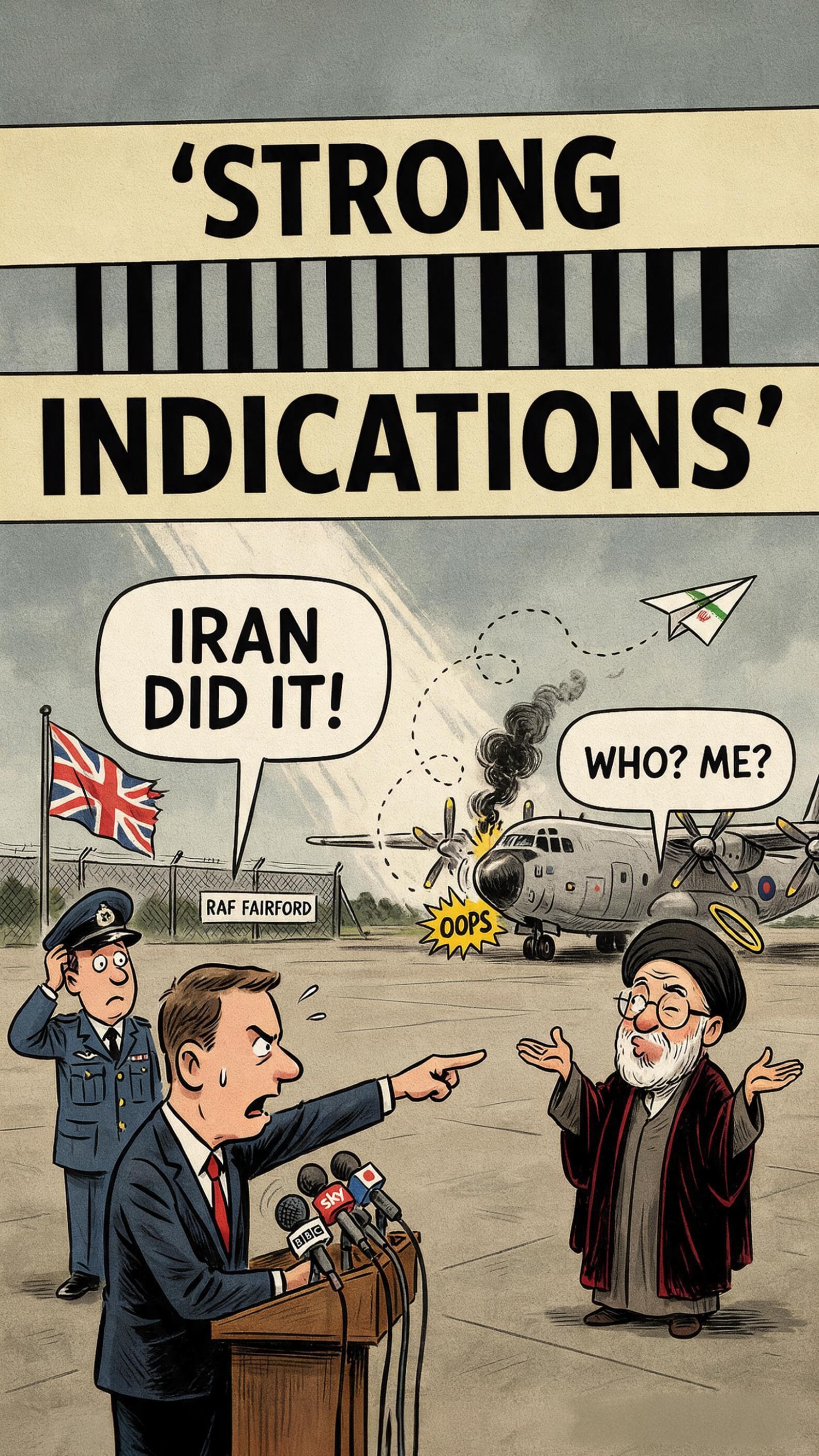
The cartoonists among us draw these moments because sometimes a picture is the only honest response to a world that has outpaced language.
The rest of us just watch, and wait, and read the next headline.
It is, after all, only Wednesday.