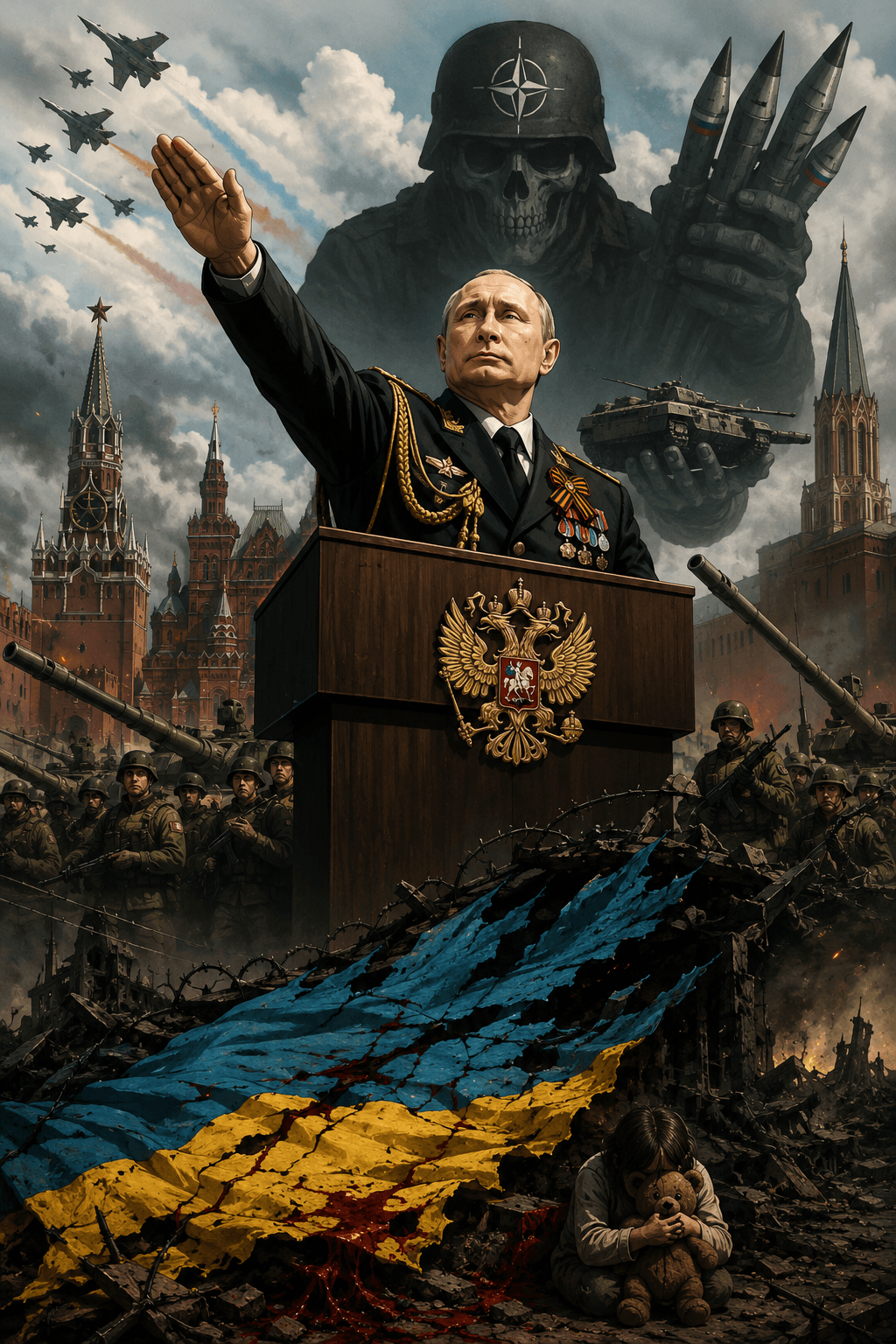
MOSCOW — Russian President Vladimir Putin used the 81st anniversary of the Soviet victory over Nazi Germany to mount a fierce defense of the ongoing war in Ukraine, declaring to a heavily guarded Red Square that Russian forces are confronting an “aggressive force” armed and bankrolled by the entire NATO alliance.
Delivering his highly anticipated annual Victory Day address on May 9, 2026, Putin characterized the Kremlin’s military objectives as a “just” cause. However, the optics of the event stood in stark contrast to his resolute rhetoric. For the first time in nearly two decades, the traditional showcase of Russian military might was drastically scaled down, proceeding without the customary display of tanks, mobile missile launchers, and heavy armored vehicles.
The muted celebrations unfolded against the backdrop of a sudden, U.S.-brokered three-day ceasefire and an expected historic prisoner exchange, marking a complex new chapter in a devastating conflict now deep into its fifth year.
Framing NATO as the Aggressor
Victory Day has historically served as the emotional and patriotic centerpiece of Vladimir Putin’s quarter-century rule. By invoking the immense sacrifices of the Soviet Union during World War II, the Kremlin has consistently sought to draw a direct ideological line between the defeat of Nazi Germany and the modern geopolitical struggle in Eastern Europe.
“The great feat of the generation of victors inspires the soldiers carrying out the goals of the special military operation today,” Putin told the assembled military units and foreign dignitaries. He firmly reiterated that the ongoing war was thrust upon Russia by Western expansionism. “They are confronting an aggressive force armed and supported by the entire NATO bloc. And despite this, our heroes move forward. I firmly believe that our cause is just.”
While the speech was steeped in defiance, the audience reflecting Russia’s current diplomatic standing was notably limited. Unlike previous eras where Western leaders or Chinese President Xi Jinping stood atop the Lenin Mausoleum, this year’s international guests were largely restricted to close allies and non-aligned partners. Attendees included Belarus President Alexander Lukashenko, Kazakhstan’s Kassym-Jomart Tokayev, Slovak Prime Minister Robert Fico, and leaders from Uzbekistan, Laos, and Malaysia.
A Historic Absence of Military Hardware
The most defining element of the 2026 Victory Day parade was what was missing. Typically, Red Square rumbles with the treads of main battle tanks, advanced air-defense systems, and intercontinental ballistic missiles, serving as a global advertisement for the Russian defense industry. This year, authorities cited the “current operational situation” for the total absence of heavy military hardware.
The parade was restricted entirely to marching foot soldiers, cadets from military academies, and a brief flypast by fighter jets. Security analysts and geopolitical observers note that this unprecedented reduction highlights the intense logistical strains and security vulnerabilities currently facing the Russian armed forces.
In the weeks leading up to the parade, Ukraine had intensified its long-range drone strikes deep inside Russian territory, successfully targeting oil refineries, military logistics hubs, and infrastructure. Fears of a high-profile attack on Moscow prompted extreme security measures. Mobile internet and messaging services in the capital were throttled, and the usually bustling streets surrounding Red Square were completely emptied of civilians.
The Arrival of North Korean Troops
In a vivid illustration of shifting global alliances, the marching columns included a contingent of servicemen from the North Korean army. Their participation in the Moscow parade comes after widespread intelligence reports indicated that Pyongyang had deployed troops to assist Russian operations in the contested Kursk region. This unprecedented integration underscores the deepening military partnership between Moscow and Pyongyang as Russia seeks to bypass international sanctions and bolster its frontline forces.
A Fragile Ceasefire and Historic Prisoner Swap
Despite the martial posturing on Red Square, diplomatic backchannels yielded a surprising temporary halt to the hostilities. Following intensive pressure and mediation by U.S. President Donald Trump, both Moscow and Kyiv agreed to observe a unilateral, three-day ceasefire spanning the Victory Day weekend from May 9 to May 11.
President Trump announced the truce on his Truth Social platform, expressing hope that it could signal “the beginning of the end of a very long, deadly, and hard-fought War.”
Crucially, the ceasefire agreement includes provisions for a massive 1,000-for-1,000 prisoner-of-war exchange, one of the largest negotiated swaps since the conflict erupted. Prior to the agreement, the Kremlin had issued severe warnings, threatening a “massive” retaliatory missile strike on the heart of Kyiv if the Ukrainian military attempted to disrupt the Victory Day commemorations.
Ukrainian President Volodymyr Zelenskyy confirmed his government’s adherence to the truce, framing the decision around humanitarian priorities rather than military concession. “Red Square is less important to us than the lives of Ukrainian prisoners who can be returned home,” Zelenskyy stated, issuing a formal decree for the Ukrainian armed forces to halt offensive operations targeting the parade.
Shifting Global Focus and Stalled Negotiations
The realization of the Victory Day ceasefire arrives at a precarious moment for international diplomacy. U.S.-mediated peace talks had largely stalled since February 2026, driven in part by Washington’s sudden shift in strategic focus toward its escalating conflict with Iran.
With Western diplomatic and military attention increasingly divided across multiple global flashpoints, the pressure on both Russia and Ukraine to find a negotiated off-ramp has intensified. President Zelenskyy has expressed hope that U.S. envoys will return to Kyiv in the coming weeks to reboot the stalled peace negotiations, leveraging the momentum of the prisoner exchange.
Impact and Outlook
The 2026 Victory Day parade serves as a microcosm of Russia's current geopolitical reality: rhetorically unyielding, yet visibly constrained by the operational realities of a prolonged war. The absence of military hardware and the heavy reliance on an international alliance network that now features North Korean infantry troops point to a heavily taxed military infrastructure.
Looking forward, the immediate global focus will be on the durability of the May 9-11 ceasefire and the successful execution of the 2,000-person prisoner exchange. If the truce holds without major violations, it could serve as a vital confidence-building measure. However, with Putin firmly defining the war as an existential clash against the entirety of NATO, the ideological groundwork for a prolonged, attritional struggle remains firmly in place.