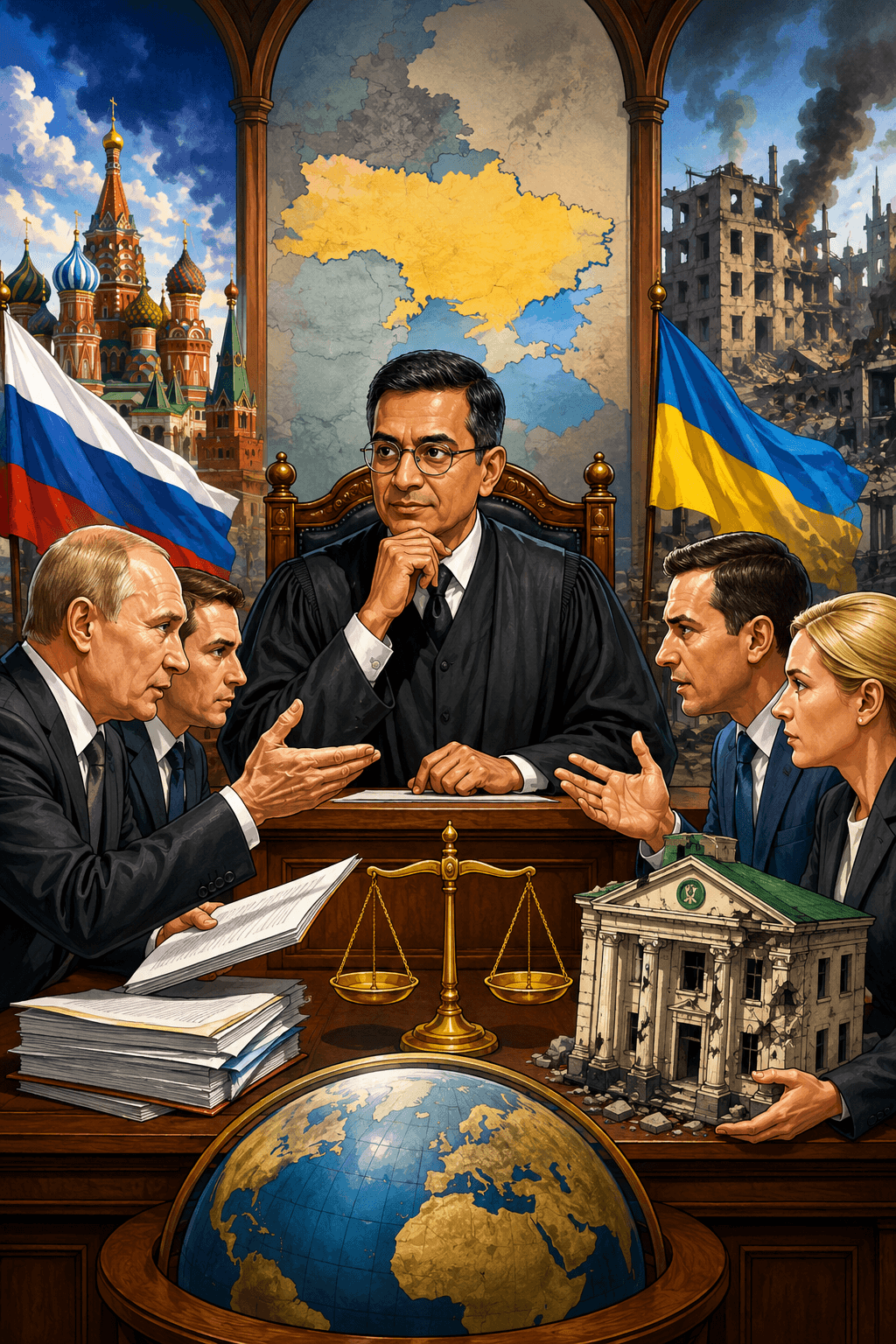
In a significant development at the intersection of international law and global geopolitics, Russia has appointed former Chief Justice of India (CJI) D.Y. Chandrachud as its arbitrator in a high-profile investment treaty dispute. The case, brought forward by the Ukrainian state-owned bank Oschadbank, revolves around hundreds of millions of dollars in claimed losses stemming from the ongoing Russia-Ukraine war.
This appointment not only highlights the increasing legal fallout from the Eastern European conflict but also marks a notable shift in Russia’s strategy regarding international arbitration. Furthermore, it places one of India’s most distinguished legal minds at the center of a deeply complex geopolitical and economic battle.
The Core of the Dispute: Oschadbank vs. Russia
The crux of the current arbitration lies in the devastation and territorial shifts caused by the Russian military's full-scale invasion of Ukraine in 2022. Oschadbank, one of Ukraine's largest state-owned financial institutions, initiated the arbitration process to seek compensation for the loss of its assets and business operations in four heavily contested Ukrainian regions: Donetsk, Luhansk, Kherson, and Zaporizhzhia.
According to reports, Oschadbank served a formal notice of dispute to the Russian Federation in July 2025. After this notice allegedly went unanswered by Moscow, the bank escalated the matter by moving for the constitution of an international arbitral tribunal. The proceedings have been initiated under the legal framework of the 1998 Agreement between the Government of the Russian Federation and the Cabinet of Ministers of Ukraine on the Encouragement and Mutual Protection of Investments—a bilateral investment treaty (BIT) that predates the current hostilities by more than two decades.
The total claim put forward by the Ukrainian bank is understood to be worth hundreds of millions of dollars, reflecting the vast infrastructure and operational presence the bank maintained in those four regions before the escalation of the conflict.
Composition of the Arbitral Tribunal
International arbitration relies heavily on the expertise, neutrality, and global standing of its tribunal members. In the Oschadbank case, a three-member arbitral tribunal has been established, drawing legal experts from across the globe.
Justice D.Y. Chandrachud (Appointed by Russia): The former Chief Justice of India brings decades of constitutional and commercial law expertise to the panel. His selection by Russia is a strategic move to enlist a highly respected jurist from a nation that has maintained a neutral diplomatic stance throughout the war.
Professor Stavros Brekoulakis (Appointed by Oschadbank): A prominent Greek arbitrator and a professor at the National University of Singapore, Brekoulakis was selected by the Ukrainian bank to represent its interests on the panel.
Dyalá Jiménez (Tribunal President): A Costa Rican arbitrator and former trade minister, Jiménez will preside over the tribunal. Crucially, she was jointly selected by both Oschadbank and Russia, ensuring a mutually agreeable leadership structure for the proceedings.
A Strategic Shift for Former CJI Chandrachud
Justice Chandrachud’s decision to accept the role of Russia's arbitrator is particularly notable given his recent history with similar international disputes.
Previously, the former CJI had declined approaches from the Russian government to serve as its arbitrator in other treaty disputes. These included high-profile cases involving the German oil and gas company Wintershall Dea and the Ukrainian state-owned electricity transmission company Ukrenergo.
In the Wintershall proceedings, the Permanent Court of Arbitration had initially designated Justice Chandrachud as the appointing authority. However, he chose to step down from that role after disclosing communications he had received from Russia, emphasizing his commitment to judicial propriety and transparency. His acceptance of the mandate in the Oschadbank case therefore marks a distinct change from his earlier reservations, suggesting that the parameters or conditions of this specific tribunal met his rigorous professional standards.
Historical Precedent: The Crimea Arbitration
To fully grasp the significance of this new development, it is essential to look at the legal history between these two specific entities. This is not the first time Oschadbank has taken Russia to an international tribunal.
Following Russia's annexation of the Crimean Peninsula in 2014, Oschadbank filed a similar arbitration claim concerning the expropriation of its operations and assets in that region. In that earlier case, a tribunal constituted under the Permanent Court of Arbitration ultimately found Russia liable for the unlawful expropriation of the bank's assets. Oschadbank was awarded approximately $1.1 billion in damages, along with accrued interest and arbitration costs.
A defining feature of the Crimea arbitration was Russia's outright refusal to participate. Moscow boycotted the proceedings entirely, though the tribunal proceeded and issued its ruling under applicable arbitration rules.
Analysis: In sharp contrast to its strategy a decade ago, Russia’s decision to actively participate in the current 2026 proceedings—evidenced by its deliberate appointment of a jurist of Justice Chandrachud's caliber—signals a major shift in its legal defense strategy. Rather than ignoring the tribunal, Moscow appears intent on vigorously defending its position on the international legal stage.
Geopolitical and Economic Implications
The appointment of an Indian jurist to a dispute heavily intertwined with the Russia-Ukraine war carries subtle geopolitical undertones. While international arbitrators act in an independent, professional capacity rather than as state representatives, the optics of Russia choosing a former Indian Chief Justice reflect the complex diplomatic tightrope India has walked since 2022. India has consistently advocated for diplomacy and dialogue while maintaining robust economic and strategic ties with both Moscow and Western capitals.
Economically, this case will test the durability and applicability of Bilateral Investment Treaties (BITs) during active, prolonged armed conflicts. The 1998 Russia-Ukraine BIT was designed for peacetime economic cooperation. Applying its clauses to assets destroyed or seized during a full-scale military invasion presents profound legal challenges for the tribunal.
Outlook and Impact
The outcome of the Oschadbank arbitration will likely set a massive precedent for other Ukrainian state and private entities seeking reparations for war-related losses. If the tribunal, led by Jiménez, Chandrachud, and Brekoulakis, navigates the complexities of wartime expropriation successfully, it could trigger a wave of similar claims under the 1998 treaty.However, the ultimate challenge will remain enforcement. Even if Oschadbank secures another favorable ruling, extracting hundreds of millions of dollars from the Russian state amid intense global sanctions will be an arduous, potentially decade-long legal battle. For now, the global legal community will be watching this three-member tribunal closely, as it attempts to apply the rule of law to the chaos of war.