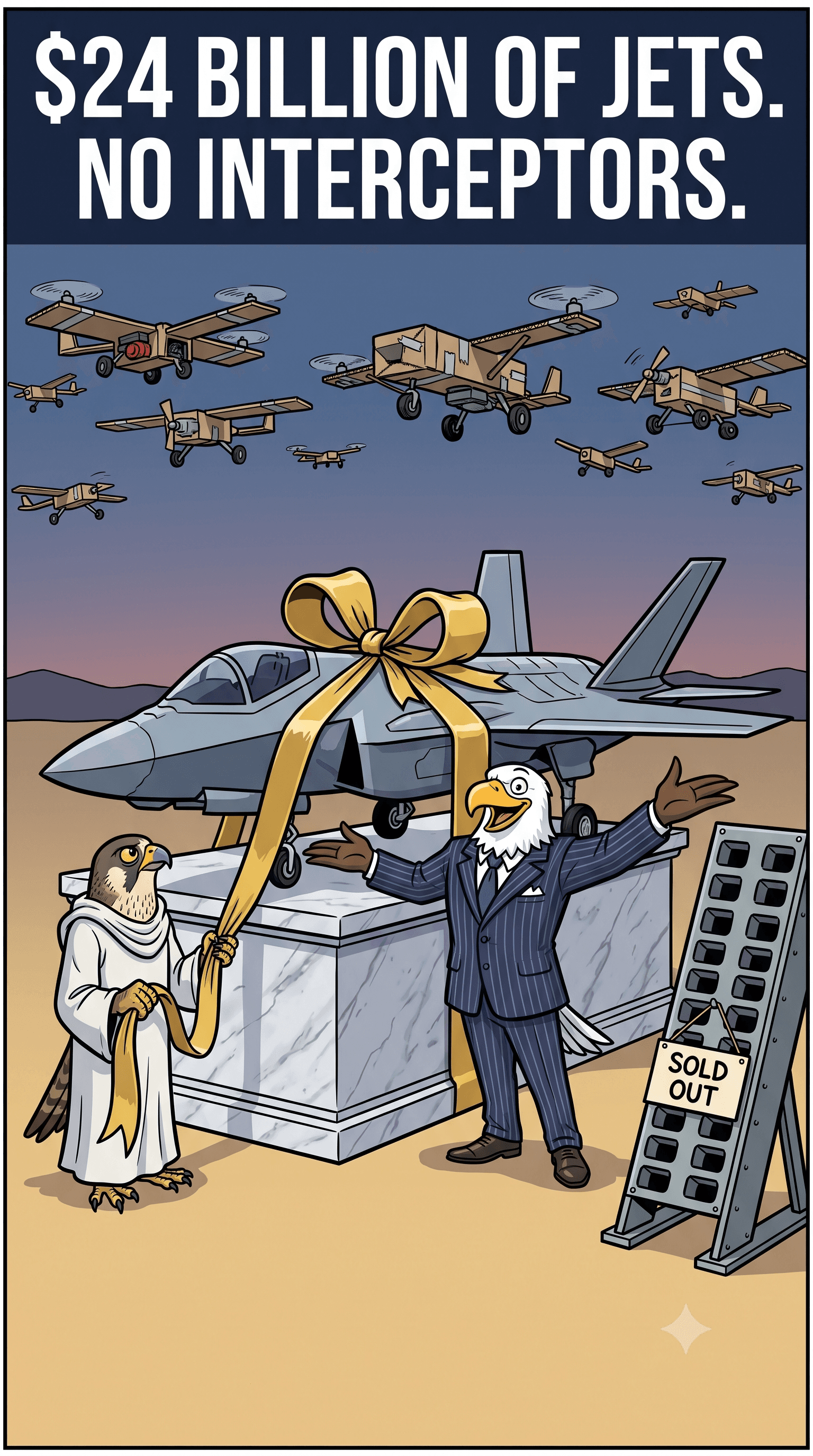
On Thursday 18 September 2026, the US State Department approved a potential Foreign Military Sale to Saudi Arabia: 48 F-35 Lightning II aircraft, 49 Pratt & Whitney engines, together with spare parts, communications equipment and support. The estimated value is $24.3 billion. Congress now has its statutory window to object before the sale can proceed.
The Saudi embassy called it proof of "the strength and enduring nature of the Saudi-U.S. strategic partnership and the continued advancement of our defense cooperation."
It is, by any measure, a historic deal. Israel has been the only operator of the F-35 in the Middle East for about a decade, and every American arms sale in the region is assessed against a requirement to preserve Israel's qualitative military edge. Clearing an Arab state for the aircraft is a genuine shift.
It is also not what Saudi Arabia asked for.
What was asked for, the day before
On 17 September, two regional officials told the Associated Press that the kingdom had approached France, Britain, Pakistan and Egypt for air-defence assistance, because it is running low on missile interceptors. Both spoke on condition of anonymity, not being authorised to brief the media. Saudi officials declined to comment.
That is a weaker class of fact than the sale, and it should be read as one. But it is the only account on the table, and nothing in the following day's announcement contradicts it.
These are two different problems
The kingdom's problem is not that its aircraft are outclassed. It is arithmetic.
A one-way attack drone of the Shahed class is a lawnmower engine, a warhead and a guidance package — built in quantity, by hand, for tens of thousands of dollars. The interceptor sent to meet it is a precision missile priced in the millions. Intercepting works. It also loses on every exchange. Win every engagement and you still empty the rack.
Which is why air-defence campaigns are settled by inventory rather than by hit rate. The number that matters is not how many you stopped. It is how many you have left, and how fast the next one arrives.
On that second question: Lockheed Martin delivered 620 PAC-3 interceptors across the entire allied network in 2025 — roughly 1.7 a day. The combined backlog from more than a dozen allied states runs to over 4,300 rounds, about seven years of output at that rate, already spoken for. Missile assembly runs about 24 months; the solid rocket motors run about 30 and are the binding constraint.
You cannot buy your way out of that with money. Saudi Arabia has money. That was never the shortage.
Can an F-35 shoot down a drone? Yes — and that is not the point
It can, and fighters have done it. Israeli F-35s and F-16s have engaged drones and cruise missiles.
But a fighter is a poor instrument for this particular job, for three reasons that have nothing to do with how good the aircraft is.
Cost per engagement gets worse, not better. An air-to-air missile fired from a fighter costs more than a Shahed, and you have added the cost of flying the sortie.
Coverage is a function of sorties. A ground battery sits on station indefinitely. An aircraft has fuel, crew hours and maintenance cycles. Holding continuous cover over a country the size of Saudi Arabia with fighters is not a thing anyone attempts.
And it does not touch magazine depth. Whatever the launch platform, the limiting factor is how many interceptors exist. Adding aircraft adds ways to launch. It does not add rounds.
The F-35 is an extraordinary aircraft for the missions it was built for — penetrating contested airspace, fusing sensor data, surviving against a peer air-defence network. None of those missions is "stop a swarm of cheap drones arriving nightly."
The two absences
Read the published description of the package closely and two things are missing.
Munitions are not listed. Aircraft, engines, spares, communications equipment, support. A weapons package would normally be notified separately, and may yet be. But as approved, this sale contains no interceptors of any kind.
No delivery date has been published. Not for the first aircraft, not for the last. This matters more than it sounds: congressional review is only the beginning of the process, production slots for the F-35 are allocated years ahead, and the US Government Accountability Office has documented persistent late deliveries across the programme. (That is programme-wide context, not a Saudi-specific forecast — no timeline has been announced, so any date is inference.)
Set those two absences against a drone campaign happening now, and the announcement does something more limited than it appears. It is a statement about the next decade of the relationship. It is not a response to this month.
What Congress is actually reviewing
Under the Arms Export Control Act, major sales of this kind to states outside a short list of close allies carry a thirty-day congressional review period, during which Congress may move to block. In practice such resolutions rarely succeed, but the period is where objections surface.
Two are already visible. Lawmakers have questioned Saudi arms transfers since the murder of Jamal Khashoggi in 2018, and some remain cautious about deepening the military relationship. Separately, reporting around the approval has raised concerns about exposure of F-35 technology given Saudi Arabia's commercial relationships with China — a recurring objection to F-35 transfers, and the reason the UAE's own F-35 negotiation stalled.
What to watch
Whether a munitions package follows, and what is in it. If a separate notification appears carrying PAC-3 or THAAD rounds, the kingdom's actual request has been answered and the fighter sale was the headline rather than the substance. If no such notification comes, it has not been.
Whether any of the four countries transfers hardware. France, Britain, Pakistan and Egypt can all offer training, radar data or a liaison cell — the cheap forms of help that cost no inventory. Only a transfer of actual rounds changes anything.
Whether Riyadh starts buying cheap. Guns, electronic warfare, interceptor drones. These are the only responses that fix the cost ratio rather than absorbing it, and they will show up in procurement notices before they show up in statements.
And whether anyone ever puts a number on Saudi interceptor stocks. Nobody has. The shortage is still two anonymous officials and a declined comment. Until that changes, its depth is an inference — and the size of the gap between what was asked for and what was offered is an inference too.
Sourcing note: The sale details — 48 aircraft, 49 engines, $24.3 billion, the accompanying spares and support, and the State Department approval of 18 September 2026 — are from the published notification as reported by Defense News, Stars and Stripes, CNBC and NBC News, together with the Saudi embassy statement. The four-country approach and the interceptor shortage are reported by the Associated Press on the account of two regional officials speaking anonymously; Saudi officials declined to comment. Interceptor production figures, lead times and the allied backlog come from published analysis of the Patriot industrial base. The thirty-day review period is the standard procedure under the Arms Export Control Act. Delivery-schedule context is drawn from GAO reporting on the F-35 programme generally; no Saudi delivery timeline has been announced.