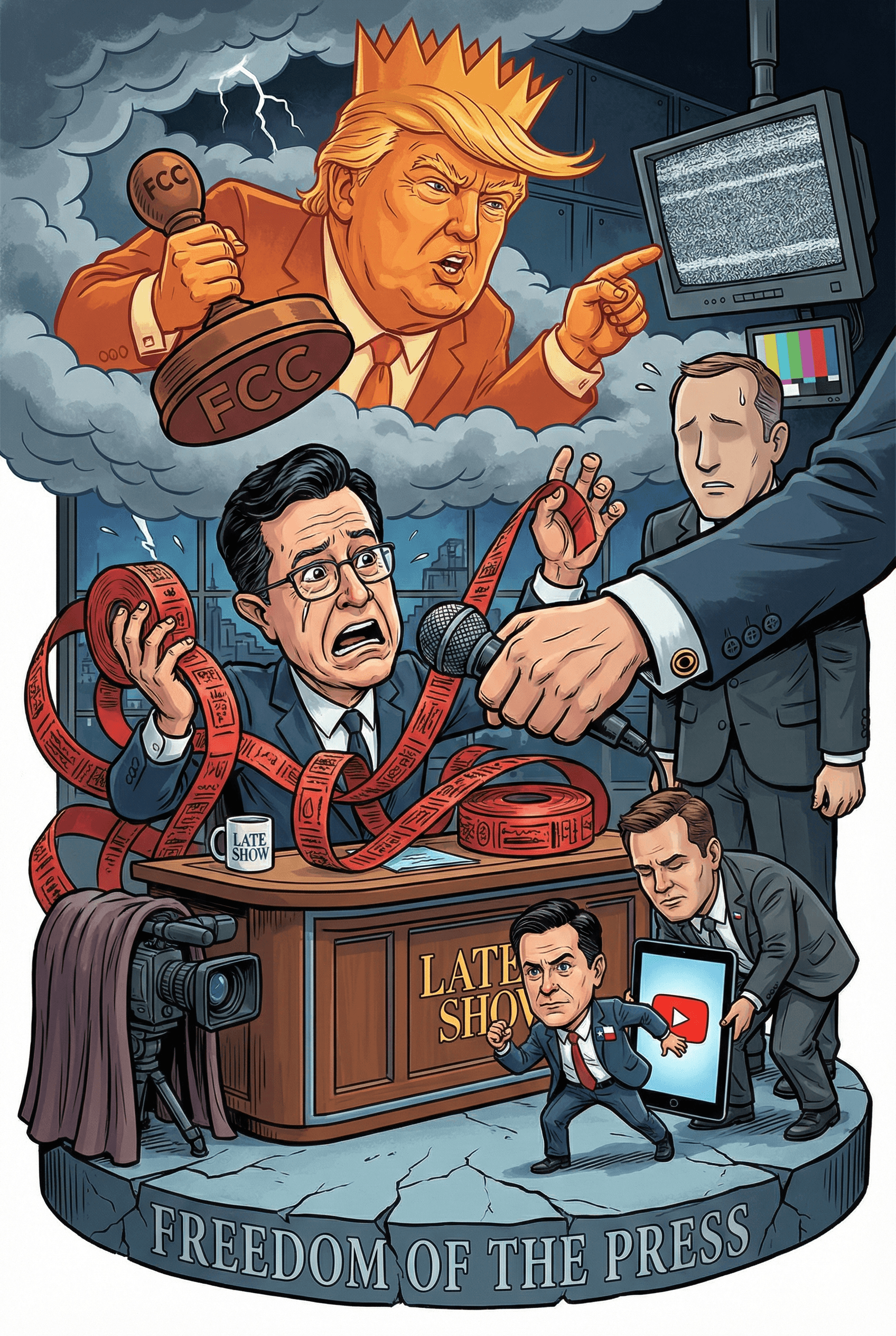
In a dramatic on-air rebuke that has reignited concerns over press freedom in the United States, late-night host Stephen Colbert accused his own network, CBS, of blocking an interview with a Democratic candidate due to fear of the Trump administration. The incident, which unfolded on The Late Show on Monday, February 16, 2026, centers on a canceled appearance by James Talarico, a Texas state representative and U.S. Senate candidate.
Colbert’s allegations have spotlighted the growing tension between major media conglomerates and federal regulators under President Donald Trump’s second term, specifically involving the Federal Communications Commission (FCC) and its Chairman, Brendan Carr.
The Incident: A Monologue of Dissent
On Monday night, Colbert opened his show not with his usual comedic monologue, but with a somber explanation of an empty guest chair. He informed the audience that Talarico, a rising star in the Democratic Party running to unseat Republican Senator John Cornyn, had been scheduled to appear. However, CBS lawyers intervened at the eleventh hour.
“He was supposed to be here, but we were told in no uncertain terms by our network’s lawyers, who called us directly, that we could not have him on the broadcast,” Colbert stated.
According to Colbert, the network’s legal team cited the FCC’s "equal-time rule," which mandates that U.S. broadcast stations must provide equivalent airtime to opposing political candidates if one is given a platform. While legitimate news interviews—including those on late-night talk shows—have historically been exempt from this rule, Colbert claimed CBS was preemptively capitulating to new, stricter guidance from the Trump-led FCC.
“Let’s just call this what it is,” Colbert declared. “Donald Trump’s administration wants to silence anyone who says anything bad about Trump on TV.”
The FCC and the "Equal Time" Controversy
The legal justification for the cancellation revolves around the Communications Act of 1934 and its interpretation by the current FCC. Historically, the "bona fide news interview" exemption allowed programs like The Late Show, The Tonight Show, and The View to interview candidates without triggering a requirement to host their opponents.
However, FCC Chairman Brendan Carr, a Trump appointee who has aggressively targeted what he calls "partisan" media, issued guidance in January 2026 questioning this long-standing exemption. Carr argued that shows motivated by "partisan purposes" might no longer qualify for the news exemption.
Colbert argued that while Carr had only threatened to remove the exemption, CBS was already enforcing it voluntarily out of fear. “He hasn’t done away with it yet, but my network is unilaterally enforcing it as if he had,” Colbert said, labeling the decision a result of corporate timidity rather than legal necessity.
CBS Responds: "Legal Guidance," Not Censorship
CBS has pushed back against Colbert's narrative. In a statement released Tuesday, the network denied explicitly prohibiting the interview.
“The Late Show was not prohibited by CBS from broadcasting the interview with Rep. James Talarico,” the statement read. “The show was provided legal guidance that the broadcast could trigger the FCC equal-time rule for two other candidates, including Rep. Jasmine Crockett, and presented options for how the equal time for other candidates could be fulfilled.”
Instead of navigating these requirements, the show’s producers opted to record the interview and upload it exclusively to YouTube, a platform not subject to FCC broadcast regulations. In the online-only clip, Talarico and Colbert discussed the situation freely, with Talarico asserting, “I think Donald Trump is worried that we’re about to flip Texas.”
Corporate Mergers and Political Leverage
Analysts suggest the network’s caution may be linked to the precarious financial and regulatory position of its parent company, Paramount Global. Paramount is currently in the process of a merger with Skydance Media, a deal that requires federal regulatory approval.
This economic context is critical. President Trump has frequently attacked media companies critical of his administration, and his relationship with CBS has been particularly hostile. In 2025, Trump sued the network over a 60 Minutes interview with then-Vice President Kamala Harris, alleging deceptive editing. Reports indicate that Paramount settled the suit for approximately $16 million in July 2025—a settlement Colbert publicly criticized on-air as a "bribe."
Days after Colbert’s criticism of that settlement, CBS announced that The Late Show would be canceled in May 2026, citing "financial reasons." The timing of the cancellation and the recent interview block have fueled speculation that the network is clearing the decks to ensure the Skydance merger proceeds smoothly under a Trump Justice Department.
Reactions and "Corporate Capitulation"
The controversy has drawn sharp rebuke from press freedom advocates and Democratic officials. FCC Commissioner Anna Gomez, the sole Democrat on the commission, released a blistering statement supporting Colbert and criticizing the network.
“This is yet another troubling example of corporate capitulation in the face of this Administration’s broader campaign to censor and control speech,” Gomez wrote. She emphasized that the FCC has "no lawful authority to pressure broadcasters for political purposes."
James Talarico, the candidate at the center of the storm, used the moment to highlight what he views as the erosion of democratic norms. “Corporate media executives are selling out the First Amendment to curry favor with corrupt politicians,” he said in the YouTube interview.
Outlook: The Future of Political Satire
This incident marks a significant escalation in the conflict between the Trump White House and legacy media. If networks begin voluntarily self-censoring to avoid regulatory scrutiny, the landscape of American political satire and journalism could shift dramatically.
With The Late Show set to conclude in just a few months, Colbert appears to be using his remaining time to challenge both the administration and his corporate bosses. The question remains whether other broadcasters will follow CBS’s cautious lead or stand their ground against the FCC’s new pressure tactics.
As the 2026 midterm elections approach, the battle over airtime, access, and the definition of "news" is likely to intensify, with the American public serving as the ultimate witness.
#StephenColbert #CBS #FCC #FreedomOfThePress #TrumpAdministration #JamesTalarico #MediaCensorship #USPolitics #FirstAmendment #ParamountGlobal #BrendanCarr #2026Elections