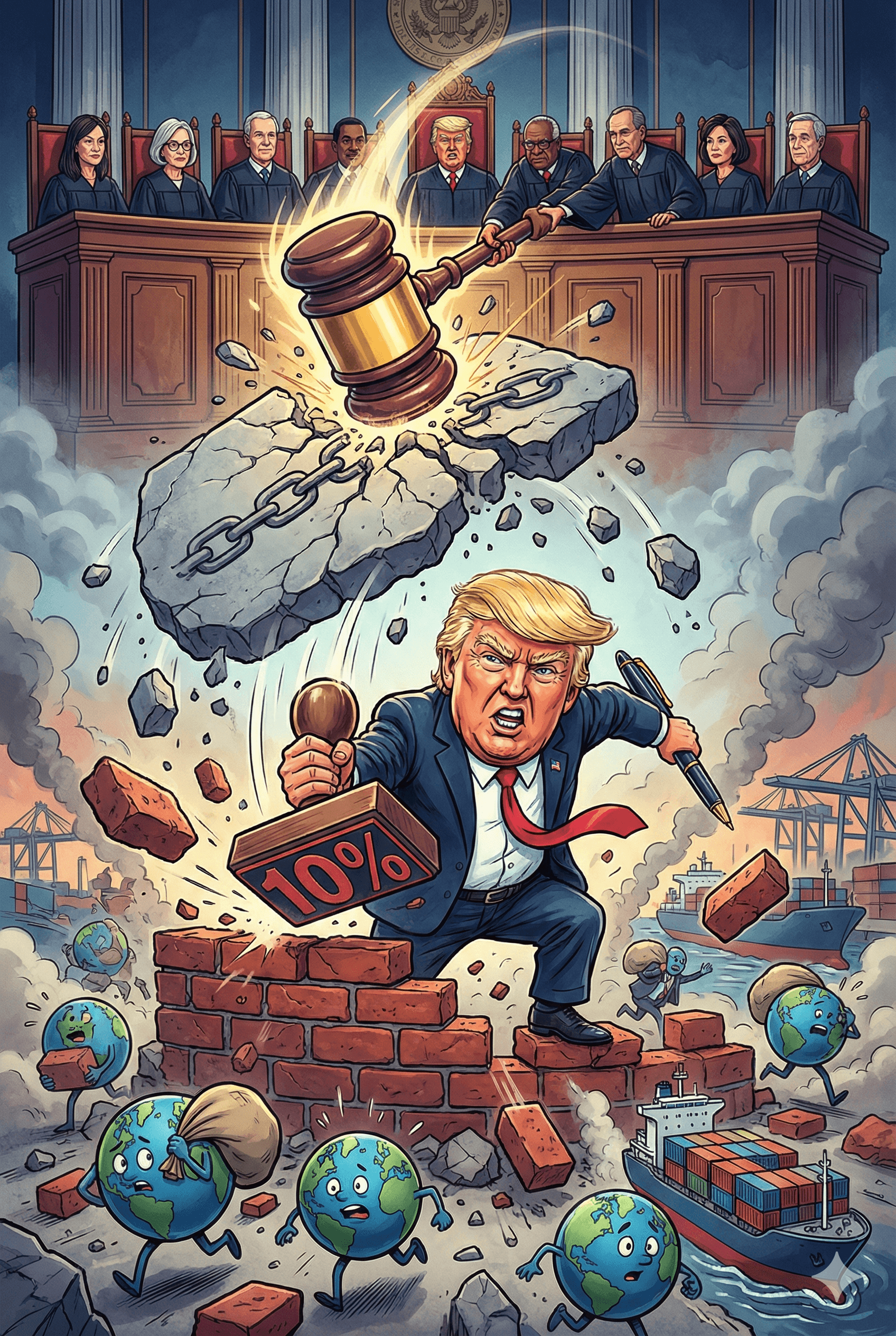
On Friday, February 20, 2026, the United States Supreme Court delivered a landmark 6-3 ruling striking down President Donald Trump's sweeping global tariffs. The court concluded that the executive branch overstepped its constitutional authority by using emergency powers to unilaterally impose global import taxes. In a swift and defiant response, President Trump announced the immediate implementation of a new 10% global tariff under a different, rarely used trade statute, setting the stage for renewed economic uncertainty and legal battles.
The Supreme Court Ruling: A Constitutional Check on Executive Power
At the heart of the Supreme Court's decision was the International Emergency Economic Powers Act (IEEPA) of 1977. During his second term, President Trump heavily relied on this statute to impose broad, reciprocal tariffs on nearly all U.S. trading partners, citing national emergencies such as persistent trade deficits and the influx of illicit drugs like fentanyl.
Authored by Chief Justice John Roberts, the majority opinion emphasized that Article I of the U.S. Constitution exclusively vests the power to lay and collect taxes and duties in Congress. The Court invoked the "major questions doctrine," asserting that an action of such vast economic and political significance requires clear congressional authorization. According to the majority—which included conservative Justices Neil Gorsuch and Amy Coney Barrett alongside the Court's three liberal justices—the IEEPA’s provision to "regulate importation" does not legally equate to the authority to levy tariffs.
Justices Clarence Thomas, Samuel Alito, and Brett Kavanaugh dissented. In his dissenting opinion, Justice Kavanaugh argued that tariffs are a traditional regulatory tool in foreign commerce and that Congress intended to give the President substantial flexibility during national emergencies.
Trump’s Reaction and the Pivot to a New 10% Tariff
President Trump expressed fierce opposition to the ruling, describing the decision as "deeply disappointing." During a White House press briefing shortly after the ruling was handed down, he stated he was "absolutely ashamed" of the justices who voted against his signature economic policy.
Unwilling to abandon his aggressive trade agenda, Trump immediately pivoted to a backup plan. He signed an executive order imposing a new 10% global tariff on foreign goods, scheduled to take effect on February 24, 2026.
To implement this new levy, the administration invoked Section 122 of the Trade Act of 1974. Unlike the IEEPA, Section 122 explicitly allows the president to impose temporary import surcharges of up to 15% for a maximum of 150 days to address "large and serious" balance-of-payments issues. Because this statute has strict time limits and has historically never been used in this broad manner, legal and trade experts anticipate further scrutiny. Trump also noted his administration would pursue additional tariffs through Section 301 investigations targeting unfair foreign trade practices.
Background: The IEEPA and the Global Trade War
The legal clash is the culmination of Trump’s assertive use of tariffs as both an economic shield and a foreign policy weapon. Early in his second term, Trump declared national emergencies to justify a 25% duty on most imports from Canada and Mexico, a 10% duty on numerous Chinese imports, and broad baseline tariffs on allies and adversaries alike.
While previous presidents utilized the IEEPA primarily to freeze foreign assets or impose targeted sanctions on hostile nations, Trump was the first to interpret the law as a blanket authorization for import taxes. The resulting global import taxes unsettled financial markets, sparked retaliatory measures from foreign governments, and fundamentally reshaped global supply chains. Small importing businesses and a coalition of 12 U.S. states challenged the policy, leading to the Supreme Court's definitive intervention.
Economic and Geopolitical Implications
The invalidation of the IEEPA tariffs creates an immediate and complex logistical challenge: the potential refund of collected duties. Estimates from the Penn-Wharton Budget Model suggest that the U.S. Treasury has collected upwards of $175 billion under the now-illegal IEEPA tariffs. Justice Kavanaugh noted in his dissent that the process of issuing billions of dollars in refunds will likely result in a bureaucratic "mess," as businesses navigate lower courts and federal agencies to reclaim their funds.
For domestic consumers and businesses, the whiplash between the struck-down tariffs and the newly implemented surcharges extends a period of profound uncertainty. Retailers, manufacturers, and agricultural sectors that had already adjusted their pricing models to absorb the initial IEEPA tariffs must now recalibrate for the 10% Section 122 levy. Economists warn that this unpredictability hinders long-term corporate investment and could sustain inflationary pressures on everyday imported goods, ranging from electronics to clothing.
Geopolitically, the transition from the IEEPA to the Trade Act of 1974 alters the immediate landscape for U.S. trading partners. While the Supreme Court's rejection of his global import taxes was initially celebrated by international markets, the relief was short-lived due to the newly announced 10% tariff. However, specific bilateral agreements remain intact. Following the ruling, Trump clarified that the recent interim trade deal with India—which locked U.S. tariffs on Indian goods at 18% in exchange for strategic trade commitments—would not be altered, stating, "Nothing changes, they'll be paying tariffs."
Outlook: What Happens Next?
From an analytical perspective, the global economy faces a volatile transitional period. The new 10% global tariff under Section 122 acts as a temporary stopgap, legally restricted to a 150-day window unless Congress intervenes to extend it. This places the burden squarely on the legislative branch, setting up a high-stakes political showdown over the future of American trade policy.
Furthermore, the Supreme Court's strict application of the major questions doctrine severely limits executive overreach in economic matters. While President Trump continues to seek alternative statutory avenues, including Section 232 (national security) and Section 301 (unfair trade practices), the judicial guardrails established by this ruling ensure that sweeping, permanent taxation will require congressional approval. Businesses, consumers, and international markets will be watching closely as the February 24 deadline approaches, preparing for yet another turbulent chapter in global trade.
Sources for Research
PBS NewsHour: "WATCH: Trump announces 10% global tariff after Supreme Court strikes down his sweeping policy"
The Economic Times: "US Supreme Court rules against Trump’s global tariffs imposed under emergency law"
The Hindu: "U.S. Supreme Court rejects tariffs LIVE | India faces lower 10% tariff after Trump's proclamation"
Associated Press: "Supreme Court strikes down Trump’s sweeping tariffs, sparking fierce pushback and vow of new levies"
LiveLaw: "President Donald Trump's Global Tariffs Illegal: US Supreme Court"
#News #Geopolitics #GlobalEconomy #TrumpTariffs #SupremeCourt #TradeWar #USPolitics #InternationalTrade #MacroEconomics #Section122