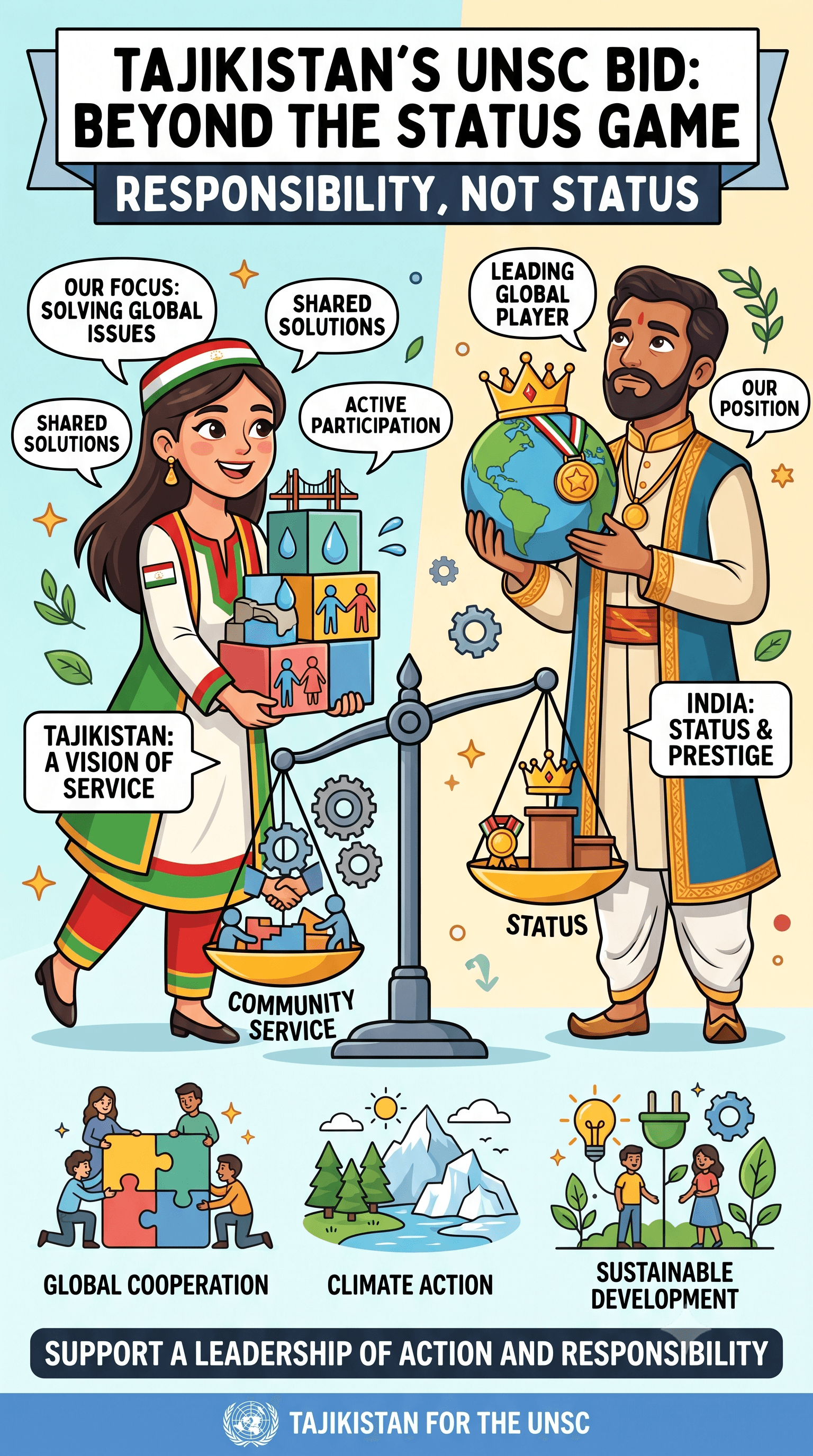
At the 81st session of the United Nations General Assembly, a significant diplomatic contest has taken center stage. Tajikistan, actively competing with India for the sole Asia-Pacific non-permanent seat on the UN Security Council for the 2028-2029 term, has officially framed its campaign as a pursuit of global duty rather than international prestige.
Speaking during the high-level UN General Assembly debate, Tajikistan’s Foreign Minister Sirojiddin Muhriddin emphasized that his nation’s inaugural bid for the powerful UN organ is deeply rooted in a desire to foster international peace and security. By drawing a subtle contrast in the UN Security Council race, the Central Asian nation has set the tone for an intense diplomatic campaign that will culminate in the June 2027 secret ballot elections.
A Historic First: Tajikistan’s Vision for the UN Security Council
For Tajikistan, the campaign for the non-permanent seat represents a monumental diplomatic milestone. If successful, it would mark the first time in the country’s history that it secures a position on the UN Security Council.
Addressing the assembly, Foreign Minister Muhriddin articulated a clear vision, pitching his country's first-ever UN Security Council bid as a responsibility to support peace and dialogue. He stated clearly that for Tajikistan, membership in the Security Council is not about status. Instead, he noted, "It would be about responsibility to uphold the Charter, to listen to all voices, large and small, to seek common ground where divisions persist, and to contribute constructively to the maintenance of international peace and security".
Tajikistan’s strategic messaging relies heavily on its national history. Muhriddin highlighted this by noting that Tajikistan would bring the critical experience of a nation that has known conflict and built peace. Furthermore, he emphasized that the country has faced difficult borders and consistently chosen dialogue and compromise.
India vs Tajikistan: The Race for the 2028-29 Asia-Pacific Seat
The race for the UN Security Council non-permanent seat pits a seasoned diplomatic heavyweight against an ambitious first-time contender. With only a single seat available for the Asia-Pacific Group, only one of these two nations will advance.
India announced its initial candidacy early in December 2022 as a strategy to build diplomatic momentum. In July 2026, India's External Affairs Minister S. Jaishankar formally launched the country’s campaign at an event at the UN headquarters attended by ambassadors and diplomats.
India's campaign is anchored in the theme of 'SHANTI', which stands for Securing Holistic Advancement through Norms, Trust and Integrity. During the launch, Jaishankar outlined India’s priorities, which include acting as a voice for the Global South, advancing reformed multilateralism, and ensuring future-ready peacekeeping.
India boasts a proven track record, having previously served eight terms on the 15-member Security Council, with its most recent term in 2021-2022. During past tenures, India delivered notable institutional outcomes, including the 2021 Maritime Security Presidential Statement and the 2022 Counter-Terrorism Delhi Declaration.
Diplomatic Maneuvering and Regional Backing
Despite the overarching competition, both nations are maintaining cordial diplomatic relations. On the sidelines of the General Debate of the 81st session of the UN General Assembly, External Affairs Minister Jaishankar met with his Tajik counterpart, Muhriddin. Jaishankar publicly described the interaction as a good discussion regarding the region and their longstanding bilateral cooperation.
However, behind the scenes, the diplomatic race is becoming highly competitive. Tajikistan reportedly enjoys backing from the Organisation of Islamic Cooperation (OIC), making the race for the Asia-Pacific seat much tighter for India.
Historically, Tajikistan has been a supportive partner to New Delhi. In 2020, Tajikistan extended its support for India's candidature for a non-permanent seat in the UNSC for the 2021-2022 term. Furthermore, Tajikistan has publicly supported India's bid for permanent membership in the UNSC. This historical dynamic adds a fascinating layer of complexity to the current competitive environment.
The Mechanics of UNSC Non-Permanent Elections
Understanding the dynamics of this race requires a brief look at the UN Security Council election process. The UNSC consists of 15 members, which includes five permanent members with veto power and 10 non-permanent members elected for two-year terms.
The non-permanent seats are distributed according to a regional formula. The upcoming election is set for June 2027 in the UN General Assembly to decide the single vacancy for the Asia-Pacific Group.
Secret Ballot: The election will be conducted via a secret-ballot vote.
Two-Thirds Majority: A winning candidate must secure a two-thirds majority of the voting members in the General Assembly to get elected.
Vote Trading: The nature of these elections often involves reciprocal vote-trading arrangements across various UN bodies, which explains why states declare their candidacies years in advance to lock in pledges.
The structural reality of these elected seats is that while they offer immense diplomatic visibility, they lack the substantive veto power held by permanent members under UN Charter Article 27(3). This disparity remains a central focus of India's ongoing push for broader multilateral reform.
Outlook and Global Impact
As the countdown to the June 2027 election continues, the Tajikistan UNSC bid alongside India's robust campaign underscores the shifting diplomatic currents within the Asia-Pacific Group. For the broader international community, this election presents a choice between India's vast institutional experience and structural reform agenda, and Tajikistan’s fresh perspective centered on conflict resolution and egalitarian responsibility.
The outcome will not only determine who represents the Asia-Pacific region on global security matters but will also test the efficacy of regional bloc voting and strategic alliances. Regardless of the eventual victor, both nations have successfully highlighted the critical need for an engaged, responsive, and responsible United Nations Security Council.