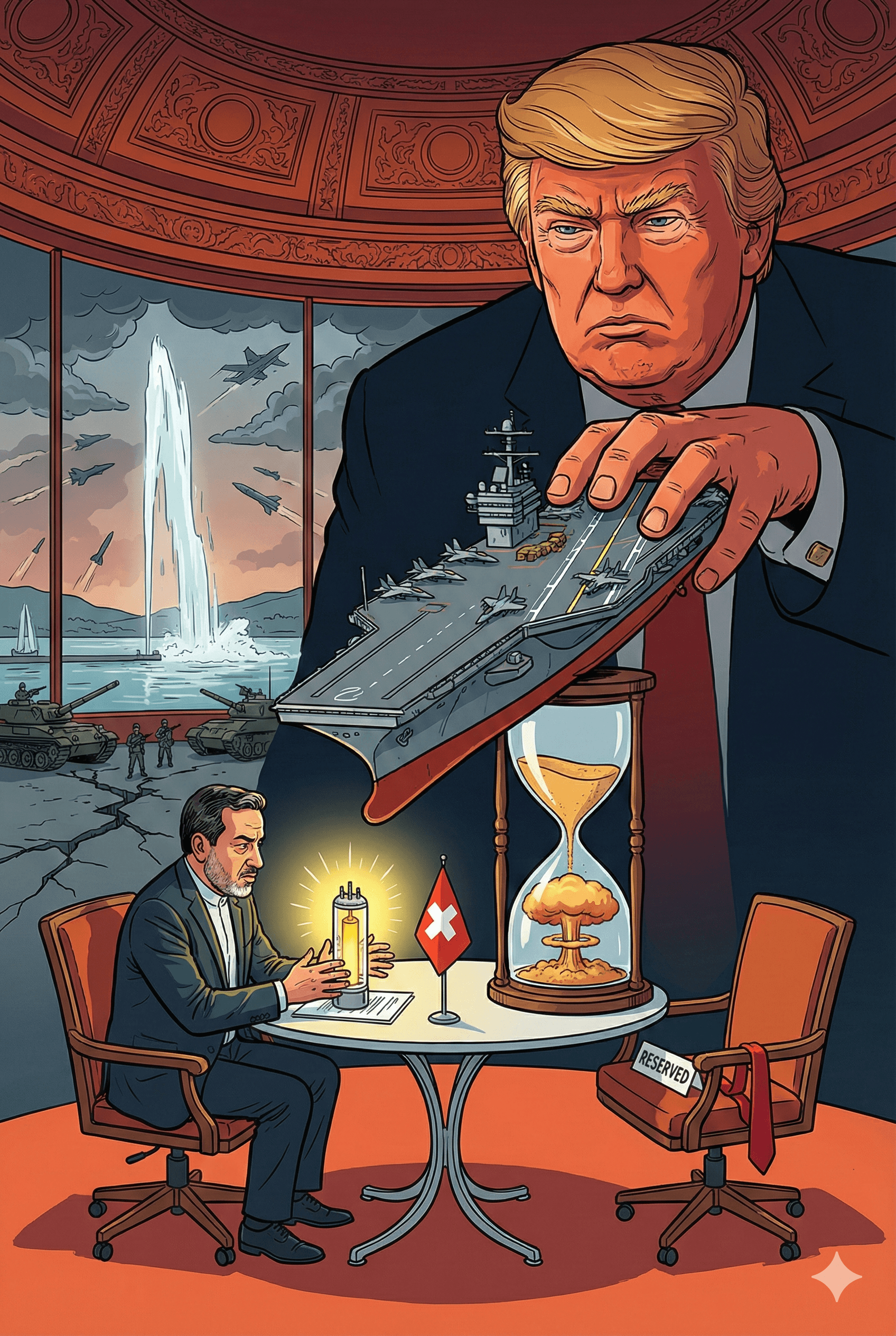
GENEVA, Switzerland — United States and Iranian officials have converged in Geneva today for a critical second round of indirect negotiations, with the specter of renewed military conflict looming large over the proceedings. The talks, mediated by Omani officials, come as President Donald Trump warns of "consequences" should diplomacy fail, while simultaneous military drills in the Strait of Hormuz underscore the fragility of the current standoff.
As delegations settled into their respective venues this morning, the atmosphere was charged with the weight of recent history. Following a breakdown in relations that led to US and Israeli airstrikes on Iranian nuclear facilities in June 2025, this diplomatic push represents a fragile opportunity to prevent a wider regional war.
Trump’s Ultimatum: Diplomacy or “Consequences”
Speaking to reporters aboard Air Force One on Monday, President Trump struck a characteristic balance between deal-making optimism and military threats. "I’ll be involved in those talks, indirectly. And they’ll be very important," Trump stated. He added his belief that Tehran is motivated to reach an agreement, asserting, "I don’t think they want the consequences of not making a deal."
The White House has dispatched a high-level delegation to Geneva, led by Middle East Envoy Steve Witkoff and senior advisor Jared Kushner. Their presence signals the administration's prioritization of the file, though they will not meet directly with their Iranian counterparts. Instead, messages will be ferried by Omani diplomats, led by Foreign Minister Badr Albusaidi, continuing the format established during the first round of talks in Muscat earlier this month.
Secretary of State Marco Rubio, currently visiting Budapest, reiterated the US stance: "The president always prefers peaceful outcomes and negotiated outcomes," he said, while refusing to prejudge the results of the Geneva rounds.
Tehran’s Stance: "Realistic" Expectations vs. Red Lines
Leading the Iranian delegation is Foreign Minister Abbas Araghchi, a veteran diplomat with deep experience in nuclear negotiations. Upon his arrival in Geneva, Araghchi engaged in "deep technical discussions" with Rafael Grossi, Director General of the International Atomic Energy Agency (IAEA). The meeting with the UN nuclear watchdog is seen as a pivotal step, as Tehran had suspended cooperation following the 2025 conflict.
Iranian officials have expressed cautious optimism. Foreign Ministry spokesman Esmaeil Baqaei noted on Monday that the US position appears to have moved toward a "more realistic" one regarding Iran’s nuclear program. However, Tehran maintains strict red lines. "What is not on the table: submission before threats," Araghchi posted on social media.
Deputy Foreign Minister Majid Takht-Ravanchi has signaled that while Iran is open to compromise on its uranium stockpile—currently estimated to be nearing weapons-grade levels—any concession is contingent on the lifting of crippling economic sanctions. "If we see sincerity on their part, I am sure we will be on a road to have an agreement," Takht-Ravanchi told international media.
Shadow of War: Military Posturing Intensifies
While diplomats speak in Geneva, the military reality on the ground paints a starker picture. The Pentagon has confirmed the deployment of a second aircraft carrier, the USS Gerald R. Ford, to the Middle East, joining the existing carrier strike group in a show of overwhelming force.
Simultaneously, Iran’s Islamic Revolutionary Guard Corps (IRGC) launched large-scale live-fire drills near the Strait of Hormuz on Monday. The exercises are a clear signal of Iran's capability to disrupt global energy supplies—roughly 20% of the world's oil passes through the strategic waterway—should negotiations collapse and hostilities resume.
The talks also face pressure from US allies. Israeli Prime Minister Benjamin Netanyahu stated Sunday that any deal must ensure the total "dismantling" of Iran's enrichment capabilities, a demand Tehran has historically rejected as a non-starter.
The Core Disputes
The negotiators in Geneva face a daunting list of unresolved issues:
Nuclear Enrichment: The US demands a halt to enrichment and the surrender of existing stockpiles. Iran insists on its right to a peaceful nuclear program.
Sanctions Relief: Tehran requires immediate economic relief, particularly regarding oil exports and access to frozen assets.
Regional Security: Washington is pushing to broaden the talks to include Iran’s ballistic missile program and its support for proxy groups in the region—topics Iran has previously refused to discuss.
IAEA Oversight: Re-establishing full inspector access to Iranian sites is a prerequisite for any Western trust, particularly after the "blind spots" created during the last year of conflict.
Outlook: A Fragile Window for Peace
Political analysts view this week's meetings as a "make-or-break" moment. A failure to produce a roadmap could empower hardliners in both Washington and Tehran, potentially accelerating the slide toward a direct confrontation that both sides claim to want to avoid.
"In this Trumpian world, do not expect every agreement to be written down on paper immediately," notes regional expert Ellie Geranmayeh. "But the alternative to a deal is an escalation ladder that no one can fully control."
As the closed-door sessions continue, the world watches to see if the "Art of the Deal" can reconcile with the "Art of Resistance," or if the drums of war will drown out the dialogue in Geneva.
#IranUSTalks #Geneva #DonaldTrump #MiddleEastCrisis #NuclearDeal #Geopolitics #OilPrices #ForeignPolicy #Diplomacy #GlobalSecurity #IranSanctions