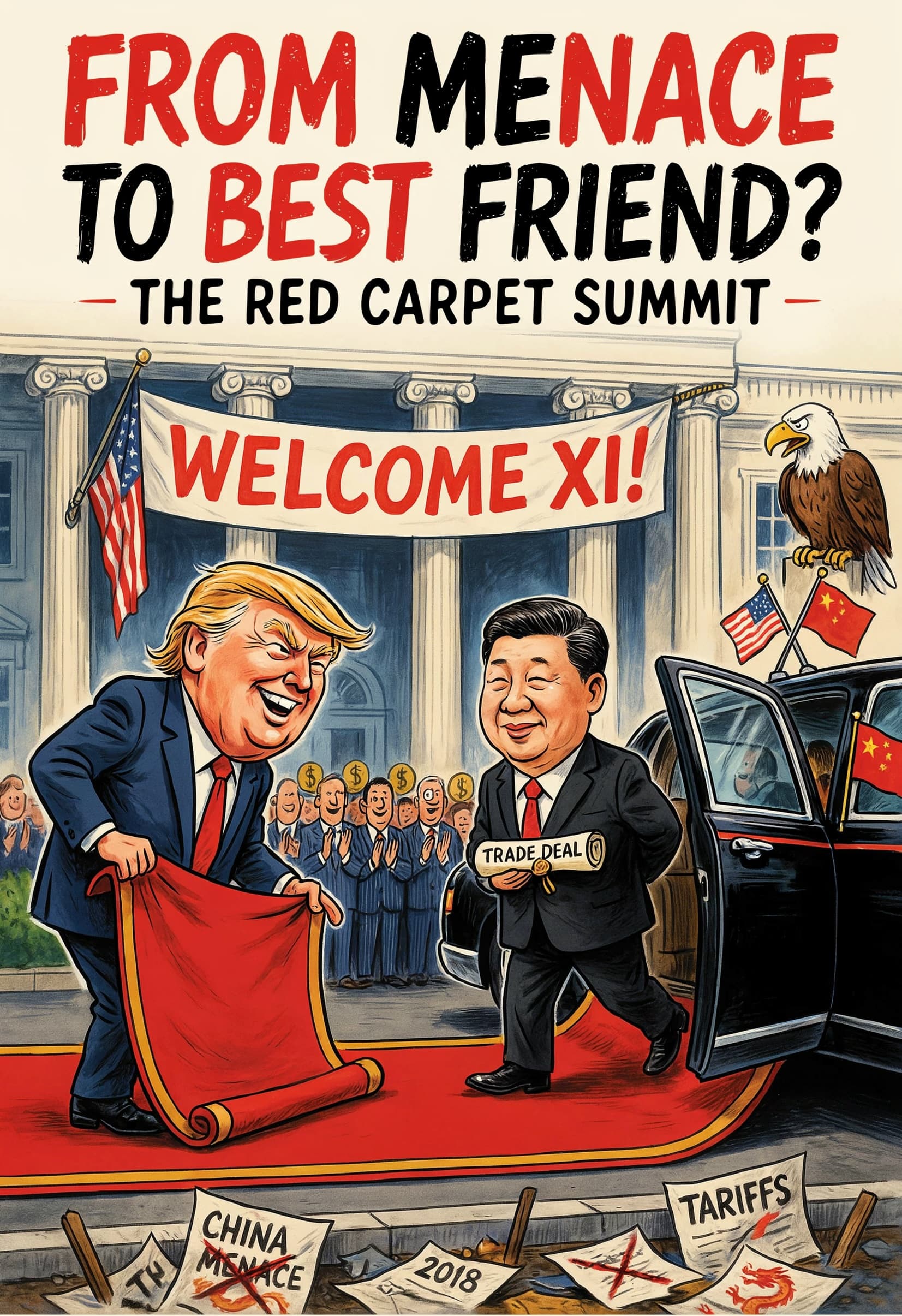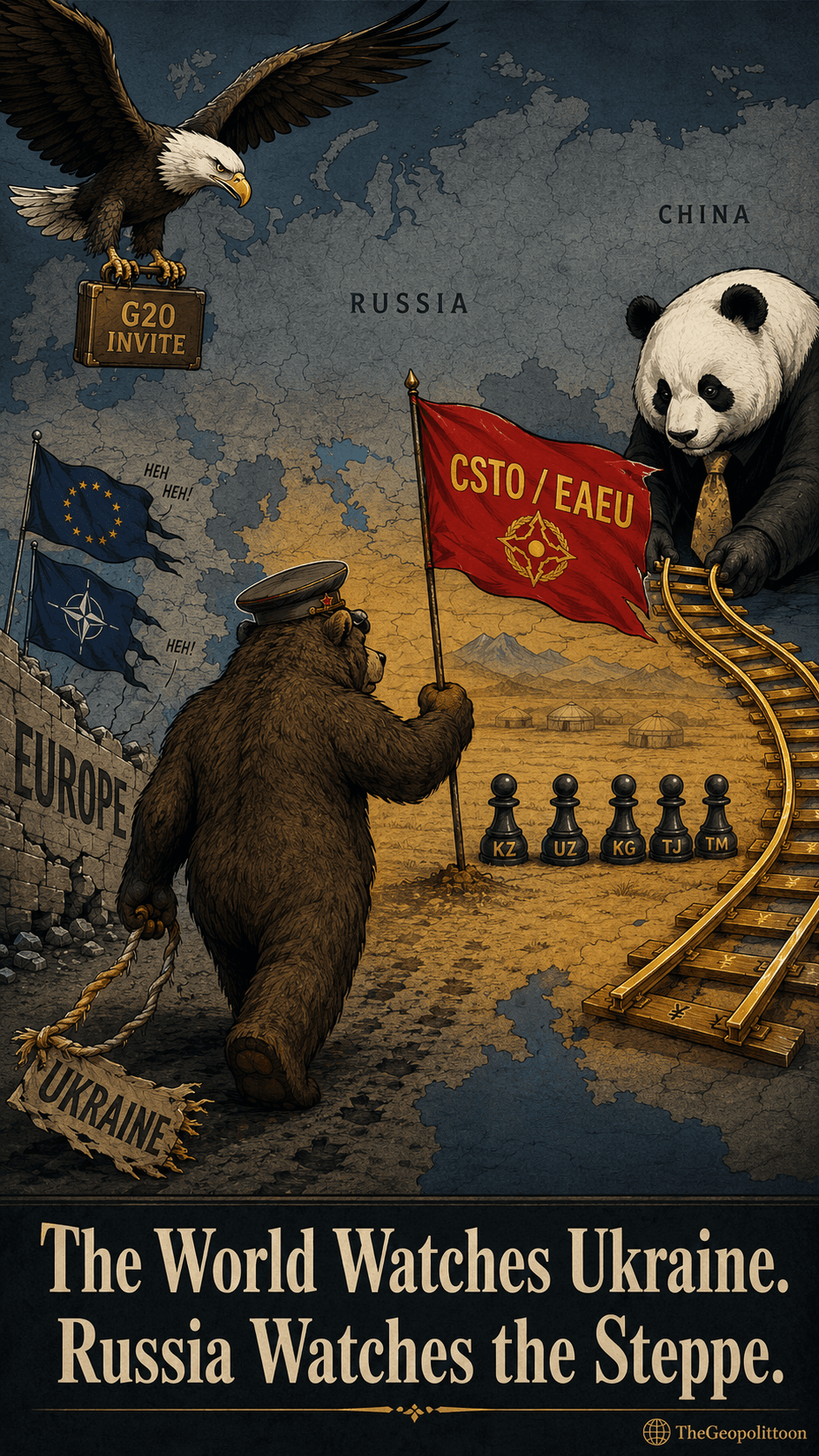
As global headlines fixate on drone warfare over Ukraine, naval blockades in the Strait of Hormuz, and the Trump-Xi summit in Beijing, a quieter but consequential story is unfolding in the vast steppes between the Caspian Sea and the Himalayas. Russia — battered by sanctions, diplomatically isolated across Europe, and bogged down in its longest military campaign since Afghanistan — is methodically reasserting itself in a region it considers its strategic backyard: Central Asia.
The five former Soviet republics of Kazakhstan, Uzbekistan, Kyrgyzstan, Tajikistan, and Turkmenistan represent a combined economy projected to reach approximately $600 billion in 2026, growing at rates above the global average. For a Russia increasingly cut off from Western markets, this is not a peripheral interest — it is a lifeline.
A Shrinking Map of Influence
Russia's global footprint has contracted sharply since its full-scale invasion of Ukraine in 2022. In Europe, Russian influence has collapsed. Serbia is diversifying its energy imports. Bosnia and Herzegovina is deepening ties with the EU and the United States. Hungary, long considered Moscow's Trojan horse inside the EU, saw Viktor Orbán suffer an unexpected electoral defeat in April 2026, removing Russia's most reliable European ally from the field. In the broader post-Soviet space, Georgia, long tethered culturally and economically to Russia, has witnessed mass pro-EU protests. Even Russia's relationships with traditional partners — Syria, Venezuela, Cuba, and Iran — are under growing strain from US pressure.
Central Asia stands apart. It remains one of the few regions where Russian institutional influence persists in structured, durable form.
The Architecture of Control
Russia's grip on Central Asia is not maintained by military force alone. It is layered across multiple institutions. The Collective Security Treaty Organisation (CSTO) — Moscow's answer to NATO — continues to function as a security umbrella for several Central Asian states. In May 2026, Russia chairs a high-level CSTO summit under the theme "Collective Security in a Multipolar World," a deliberate framing designed to present Moscow as a stabilising force in an era of Western overreach. The Eurasian Economic Union (EAEU) binds Kazakhstan and Kyrgyzstan into a common economic framework dominated by Moscow, covering trade, labour migration, and financial regulation. Central Asian economies remain deeply integrated into Russian financial and logistical networks — a structural dependency that cannot be unwound overnight.
Cultural and demographic ties reinforce the architecture. Millions of Central Asian migrant workers labour inside Russia, sending remittances home. Russian remains a lingua franca of business, government, and education across the region. These soft levers of influence outlast any single political moment.
The Great Game, Round Three
But Russia is not competing unopposed. Central Asia has become the arena for a new Great Game — a 21st-century echo of the 19th-century rivalry between the British and Russian empires for dominance over the region.
China has expanded its economic footprint dramatically through Belt and Road Initiative investments, infrastructure loans, and the formalisation of its "shared future" framework at the China-Central Asia Summit in Astana in 2025. Beijing brings capital that Moscow cannot match. But China deliberately avoids open political alliances, preferring to buy influence through economic penetration rather than security guarantees — a strategy that leaves space for Russia to remain the dominant security actor.
The United States, meanwhile, has re-engaged. The Trump administration's "TRIPP" project — a connectivity corridor linking Azerbaijan, Armenia, and Turkey — is a direct attempt to reduce Russian and Iranian leverage over Caspian trade routes. Washington invited Kazakhstan and Uzbekistan to the G20 Summit in Miami in 2026, a symbolic elevation of the region's global standing and a clear signal of American strategic intent.
Central Asian governments are not passive in this competition. They have mastered the art of multi-vector diplomacy — playing Moscow, Beijing, and Washington against each other to maximise economic benefit while preserving sovereignty. Kazakhstan and Uzbekistan in particular have sought to institutionalise this agency, refusing to be drawn into exclusive blocs.
Why This Story Matters Now
The Russia-Central Asia relationship is entering a decisive phase. Sanctions have made Russia more economically dependent on the region as a transit corridor and alternative market. The Ukraine war has depleted Russian military capacity and political credibility, even among nominal allies. But the institutional, cultural, and geographic ties that bind the region to Moscow are not dissolving quickly.
The bear has been cornered in the West. It is not surrendering — it is repositioning. And the steppes of Central Asia, largely invisible to Western media, may be where the next chapter of Russian power is quietly being written.