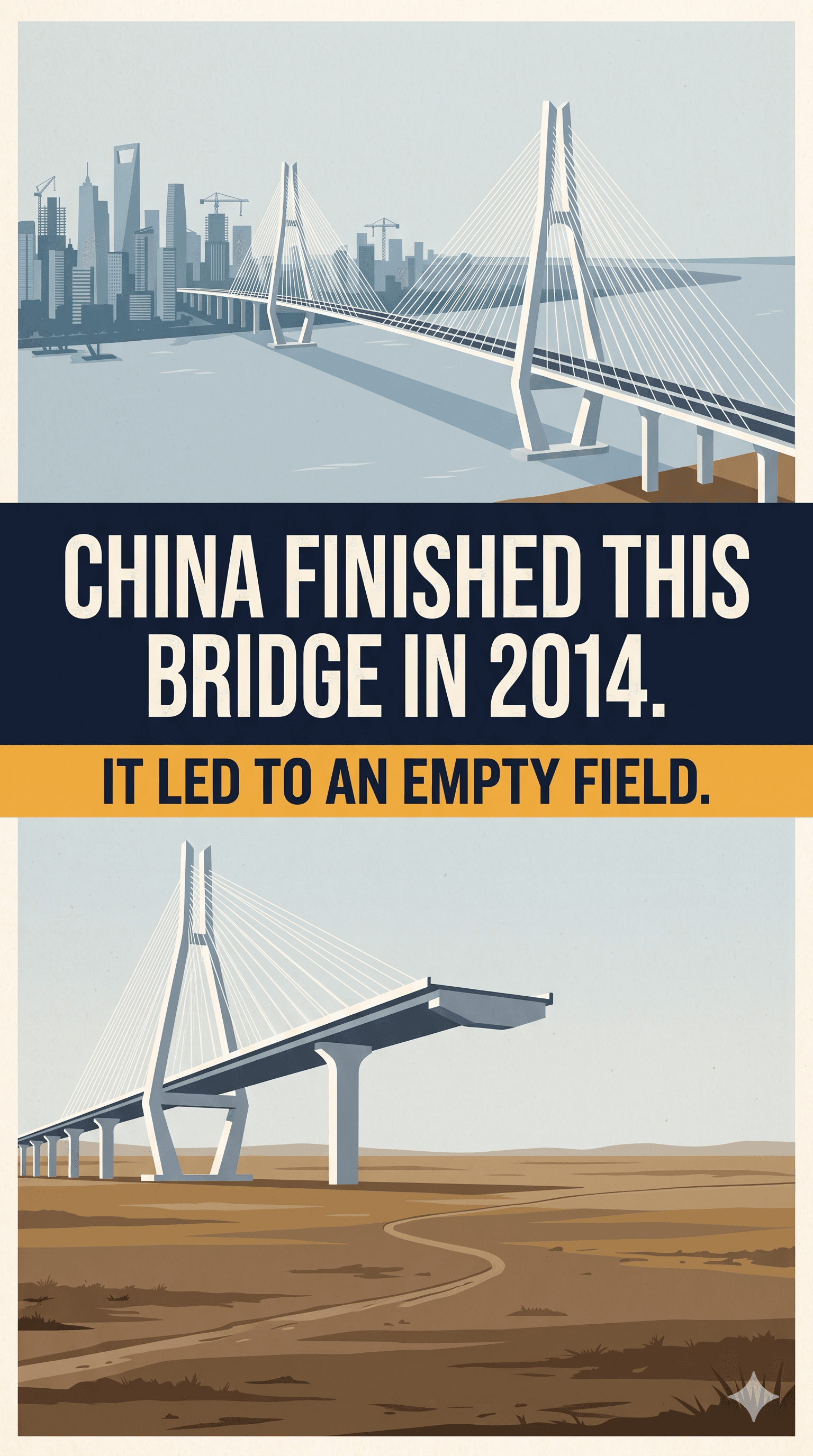
China began building the New Yalu River Bridge in December 2010 and completed its side in October 2014 — a 3,026-metre, four-lane cable-stayed span from Dandong to Sinuiju, reportedly about 2.2 billion yuan (≈US$350m), funded by China for the main structure.
North Korea hadn't built the road.
For years the bridge ran across the Yalu and stopped at the edge of farmland outside Sinuiju. Nothing on the other side.
It opened to traffic on Thursday 15 October 2026. Chinese Premier Li Qiang gave a video address — North Korean Premier Pak Thae Song gave one too — saying relations were entering a new stage and opening a new chapter, and crediting Xi Jinping and Kim Jong Un.
How long it actually sat empty. North Korea started the connecting road in September 2019 and the roads were reported complete by autumn 2022. So the literal bridge-to-a-field condition ran roughly 2014–2019, about five years, not twelve. What dragged on after that was the customs and immigration complex, where significant work only resumed in 2025 and the buildings were still only nearing completion in August 2026.
Why it stalled. Observers cite several reasons and none is settled: a cost dispute (a North Korean trade official told RFA in 2023 that Beijing had originally agreed to fund the whole thing, then argued the North should pay for the auxiliary facilities once the main span was done in 2014); disagreement over the bridge's location; Pyongyang's wariness of economic dependence on China; displeasure at Beijing's UN sanctions votes; and COVID. Xi reportedly agreed in 2019 to fund the North Korean roads and customs posts as well.
What it is for. It does not replace the Sino-Korean Friendship Bridge. That span — opened 1943, carrying one rail track plus a single road lane that traffic can only use one direction at a time, with a 20-tonne vehicle limit — keeps the rail and passenger traffic. The new bridge takes freight pressure off it.
The trade picture. China is North Korea's largest trading partner. Reuters, reporting Chinese customs data, put two-way trade in 2025 at about US$2.7bn, up 25%, roughly back to pre-COVID levels. Chinese media say the crossing could eventually handle up to 20,000 vehicles and 50,000 people a day.
The honest caveat. Whether this deepens or dilutes North Korea's dependence on Beijing is genuinely contested. Lin Chih-hao of Taiwan's INDSR argues Pyongyang may be expanding Russia ties to reduce long-standing reliance on China. Lim Eul-chul of Kyungnam University reads the bridge the other way — as deepening China–DPRK ties and giving both a gateway they control. Ma Junwei of Tamkang University suggests Beijing may be using it as leverage precisely because it worries about the Moscow tilt.