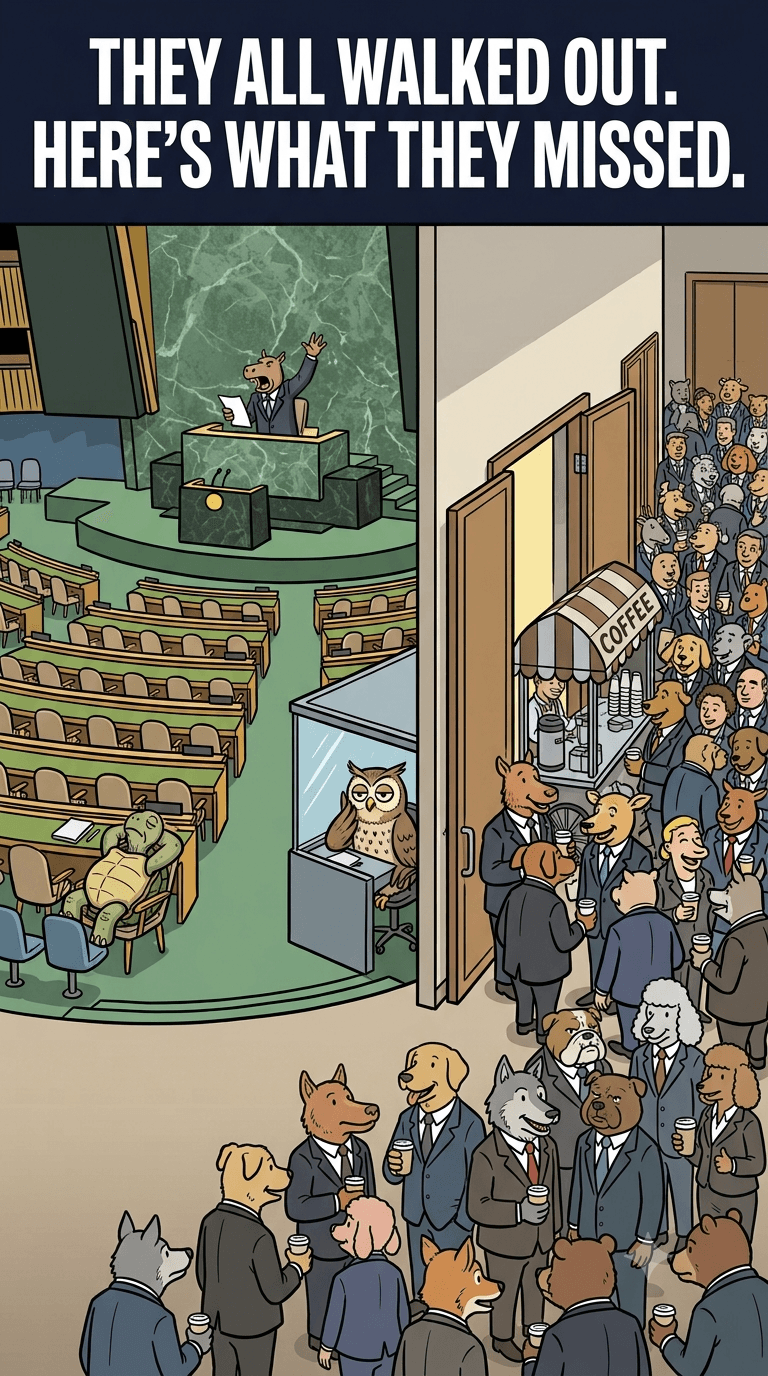
Sergey Lavrov spent Wednesday putting an argument to the Security Council. Here it is, stated as Russia states it — including the parts that are stronger than you have been told — and then the four things it does not survive.
What this piece is. Not an endorsement. Most people have never encountered Russia's argument in any form except a one-line summary written by someone rebutting it, and an argument you cannot state accurately is one you cannot answer. So it is set out here in full, in Lavrov's own words, without interruption. The assessment comes afterwards, separately, and is not softened. Where a claim is contested, it is marked contested — including the ones where the contest is closer than the coverage suggests.
What happened on 23 September
Two speeches, one day, two rooms.
President Volodymyr Zelensky addressed the General Assembly. He asked leaders to keep choking Russian revenues and to stop trading with Russia. He said Russian forces had recruited fighters from 47 countries including Ghana, Nepal and India, pointed to Russian–North Korean military cooperation, and said Russia had deployed 63,000 attack drones against Ukraine during 2026. He announced drone agreements with Finland, Australia and Canada.
Of Putin, he said: "Putin is always looking for someone who can help him kill more, kill more people for every kilometre of land, take more territory and take another country instead of simply stopping."
Of the months ahead: "Ukrainians understand that this winter could be very harsh for us, but in response we will have no choice but to make it painful for Russia too."
Foreign Minister Sergey Lavrov addressed the Security Council. US Secretary of State Marco Rubio said the same day that both sides had an interest in a limited ceasefire.
Russia's case, in Lavrov's words
1. Ukraine was made to choose, and did not choose freely
Lavrov's account begins in 2013, not 2022. He said that "Brussels decided to establish complete clarity, demanding that Ukrainians choose their ally: Russia or Europe" — and that the EU then "organized riots in Kyiv demanding the immediate conclusion of an Association Agreement between Ukraine and the EU."
2. February 2014 was a coup against a guaranteed agreement
This is the part of the argument most Western readers have never heard, and it rests on a document that genuinely exists.
On 21 February 2014, President Yanukovych signed an agreement with the opposition, guaranteed by Germany, Poland and France, in which — as Lavrov puts it — he "accepted all the conditions put forward." Lavrov's claim is that "on the night of February 22, 2014, the opposition… seized government buildings" and that the European guarantors, rather than enforcing the agreement they had witnessed, endorsed what followed: "the guarantors of the agreement trampled by the putschists… declared… the beginning of the democratic transition meets the aspirations."
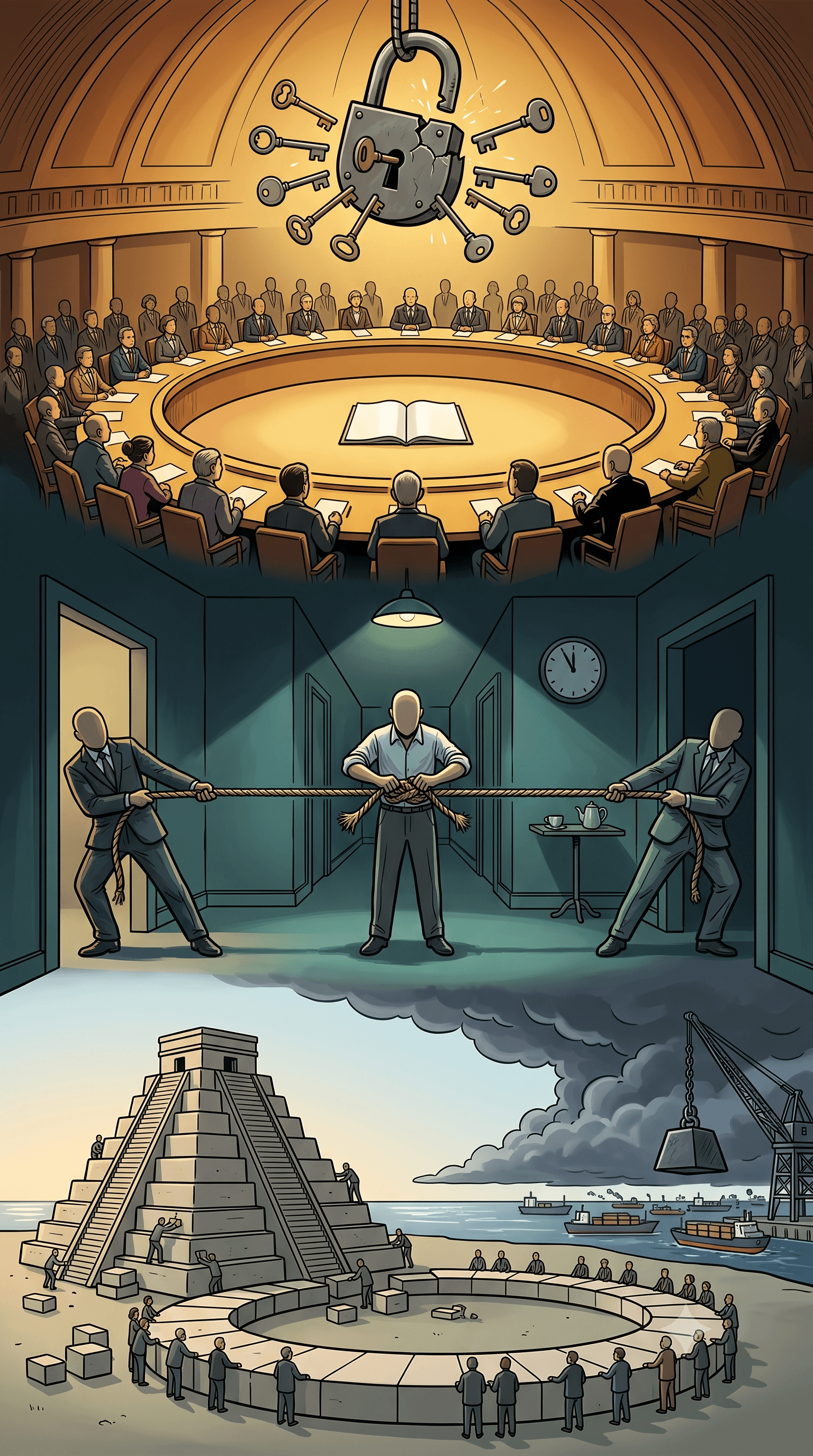
3. Minsk was not a suggestion. It was a Security Council decision.
This is the strongest plank and it deserves to be stated precisely.
Lavrov noted that the Minsk agreements were concluded on 17 February 2015 and "unanimously approved by the U.N. Security Council" — and then invoked the Charter: "Article 25 requires all members… to accept and implement the decisions of the Security Council," yet "Ukrainian President Poroshenko categorically refused."
His conclusion: "If the 2015 Minsk agreements… had been implemented… Ukraine would now remain within the same 1991 borders."
4. A settlement was reached in 2022 and killed from outside
On the Istanbul talks: "After several rounds in Belarus and Istanbul, the Ukrainian side proposed key principles for a settlement, which were accepted by our negotiators." The text, he said, "was initialed by the delegations of Ukraine and Russia, but its fate is well known. Then-British Prime Minister Boris Johnson forbade the Ukrainians from concluding a legally binding agreement."
5. And again in 2025
Lavrov said President Trump "accepted Washington's proposals, which contained certain compromises" at a summit in Anchorage, but that "Europe rushed to dissuade the U.S. President" and "buried Anchorage."
6. The legal argument
Lavrov invoked the Declaration on Principles of International Law concerning Friendly Relations, under which, he argued, "principles of sovereignty and territorial integrity apply to those states that adhere to the principle of equal rights and self-determination of peoples" — and concluded that "the Kyiv regime cannot be considered a government representing the interests of the residents of Crimea, Donbas, and Novorossiya."
On negotiations, he was unambiguous: "we will not pause a special military operation during negotiations in any format."
That is the case. Two of its planks are stronger than the standard dismissal allows, and they are worth separating from the rest before the objections begin.
Where the case is genuinely strong
Minsk II really was endorsed by the Security Council, and implementation really did stall. That is not Russian invention. The sequencing was the sticking point — Kyiv wanted control of the border before elections in the Donbas, Moscow wanted elections first — and neither side moved. Anyone who tells you the agreement failed for simple reasons is not describing what happened.
Istanbul is genuinely unresolved, not settled in either direction. By mid-April 2022 a provisional eighteen-point treaty existed: Ukrainian neutrality, no NATO membership, no foreign bases, no nuclear weapons, security guarantees from Security Council members, and acceptance of Russia's 2014 annexation of Crimea. Territory in Donetsk and Luhansk, the permitted size of Ukraine's army, and whether Russia would hold a veto over the guarantees were all unresolved.
On Johnson specifically: Ukrayinska Pravda, former Israeli prime minister Naftali Bennett and Ukrainian parliamentary leader David Arakhamia have all supported some version of the claim. Scholars including Taras Fedirko, Emma Ashford and David Hendrickson argue his influence was "relatively inconsequential" and that the talks were doomed by unresolved territory and Russian unreliability regardless. A scholarly review concluded that circumstantial evidence supports the idea Johnson's visit confirmed Zelensky's unwillingness to proceed, while adding that certainty awaits documents not yet public. The EU's disinformation unit classifies the claim as disinformation; academic specialists disagree with that classification.
So: not proven, not debunked. That is the honest state of it, and treating it as either is a tell.
And the diplomatic consensus has eroded, which Russia's critics rarely concede. In March 2022, 141 states voted to demand Russia withdraw. In October 2022, 143 voted against the annexations with 5 against. But by February 2025, Ukraine's own resolution passed 93 to 18 with 65 abstentions — and the United States voted against it, then abstained on its own amended text. That is a real change and it is a real point.
What the case does not survive
Breach of an agreement is not a legal basis for invasion. This is the centre of it. Even granting every word about Minsk — that it was binding, that Kyiv refused, that the guarantors behaved badly — the remedy for non-implementation of a Security Council-endorsed agreement is the Security Council, arbitration, sanctions, or the collapse of the agreement. It is not the seizure of territory. Article 51 permits self-defence against an armed attack. No armed attack on Russia occurred. The grievance can be entirely valid and the conclusion still not follow, and that is the shape of this argument.
The self-determination argument proves far too much. The safeguard clause in the Friendly Relations Declaration is real and Lavrov quotes it accurately. But it has never been read as licensing a foreign state to annex territory by force on a population's behalf. If it were, it would license the partition of a very large number of countries — including the Russian Federation, which contains more than one population that has made comparable claims and been refused with considerable force.
"We will not pause during negotiations" undoes the negotiation argument. An argument whose spine is they denied us a settlement four separate times is hard to sustain alongside a refusal to stop shooting while one is being discussed. Whatever the merits of 2015, 2022 and 2025, the position stated on Wednesday is not the position of a party being denied talks.
And the 2022 invasion is not what any of this explains. The Association Agreement, the 2014 agreement, Minsk, Istanbul, Anchorage — every one of these concerns how Ukraine was governed or how a settlement was reached. None of them establishes a right to cross a border in February 2022. The case is a grievance narrative, and a substantial one. It is not a legal justification, and Lavrov did not offer it as one.
What is established, what is contested, what is not known
Established: both speeches and their dates; Zelensky's figures as he gave them; the Security Council's endorsement of Minsk II; the 21 February 2014 agreement and its European guarantors; the existence of an eighteen-point draft in Istanbul; the UN vote counts in 2022 and February 2025, including the US position change.
Contested: whether Johnson's intervention was decisive; whether Minsk failed primarily through Ukrainian or Russian non-implementation; whether the 2014 change of government is properly described as a coup; what was agreed at Anchorage.
Not known: the contents of the Istanbul draft in full, and what was actually said in the private meetings on which most of this argument depends.
Sourcing note and a warning about it. Lavrov's remarks and all quotations attributed to him here are as reported by Consortium News from the Security Council session of 23 September 2026 — a single outlet whose editorial position is sympathetic to Russia's framing of this war. That does not make the quotations wrong, but it means they have not been independently verified here, and a reader should weigh them accordingly. Zelensky's speech and quotations are from Euronews and wire reporting of 23 September 2026. UN vote counts are from UN records and UN News. The Istanbul draft's contents and the scholarly dispute over Boris Johnson's role are from an H-Diplo/RJISSF commentary and the sources it reviews. Russian state messaging on this war is an active and well-documented information operation; setting out its argument accurately is not the same as accepting it, and the section above marked "what the case does not survive" is where this piece actually lands.