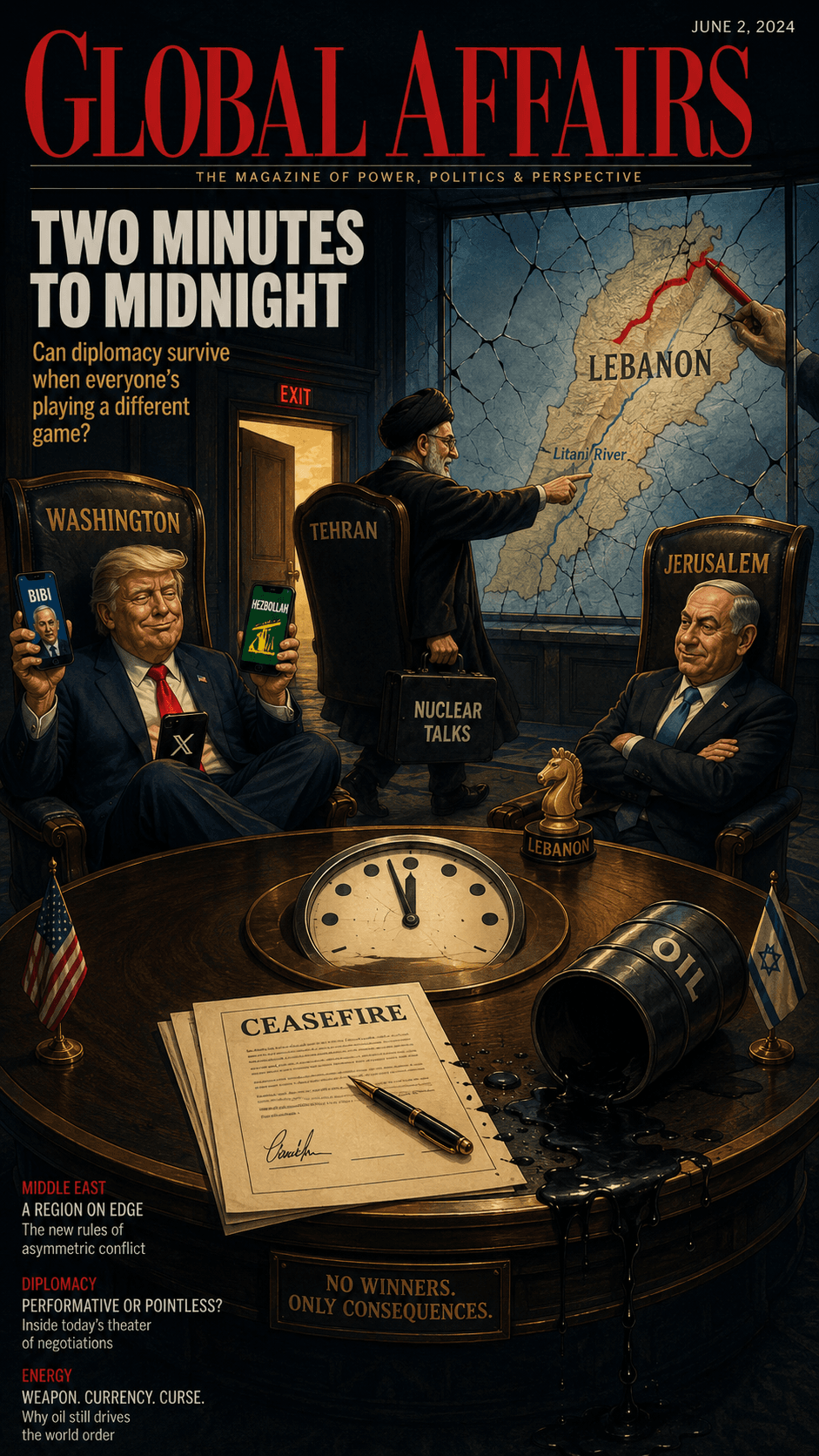
In the span of a few hours on June 1, 2026, the Middle East lurched through a full cycle of diplomacy, defiance, and collapse — and the United States sat at the centre of all of it.
It began with what appeared to be a breakthrough. US President Donald Trump announced on Truth Social that he had spoken directly with Israeli Prime Minister Benjamin Netanyahu and, through intermediaries, with Hezbollah itself. "All shooting will stop," Trump declared, saying the IDF would not enter Beirut and that Hezbollah had agreed to halt its attacks on Israel. For a region that has been convulsed by war since February 2026, the announcement offered a rare moment of relief.
It lasted roughly two hours.
Netanyahu, speaking roughly two hours after Trump's post, issued a statement that cut against the grain of Washington's announcement. The Israeli Prime Minister said he had informed Trump that if Hezbollah did not cease attacking Israeli towns and civilians, Israel would strike terrorist targets in Beirut. "This position remains unchanged," Netanyahu said. He added that IDF operations in southern Lebanon would continue "as planned" — a direct contradiction of the ceasefire terms Trump had just announced publicly.
The confusion did not stop there. A Hezbollah lawmaker claimed the ceasefire covered all of Lebanon, not just Beirut. Washington offered no immediate clarification. And within hours, Iran — watching Israel advance north of the Litani River and seize the historic Beaufort fortress — announced it was halting peace talks with the United States entirely.
Tehran's reasoning was pointed. Senior Iranian officials declared that Israel's military operations in Lebanon constituted a violation of the broader US-Iran ceasefire framework that has been in fragile effect since March. In Iran's reading, the United States and Israel are one actor — and if Israel is escalating in Lebanon, the ceasefire is broken. Iran's foreign ministry accused Washington of acting in bad faith, and talks that had been described just days ago as "rapidly progressing" were placed on indefinite hold.
The timing could hardly be worse. After months of brutal conflict that began with the US-Israeli strikes on Iran in February, the assassination of Supreme Leader Khamenei, and Iran's retaliatory closure of the Strait of Hormuz, negotiations had inched toward a tentative framework: a 60-day ceasefire extension, partial reopening of the strait, and a deferred start to nuclear talks. Oil markets had begun to ease. Stock markets had climbed. Trump had declared the deal "largely negotiated."
Now that architecture is under strain from a direction that was always its most obvious fault line: the gap between what Washington can promise and what Jerusalem will accept.
Israel has operated on a parallel logic throughout the broader Iran conflict. Netanyahu has consistently maintained that the US-Iran ceasefire does not apply to Lebanon, that Hezbollah is a separate target, and that Israel's security interests in southern Lebanon are non-negotiable. The IDF's push north of the Litani — described by the IDF Chief of Staff as creating a permanent no-go zone for Hezbollah — is not a temporary operation in Israel's framing. It is a strategic redrawing of the regional map.
For Iran, however, Hezbollah is not a separate theatre. It is central to Iran's regional deterrence architecture, and any Israeli campaign to permanently dismantle Hezbollah's presence in southern Lebanon is, in Tehran's view, an extension of the same war. Iran's decision to halt nuclear talks is both a protest and a negotiating signal: it is telling Washington that there can be no deal on the Strait or on nuclear matters while Israel is free to operate in Lebanon without US restraint.
Trump's response has been to hold both tracks simultaneously — pressing Netanyahu to show restraint while telling Iran that talks are continuing at a "rapid pace." Whether that dual-track approach can survive the current moment is uncertain. The ceasefire's terms remain disputed by all three principal parties. Israel insists it retains freedom of action in Lebanon. Hezbollah's commitments are unclear. And Iran has now formally stepped back from the table.
What is clear is that the Middle East's most complex diplomatic moment in decades has no simple architecture. The Strait of Hormuz, Lebanon, Hezbollah's disarmament, Iran's nuclear program, and the future of the Iranian state itself are all now linked — and each one is a thread that, if pulled, risks unravelling the others.
Trump declared that all shooting would stop. The region responded with more of the same.