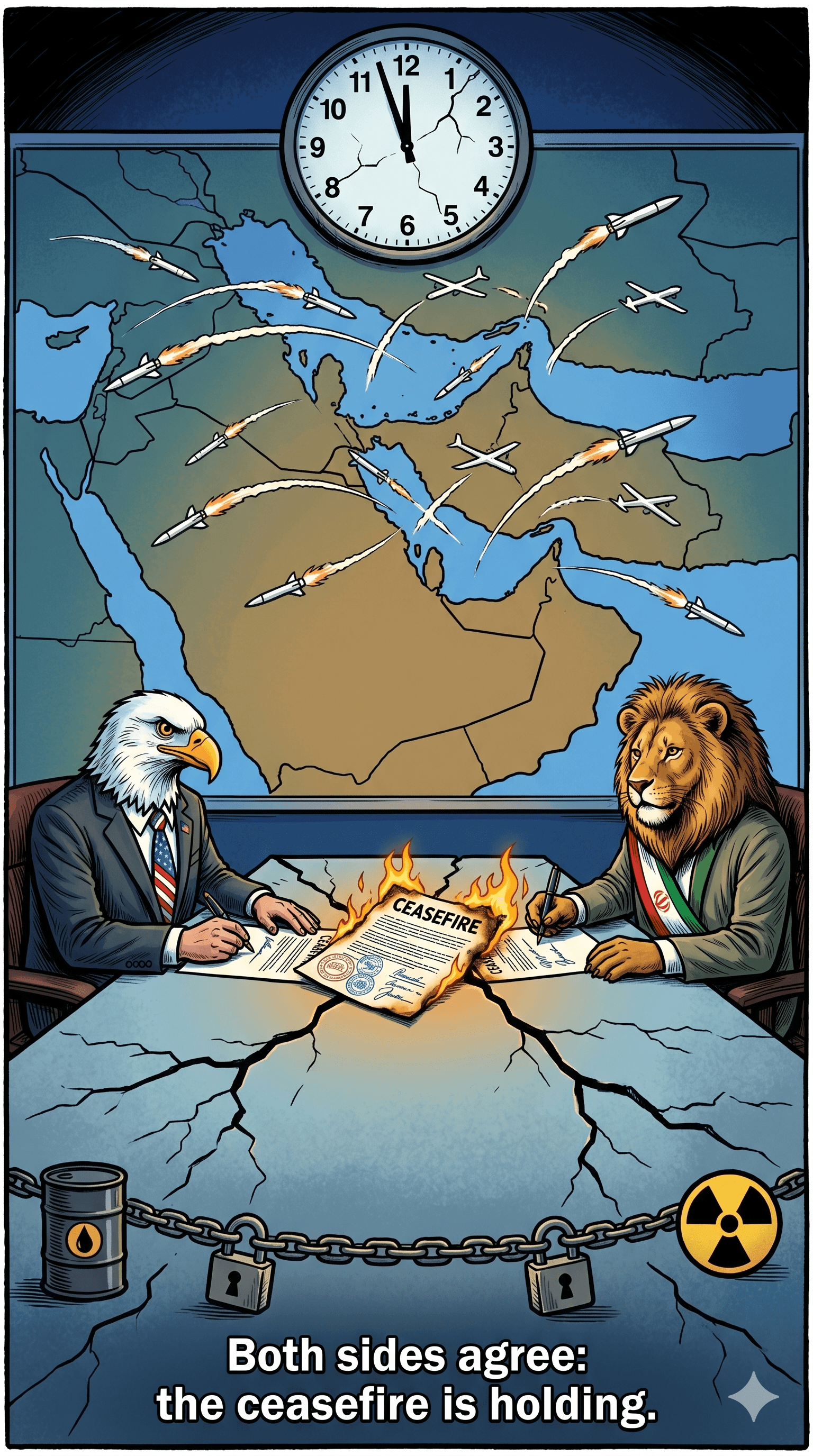
The Middle East is caught in a paradox that has no modern precedent: two nations are simultaneously negotiating peace and trading blows. As American and Iranian diplomats work toward a framework to end the 2026 Iran War, missiles and drones continue to streak across Gulf skies — and the ceasefire that was meant to stop them is fraying at every seam.
How It Got Here
The current crisis traces its origins to February 28, 2026, when the United States and Israel launched large-scale coordinated strikes on Iran, targeting its nuclear and ballistic missile infrastructure. The strikes were transformative in scope: Iran's Supreme Leader Ali Khamenei was killed in the attack, reshaping the country's entire political command structure overnight. Iran responded with what it called "Operation True Promise IV" — a sweeping retaliatory campaign targeting American military bases across the Gulf, including facilities in Kuwait, Bahrain, Qatar, and the UAE. The Strait of Hormuz, through which roughly a fifth of global oil flows, was shut down.
After weeks of escalating exchanges — and a Trump deadline that threatened to destroy Iranian bridges and power plants — Pakistan brokered a conditional ceasefire on April 7, 2026. The war paused. But it never truly stopped.
A Ceasefire That Fires Back
The April ceasefire has been a study in controlled hostility. Despite its existence on paper, both sides have continued trading strikes with remarkable frequency. In early June, Iranian forces launched a fresh round of drone and missile attacks against American assets in Kuwait and Bahrain. US CENTCOM confirmed it struck an Iranian military ground control station on Qeshm Island in response, calling it a "self-defense" action. Patriot missile batteries were filmed engaging incoming Iranian ballistic missiles over Kuwait in broad daylight.
Iran's position, relayed through state media, was unambiguous: the strikes were retaliation for American actions in the Persian Gulf and the Strait of Hormuz. Washington's position was equally firm: the ceasefire remains "in place," and talks are proceeding "very well." Both claims are technically true — and practically absurd. The ceasefire exists as a legal fiction while the conflict continues as a military reality.
The Nuclear Sticking Point
Underneath the military theatre lies a far more consequential diplomatic struggle. Talks between US and Iranian negotiators have covered four core issues: freedom of navigation through the Strait of Hormuz, Iran's nuclear enrichment program, reconstruction funding and sanctions relief, and a framework for long-term peace. Progress has been made on most fronts — except the one that matters most.
After the senior-most US-Iran diplomatic meeting since 1979, held in Islamabad in April, President Trump acknowledged that "most points were agreed to, but the only point that really mattered, nuclear, was not." Iran holds approximately 440.9 kilograms of uranium enriched to 60% purity — technically a short step from weapons-grade levels — and has shown no willingness to surrender that leverage without binding guarantees in return.
By late May, negotiators had reportedly reached a tentative memorandum of understanding to extend the ceasefire by 60 days and begin formal nuclear talks. Trump called the parties "close, but not finalized," and said he was in no rush. Even as this diplomatic signal went out, the US Treasury imposed fresh sanctions on Iran's military oil sales arm — a reminder that economic pressure and diplomacy are running on parallel tracks simultaneously.
The Hormuz Variable
The Strait of Hormuz remains the war's most potent lever. Iran's closure of the waterway since late February has rattled energy markets globally. The US port blockade of Iran has been described by Trump as "the most powerful thing" in the American arsenal — more effective, he suggested, than the strikes themselves. Both sides understand that the Strait's reopening is the economic centrepiece of any deal, which makes it both a bargaining chip and a tripwire.
What the Gulf States Are Thinking
For Kuwait, Bahrain, Qatar, and the UAE — nations that host American forces but maintain complex ties with Iran — the conflict has been a crisis not of their choosing. Kuwait suspended all commercial aviation after its airport was hit. Bahrain's US Navy 5th Fleet headquarters at Naval Support Activity Bahrain has been repeatedly targeted. These governments have largely stayed silent publicly, quietly absorbing the costs of a war between their American patron and their Iranian neighbour.
The Road Ahead
The coming weeks will determine whether the fragile diplomatic scaffolding holds or collapses. A permanent peace deal requires resolving three deeply contested issues: how much uranium enrichment Iran may retain, who controls maritime access through Hormuz, and what verification mechanisms are acceptable to both sides. None of these have easy answers.
What is clear is that the world is watching a conflict that refuses to follow conventional rules. Ceasefires coexist with combat. Diplomacy advances while missiles fly. And the fate of global energy markets, regional stability, and the nuclear non-proliferation order hangs on talks being conducted in Islamabad, Muscat, and back-channels that the public will likely never see.
The ceasefire that won't hold is also, paradoxically, the only thing stopping a wider war. For now, that is enough — and it is nowhere near enough.