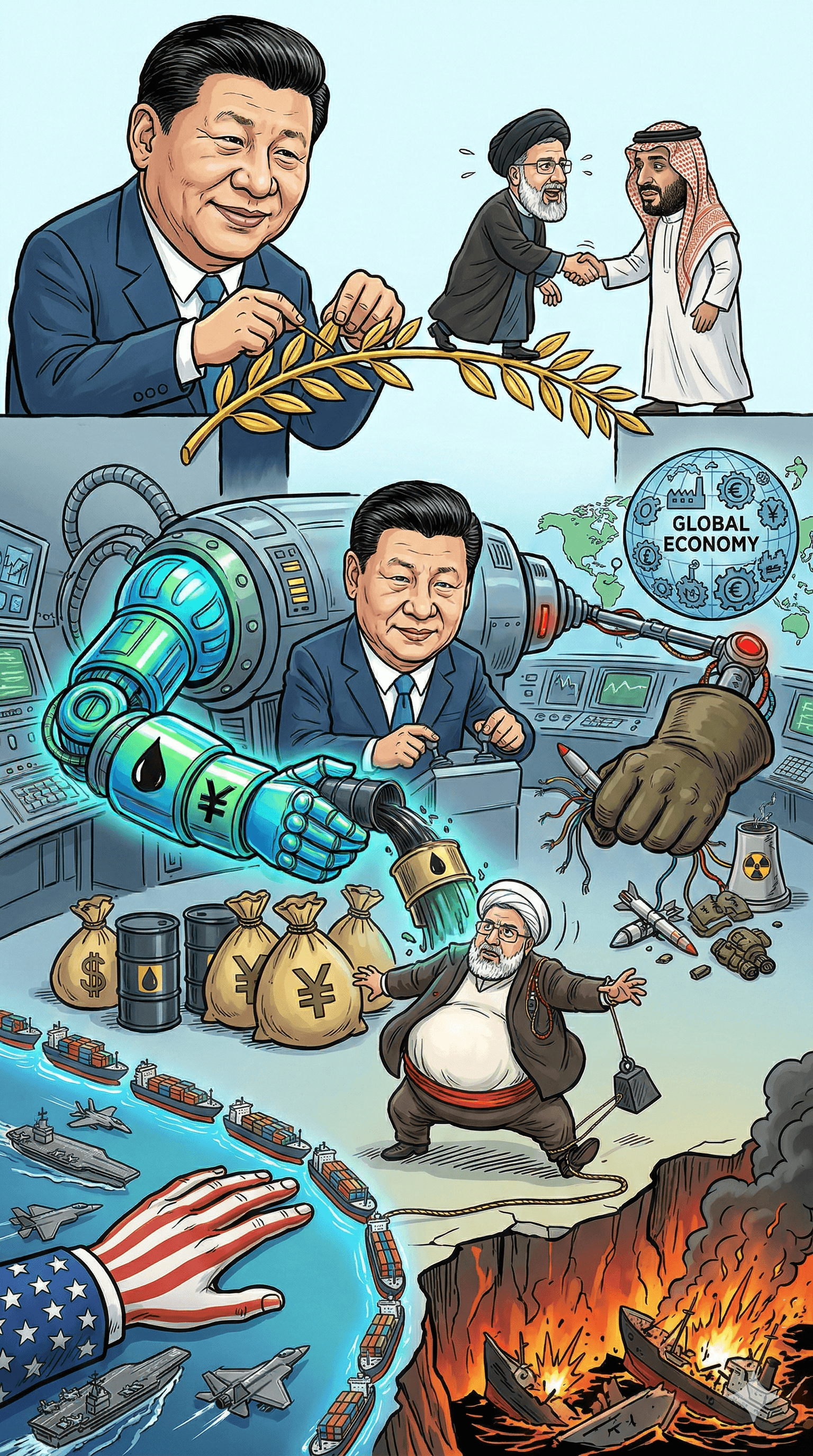
The geopolitical landscape of the Middle East experienced a seismic shift following the February 28, 2026, joint military operation by the United States and Israel. Dubbed "Operation Epic Fury," the sweeping strikes resulted in the decapitation of Iran’s military and political leadership, most notably the killing of Supreme Leader Ayatollah Ali Khamenei.
As the international community braces for the aftershocks of a potentially restructured Middle East, the world’s eyes have turned toward Beijing. Despite maintaining a highly publicized comprehensive strategic partnership with Tehran, China’s reaction has been notably restrained. This diplomatic dilemma—balancing strategic opposition to U.S. hegemony with a ruthless pragmatism regarding regional stability—highlights the curious case of China's cautious positioning on Iran.
A Strategic Partnership on Paper, Pragmatism in Practice
Following the establishment of elevated bilateral relations in 2016 and the signing of a 25-year strategic cooperation agreement in 2021, many expected China to act as a definitive shield for Tehran. However, Beijing's response to Operation Epic Fury has exposed the practical limitations of this partnership.
Chinese Foreign Minister Wang Yi deployed harsh diplomatic rhetoric, condemning the bombing campaign as "unacceptable" and denouncing the "blatant killing of a sovereign leader." Beijing was quick to urge an immediate ceasefire and a return to diplomatic negotiations. Yet, beyond rhetorical condemnation, China has largely taken a backseat, offering no explicit security guarantees or material military support to protect the remnants of the Iranian regime.
This passive stance underscores a clear hierarchy in China’s foreign policy. While Iran is an important partner in the so-called "Axis of Resistance," it does not hold the same "all-weather" strategic weight as nations like Russia or Pakistan. For Beijing, the focus remains strictly on the process—advocating for dialogue and opposing unilateral military action—rather than committing to a specific outcome for the Iranian government.
The Economic Tightrope: Oil, Trade, and Gulf Alliances
To understand Beijing’s caution, one must look at the economic realities anchoring its Middle East strategy. China’s primary interest in the region is securing the energy resources necessary to fuel its domestic economy.
Iran remains an important economic lifeline for Beijing, accounting for roughly 10 to 15 percent of China’s sea-borne oil imports, often purchased at a significant discount due to international sanctions. However, any severe escalation that leads to the closure of the Strait of Hormuz would be disastrous for global energy markets and, by extension, Chinese economic stability.
Furthermore, China has spent the last decade carefully cultivating deep diplomatic and economic ties with Iran’s regional rivals, including Saudi Arabia and the United Arab Emirates (UAE). In 2023, Beijing even brokered a historic normalization agreement between Riyadh and Tehran. Aggressively backing Iran in a direct military confrontation with the U.S. and Israel would severely alienate these wealthy Gulf partners, jeopardizing China’s broader, long-term investments across the Arab world.
The Nuclear Threat and the Risk of a Regional Arms Race
Another critical factor dictating China's cautious approach is the Iranian nuclear program. While Beijing consistently criticizes Washington for its "maximum pressure" campaigns, Chinese officials are fundamentally opposed to Iran acquiring nuclear weapons.
As the surviving, radical core of the Iranian leadership attempts to entrench itself following the loss of Khamenei, analysts warn that Tehran may accelerate its nuclear ambitions as an ultimate deterrent. Beijing fears that a nuclear-armed Iran would permanently destabilize the Middle East and trigger a rapid arms race among Gulf nations.
Additionally, Chinese defense strategists worry about a global ripple effect. Normalizing nuclear proliferation in the Middle East could encourage China’s regional rivals in the Indo-Pacific—such as Japan, South Korea, and Australia—to pursue their own nuclear deterrence capabilities, directly threatening Beijing’s security environment in East Asia.
Geopolitical Calculations and the U.S. Factor
Ultimately, China views the Iranian crisis through the overarching lens of its superpower competition with the United States. The ongoing military actions present Beijing with a narrative opportunity. By highlighting the U.S.-led operation, China is seizing the moment to reaffirm its messaging to the Global South: framing the United States as a "rogue" actor that relies on unilateral force, thereby positioning China as the responsible champion of multipolarity, global stability, and international law.
Despite this posturing, China is careful not to overplay its hand. Beijing is locked in complex, multifaceted negotiations with Washington on trade, technology, and regional security. With the highly anticipated summit between President Xi Jinping and U.S. President Donald Trump scheduled in Beijing for late March and early April 2026, China is hedging its bets. Antagonizing the U.S. through direct intervention in Iran would derail these critical high-level dialogues before they even begin.
Outlook: Playing the Long Game in a Weakened Iran
Looking ahead, China's calculus regarding Iran is rooted in a long-term strategy that views a weakened Iranian regime as both a potential risk and a unique opportunity.
On one hand, Beijing deeply fears a total regime collapse that could install a Western-aligned government in Tehran, which would severely threaten Chinese energy security and geopolitical leverage. On the other hand, the current attrition of Iran's military capabilities and the deepening of its international isolation only increase Tehran’s structural dependence on China.
As the dust settles from Operation Epic Fury, China will remain ruthlessly pragmatic. Beijing will not abandon its comprehensive strategic partner, but it will also refuse to become Iran's primary military patron. Instead, China will continue to offer a limited economic lifeline, ensuring that it remains the dominant foreign influence in Tehran while skillfully avoiding the fallout of the Middle East's most volatile conflict.
#China #Iran #MiddleEast #Geopolitics #OperationEpicFury #GlobalEconomy #USForeignPolicy #OilMarkets #Diplomacy #InternationalRelations