Standfirst: After 9/11 the cockpit became a fortress. After Germanwings we learned what that costs when the threat is already inside. On 30 September, a wounded Indian captain reached for the one control that undoes twenty-five years of security doctrine — and that is why more than 170 people are alive.
What happened
Flydubai flight FZ1073, Dubai to Tel Aviv, 30 September 2026.
At 08:44 local time, roughly two and a half hours after takeoff, the first officer allegedly stabbed Captain Smit Machchhar and attempted to crash the aircraft. The plane dropped from 33,000 feet to 17,000 feet in one minute.
Wounded, Machchhar activated the cockpit door release. Passengers and crew came through and overpowered the attacker. Other pilots travelling as passengers took the controls. The aircraft diverted to Tabuk, Saudi Arabia, landing about an hour after the attack began.
Both pilots were injured. Nobody died. There were more than 170 people on board.
Machchhar has 17 years of flying experience and has been a captain for 11 of them. Prime Minister Narendra Modi spoke to him by video call on 1 October, praising his "courage, presence of mind and composure." Benjamin Netanyahu called him "a true hero."
On 2 October, former Israeli deputy foreign minister Sharren Haskel told ANI: "His courage and determination have saved so many lives. He needs to be invited to Israel to receive a Medal of Honour here from our president, from our government." She described him as "risking his own life" while "keeping himself alive, so that he could actually open the door."
That last clause is the whole story, and it is worth understanding why.
The door
For most of aviation history, the cockpit door was a door. After 11 September 2001, it stopped being one.
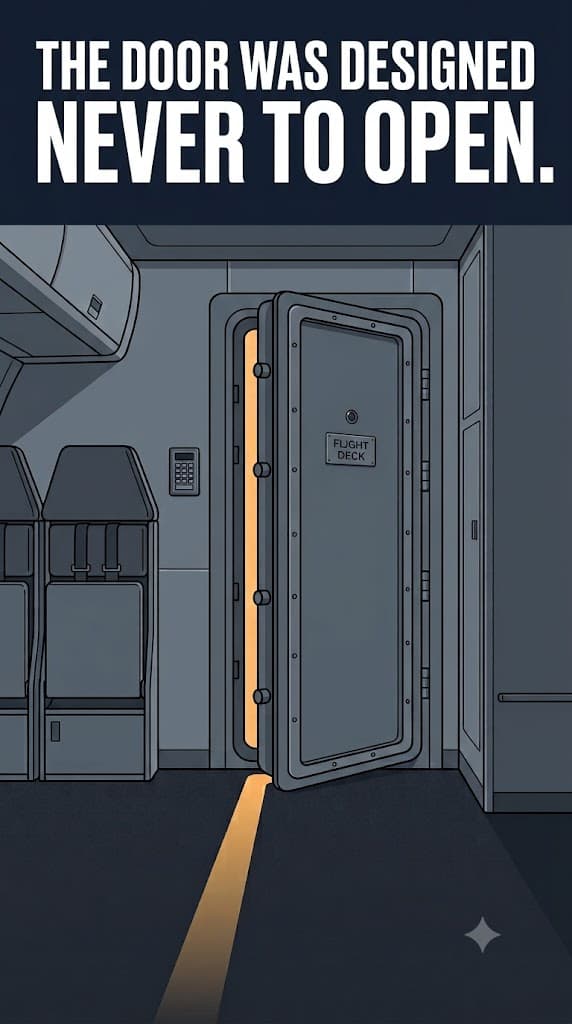
Reinforced flight-deck doors were mandated across commercial aviation: armoured, bullet-resistant, and — crucially — controlled from the inside. Captain Chesley Sullenberger described the change plainly: "we had to beef up the cockpit doors, come up with elaborate locking mechanism."
The design logic was simple and, for the threat it was built against, correct. Hijackers had taken four aircraft by entering the flight deck. So the flight deck was made impossible to enter.
There is a keypad outside. Cabin crew can request entry. But if someone inside actively refuses, the override is defeated. In Sullenberger's words: "if there's someone in the cockpit who actively denies them that and keeps the door locked, they cannot enter."
Germanwings
On 24 March 2015, Germanwings flight 9525 was cruising over the French Alps when the captain left the flight deck. The co-pilot, Andreas Lubitz, locked the door and put the aircraft into a descent into terrain. All 150 people aboard were killed.
The captain tried to force his way back in. He could not. The door worked exactly as designed.
The industry's response was the two-person rule — never leave one crew member alone on the flight deck; if a pilot steps out, a member of cabin crew steps in. Airlines worldwide adopted it within days. Many quietly dropped it again in the years that followed, on the argument that it introduced its own risks.
The deeper problem was never solved, because it is not solvable by a door. A fortress built to keep a threat out is useless, and worse than useless, when the threat holds the key.
What Machchhar actually did
Set against that history, the significance of his action becomes clear.
He was stabbed, in a cockpit, by the only other person with access to the controls, while the aircraft descended at a rate that gave him a very small number of minutes. He could not fly the aircraft and fight at the same time. He could not call for help that could reach him.
So he did the one thing the entire post-9/11 architecture is designed to prevent: he unlocked the fortress.
That is not an obvious decision. Every instinct trained into a commercial pilot since 2001 says the flight deck stays sealed. Opening it in flight, with an assailant inside and 170 unknown people on the other side, inverts twenty-five years of doctrine in the few seconds available. It worked because the threat was already inside, which is precisely the case the door was never designed for.
It also required him to stay conscious and upright long enough to reach the release while being struck. Haskel's phrasing — "keeping himself alive, so that he could actually open the door" — is not a flourish. It is a description of the sequence.
About that Medal of Honour
This is the part most coverage has left vague, and it is checkable.
Israel does have a decoration matching Haskel's description. The Israeli Presidential Medal of Honour is the state's highest civil honour, awarded by the President, first presented by Shimon Peres on 1 March 2012 and revived in 2022 by President Isaac Herzog after an eight-year gap.
Its criteria are broad: outstanding contribution "to the State of Israel or to humanity, through their talents, services, or in any other form."
And critically for this case: it is open to foreign nationals. Previous recipients include Angela Merkel, Steven Spielberg, Elie Wiesel, Zubin Mehta and several serving and former heads of state.
So the call is not rhetorical. It names a real award that an Indian civilian is formally eligible to receive. Whether it happens is a decision for the President of Israel, and nothing has been announced.
What Haskel cannot do is award it. She is a former deputy foreign minister speaking to a news agency. This is advocacy, not a decision, and the distinction has been blurred in several headlines.
What is not known, and should not be filled in
Four things, and they matter.
The motive is unestablished. Netanyahu said it was "too early to say" whether this was a targeted attack. The aircraft was flying to Tel Aviv, which has produced a great deal of inference. Inference is not evidence, and no official finding has been published.
No charges have been filed. The first officer was taken into custody in Saudi Arabia. He has not been charged, and "allegedly" is doing real work in every sentence about him.
His nationality has not been confirmed. Reporting has been careful about this; some social media has not.
And the screening question has no comfortable answer. The UAE's General Civil Aviation Authority requires medical and mental-health evaluation for pilot certification. The analyst Saj Ahmad put the limit of that bluntly: checks "are a single snapshot in time" and "will never uncover whether a person has issues that then manifest in the workplace." The first officer reportedly joined flydubai less than a year ago.
That is the uncomfortable conclusion sitting underneath a story everyone wants to be simple. A screening regime that catches a problem on the day of the test cannot catch one that develops afterwards, and no amount of door engineering addresses a person who is authorised to be on the other side of it.
What to watch
Whether the two-person rule comes back. It was adopted globally in days after Germanwings and quietly dropped by many carriers since. This is the obvious regulatory response and the first place to look.
Whether any charge is brought, and where. Custody in Saudi Arabia, an Emirati carrier, an Israeli destination and a reported transfer to the UAE make the jurisdictional question genuinely complicated.
Whether the medal is actually awarded. A call from a former minister is not a nomination. If Beit HaNassi says nothing in the coming weeks, that answers it.
And whether India recognises him too. Modi has spoken to him. India has its own civilian gallantry awards, and a pilot who saved 170 lives is an obvious candidate for them.