He had a nickname that suited him perfectly. "The Ghost of al-Qassam" — a man who moved through the ruins of Gaza like smoke, shifting between hiding places, surrounding himself with hostages as human shields, evading Israeli intelligence for nearly three years since the worst attack on Jewish people since the Holocaust. On Friday evening, May 15, 2026, three Israeli Air Force fighter jets dropped thirteen bombs on an apartment building in Gaza City's Rimal neighbourhood. The Ghost was finally caught.
Izz al-Din al-Haddad, the head of the Izz al-Din al-Qassam Brigades — Hamas' military wing — was killed in what Israel called a "precise strike" on Gaza City. Both Israel and Hamas confirmed his death. Hamas called his loss "profound." IDF Chief of Staff Lt. Gen. Eyal Zamir called it a "significant operational success."
He was the last of them. The last senior commander who had planned, directed, and executed the October 7, 2023 attacks still alive inside Gaza. Now he is gone.
Who Was Izz al-Din al-Haddad?
Haddad has been a member of Hamas' military wing since its founding in 1987 — one of the organisation's oldest and most deeply embedded commanders. He was the highest-ranking military commander of Hamas and the last leader of the October 7 massacre remaining in the Gaza Strip.
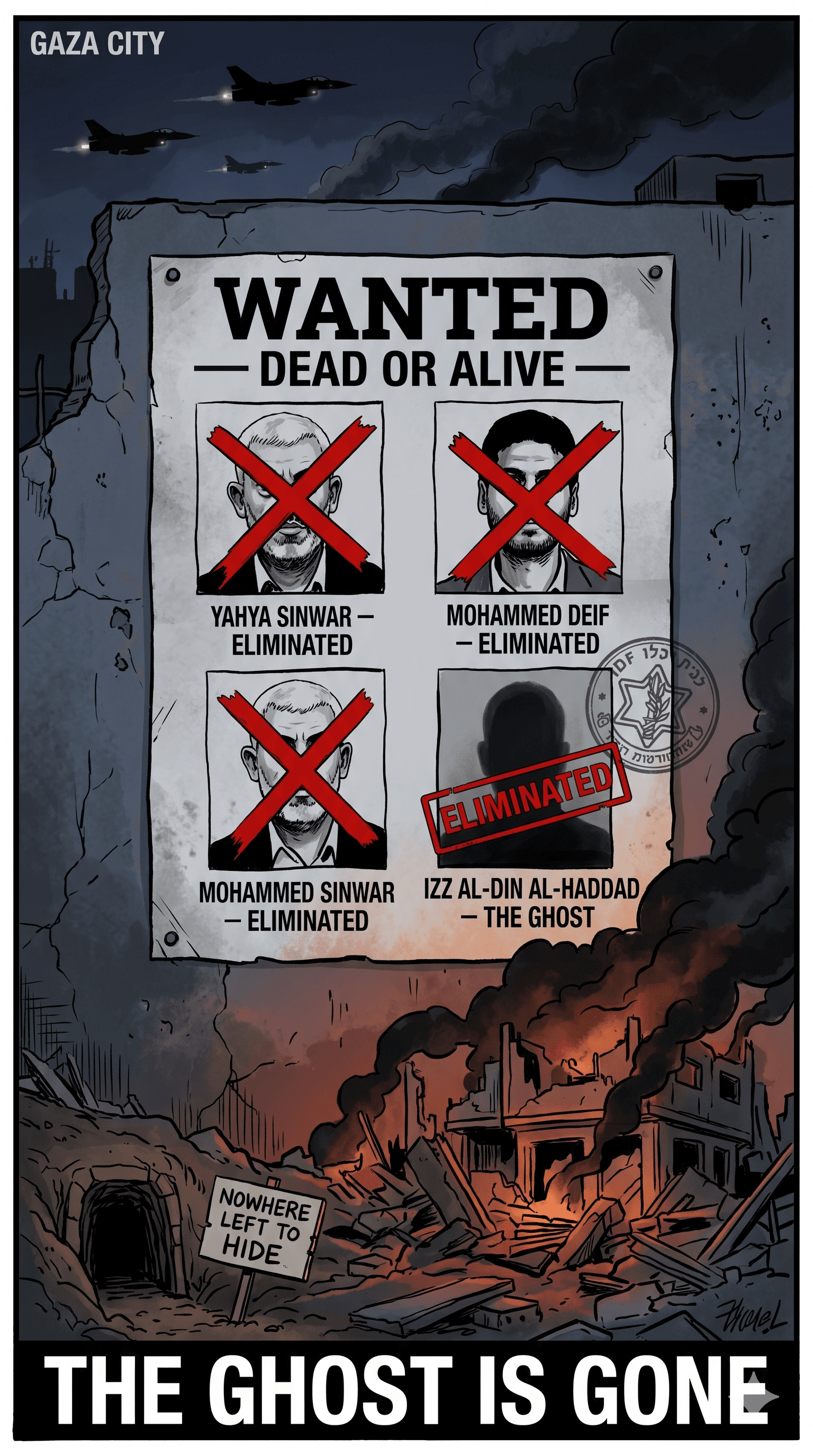
After Israel assassinated Hamas' other leaders — including Yahya Sinwar, his brother Mohammed Sinwar, and Mohammed Deif — al-Haddad was considered to be one of the militant group's top decision makers. He took over as Hamas military chief in the Gaza Strip after Israel's killing of commander Mohammed Sinwar in May 2025.
The secretive al-Haddad maintained an exceptionally low profile — known in intelligence circles as "The Ghost of al-Qassam" for his ability to disappear. He survived multiple assassination attempts by Israel, according to Hamas sources.
But his invisibility came at a moral cost that history will record. Throughout the war with Gaza, Haddad moved between numerous hiding places, was heavily involved in the hostage network in the Strip, and surrounded himself with hostages in an attempt to avoid strikes from the IDF. Under his command, Hamas murdered, starved, and abused hostages to protect his personal security and ensure the survival of the terror organisation.
He was also personally in charge of former Israeli hostages Liri Albag and Emily Damari.
How the Strike Was Carried Out
The operation that ended al-Haddad's life was years in the making — and required extraordinary precision to execute without alerting its target.
The air force carried out the strike after receiving intelligence from the Southern Command and Military Intelligence Directorate on Haddad's location, which had been identified after years of military intelligence collection. Approval was given to the IDF by government officials about ten days prior to the attack.
Prior to the attack, the air force carried out a "deception operation" intended to prevent Hamas from detecting unusual activity in the western Negev and Gazan airspace, while assuring that Hamas's military wing — as well as Haddad's inner circle — remained on low alert.
The Israeli Air Force struck a hideout apartment where Haddad was believed to be, along with a vehicle that left the location at the same time, to prevent an escape attempt. Three Israeli Air Force fighter jets participated in the strike, dropping 13 bombs during the operation
The Israeli strikes on Friday killed at least seven people, with more than 50 others injured and taken to Al-Shifa Hospital, according to emergency services in Gaza. The bodies of three women and a child were among the dead received at the hospital's morgue
The Hostages Respond
For those who survived al-Haddad's captivity, the news carried a weight that no military communiqué could fully convey.
"Every dog gets its day, and you are a hell of a dog," wrote former hostage Liri Albag on an Instagram story, who was personally notified of the operation by Defence Minister Israel Katz.
Former hostage Emily Damari also spoke out: "It's official — al-Haddad has been eliminated! Thanks to all the security forces and those involved in the operation. He planned October 7, murdered my friends and many other dear people. He planned my kidnapping and also held me in Hamas tunnels. With God's help, we will reach every one of these terrorist scum."
These were not statements of celebration for its own sake. They were the words of people who had been held underground, in darkness, by a man who used their lives as a personal shield — and who now, finally, faced a reckoning.
The Ceasefire Question
The strike did not happen in isolation. It landed in the middle of a fragile, fraying ceasefire — and its implications for that agreement are deeply uncertain.
The IDF confirmed that Haddad had recently "acted to rebuild the capabilities of the terrorist organisation's military wing and to plan numerous terror attacks against Israeli civilians and IDF troops," despite a U.S.-brokered ceasefire agreement in October.
Israel also accused al-Haddad of refusing to implement the agreement led by U.S. President Donald Trump for Hamas to disarm and for the demilitarisation of the Gaza Strip. In Israeli eyes, the strike was not a violation of the ceasefire — it was enforcement of it.
Hamas sees it differently. Hamas spokesman Hazem Qassem confirmed al-Haddad's death on Saturday, calling him "one of the greatest fighters of our Palestinian people." Hamas sources admitted the group is currently incapable of threatening rocket fire against Israel in retaliation — a rare and significant concession that speaks to how degraded Hamas' military capability has become after nearly three years of war.
What Comes Next
Nickolay Mladenov, who previously served as the UN's Special Coordinator for the Middle East Peace Process, said the disarmament of Hamas remains a key hurdle. "The plan is clear: Hamas needs to step back from governance of Gaza, its weapons need to be decommissioned and Gaza deradicalized," he said, conditioning Israel's full withdrawal from Gaza on the fulfilment of these elements — primarily Hamas' disarmament and achieving civil governance.
With al-Haddad gone, Hamas has lost every senior military commander who planned October 7. Yahya Sinwar — killed. Mohammed Deif — killed. Mohammed Sinwar — killed. Al-Haddad — killed.
IDF Chief of Staff Zamir made the Israeli position explicit: "The IDF will continue to pursue our enemies, strike them, and hold accountable everyone who took part in the October 7 massacre. This is a clear message to all the murderers who seek our lives: Sooner or later, Israel will catch up with you."
The Ghost is gone. The war, however, is not.