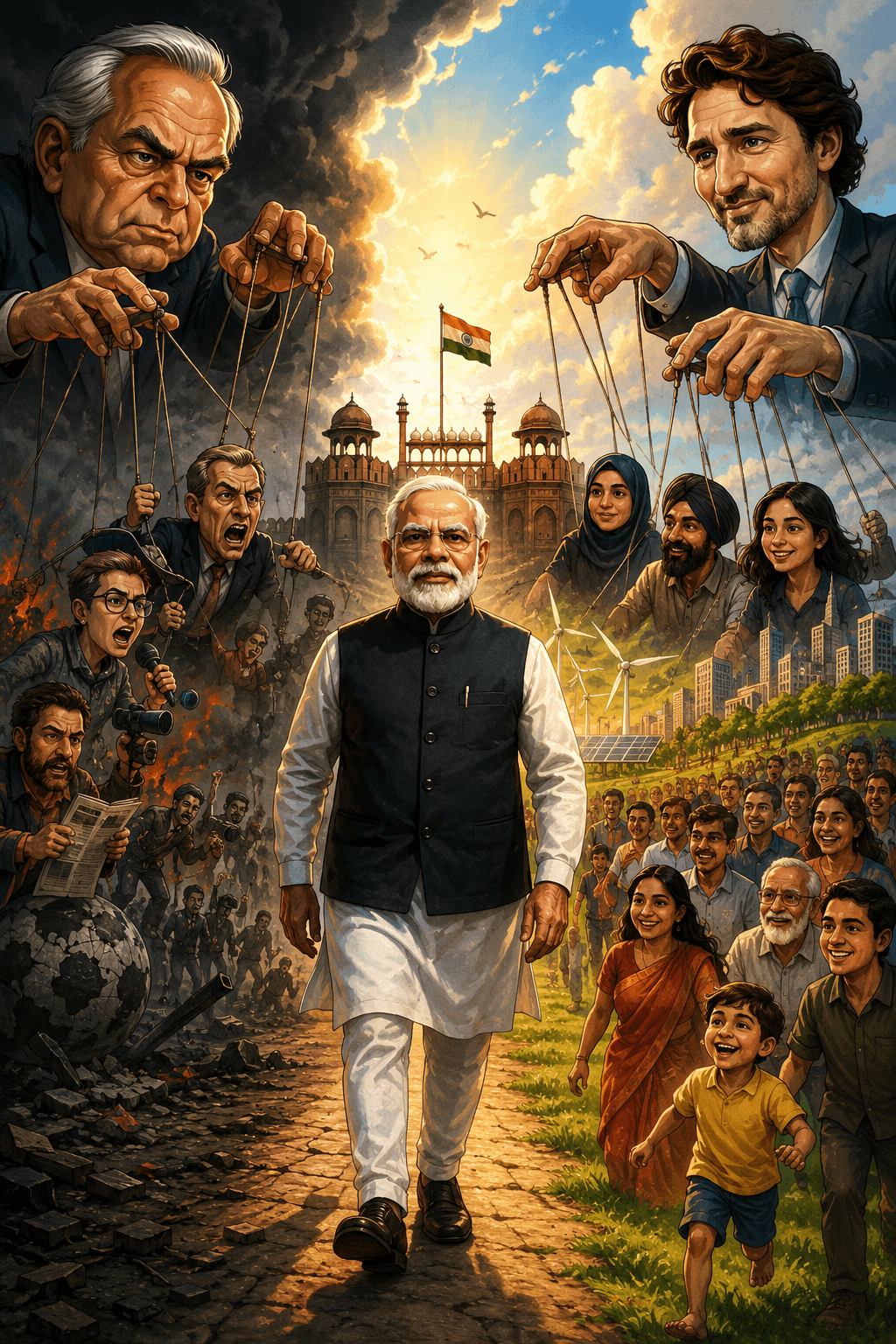
The world is currently witnessing one of the most intense geopolitical contradictions of the 21st century. On one hand, India stands as a towering economic powerhouse—a vital strategic counterweight in the Indo-Pacific, a pioneer of digital public infrastructure, and the self-proclaimed "Mother of Democracy" with the largest voting populace in human history.
On the other hand, a persistent and highly amplified global narrative, largely driven by Western think tanks and media, paints a starkly different picture. Reports from organizations like the V-Dem Institute and Freedom House have recently categorized India as an "electoral autocracy" or a "partly free" state, suggesting severe democratic backsliding.
This dramatic disconnect begs a critical geopolitical question: Is India truly slipping into authoritarianism, or is it the target of a coordinated global narrative designed to frame a rising, independent power as an intolerant state? To understand the reality, we must look past the ideological rhetoric and examine the raw data, the economic stakes, and the complex machinery of modern information warfare.
The Clash of Data: Democratic Backsliding vs. Economic Reality
The foundation of the "intolerant India" narrative stems from annual indices published by Western non-governmental organizations (NGOs). Reports highlight the tightening of legislative frameworks surrounding digital media, the use of anti-terrorism laws, and a decline in press freedom rankings—with Reporters Without Borders (RSF) recently ranking India below several active conflict zones. Domestic opposition leaders frequently echo these concerns, accusing the ruling administration of weaponizing state agencies to stifle dissent.
However, the Indian government and numerous geopolitical analysts argue that these statistics are fundamentally flawed, relying on opaque methodologies, small sample sizes, and an inherent Western bias. They point to contradictory statistics that tell the story of a thriving, highly functional state.
India continues to execute the largest democratic exercises in the world with undisputed electronic voting integrity and massive voter turnouts that dwarf those in Western nations. Furthermore, the country's economic indicators are surging. While established Western democracies grapple with inflation and stagnation, India continues to project robust GDP growth, massive foreign direct investment (FDI), and historic reductions in extreme poverty. For policymakers in New Delhi, the "dictatorship" label is not a reflection of reality, but a failure of Western institutions to comprehend a non-Western democratic model.
The Information War: Media, Celebrities, and Monetized Narratives
To understand how the "intolerant" label gained global traction, one must examine the modern machinery of narrative building. We are living in an era of weaponized information, where public perception is often engineered rather than organically formed.
In this polarized landscape, the role of mass media and celebrity influencers has come under intense scrutiny. It is a well-documented facet of modern political PR that influence can be bought and sold. There are persistent allegations and instances of media houses, social media influencers, and even Bollywood celebrities commodifying their platforms. In exchange for financial incentives, brand deals, or political patronage, high-profile figures frequently amplify specific narratives—whether that involves aggressively defending the state or participating in coordinated, foreign-backed outrage campaigns against it.
When global controversies regarding India erupt, they are often fueled by synchronized celebrity commentary and algorithmic manipulation rather than grassroots reality. This monetized "activism" creates a smokescreen. It allows political actors—both domestic and international—to manufacture consent and project an image of widespread domestic chaos or global condemnation, deliberately obscuring the nuanced, on-the-ground reality of Indian society.
Geopolitical Motivations and the "Global Left"
Why would there be a strategic interest in painting India as an autocracy? Geopolitical experts point to the shifting balance of global power. For decades, the post-WWII international order has been dominated by Western ideologies. As India rises to claim leadership of the Global South—championing a multipolar world and refusing to blindly align with Western foreign policy (such as its neutral stance on the Russia-Ukraine conflict)—friction is inevitable.
Many analysts argue that what is often termed the "Global Left" narrative is, in fact, a geopolitical tool. By continuously questioning India's democratic credentials, Western institutions and human rights organizations maintain a lever of diplomatic pressure. It is a soft-power strategy designed to keep a rising, fiercely independent superpower on the defensive, ensuring it remains morally tethered to Western approval.
Economic and Military Implications
Despite the aggressive narrative warfare, the cold calculus of global economics and military strategy tells a different story. Capital markets prioritize stability, growth, and demographic dividends over NGO rankings.
Economic Impact:
The narrative of an "intolerant India" has entirely failed to deter global capital. Tech giants like Apple, Foxconn, and major semiconductor manufacturers are rapidly shifting their supply chains away from China and heavily into India. Global investors recognize that India offers a stable, business-friendly environment with a rapidly expanding middle class. If India were truly descending into chaotic dictatorship, capital flight would be immediate; instead, the opposite is happening.
Military and Strategic Stakes:
Diplomatically, the West cannot afford to alienate India. The United States and its allies view India as the indispensable anchor of the Quad alliance and the primary counterweight to Chinese hegemony in the Indo-Pacific. Consequently, while Western lawmakers might occasionally issue statements regarding human rights to satisfy domestic constituencies, their defense departments are simultaneously signing multi-billion-dollar deals with New Delhi for advanced weaponry, jet engines, and intelligence sharing. Realpolitik continues to triumph over narrative politics.
What Happens Next: The Strategic Outlook
As India progresses toward the end of the decade, the friction between its on-the-ground reality and its global media portrayal will likely intensify.
For ordinary citizens and global markets, the consequences are complex. A persistent negative narrative could occasionally complicate India's diplomatic maneuvering or create hurdles for its vast diaspora. However, as long as India maintains its economic velocity and internal political stability, the "dictatorship" label will remain a talking point rather than a strategic vulnerability.
Ultimately, the world is witnessing the growing pains of a multipolar system. The battle over India's narrative is not just about domestic Indian politics; it is a proxy war over who gets to define the rules of the global order in the 21st century.