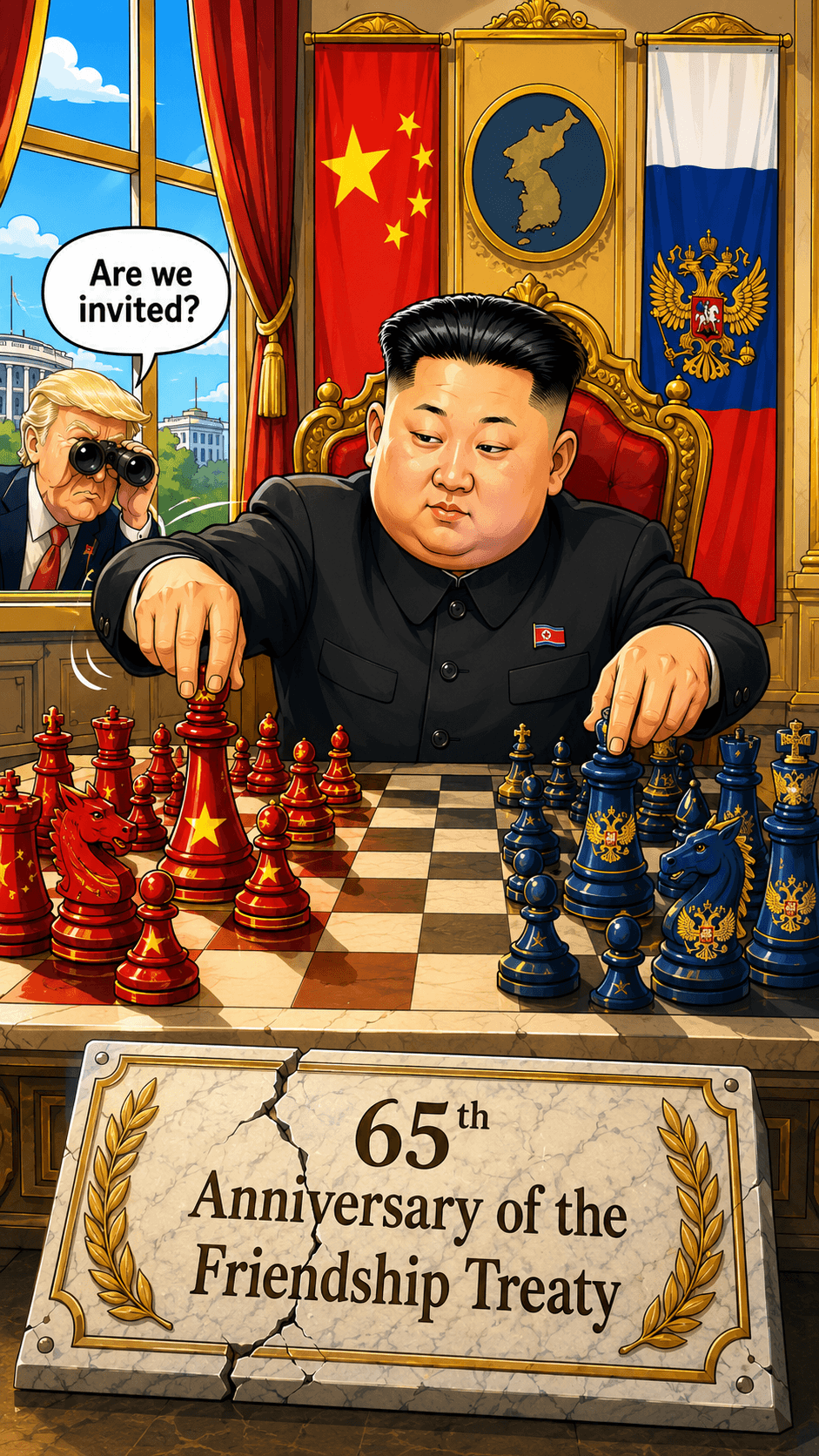
On June 8–9, 2026, Chinese President Xi Jinping made a rare state visit to Pyongyang, North Korea — his first trip to the Hermit Kingdom in years. Framed around the 65th anniversary of the China–North Korea Treaty of Friendship, Cooperation and Mutual Assistance, the summit was laden with symbolism. But beneath the ceremonial pageantry, a far more consequential power shift was underway.
Kim Jong Un didn't just receive his most powerful neighbor. He managed him.
Why Xi Went to Pyongyang
The visit didn't happen in a vacuum. It came just weeks after Xi's three-day summit with Donald Trump in Beijing — a meeting where the Korean Peninsula was reportedly on the agenda. With Washington actively courting Kim (Trump has repeatedly signaled interest in restarting direct US-North Korea diplomacy), Beijing had reason to feel nervous about being sidelined.
Xi went to Pyongyang to reassert China's centrality. He needed to remind Kim that Beijing, not Washington or Moscow, is the indispensable partner.
But Kim had other ideas.
What Kim Got — And What He Didn't Give
The summit produced no mention of denuclearization. None. In the weeks leading up to Xi's arrival, Kim had sent unmistakable signals: North Korean state media reported he had inspected a munitions facility being briefed on expanding ballistic and cruise missile capacity. Days earlier, Kim visited a plant producing weapons-grade nuclear material, declaring Pyongyang's intent to "beef up nuclear forces at an exponential rate."
This was not diplomatic miscommunication. It was deliberate messaging: the nuclear program is not on the table, not even for China.
Beijing entered the summit with modest expectations and left having preserved the relationship — but little more. Xi got symbolic affirmation of alliance. Kim got leverage.
Nikkei Asia analysts raised a more provocative possibility: that Xi may have quietly offered China shipping access to the Sea of Japan through North Korea via the Tumen River — a longstanding Chinese strategic objective. If accurate, Kim extracted a major infrastructural concession simply by showing up.
The Russia Factor
Behind the China-North Korea optics lies a triangular dynamic that explains Kim's confidence. Over the past year, Pyongyang has deepened its military relationship with Moscow — reportedly supplying troops and munitions to Russia's war in Ukraine in exchange for military technology transfers. That relationship gave Kim something he never had before: a second great-power patron willing to offer military goods, not just economic lifelines.
China watched this with unease. Beijing has traditionally maintained its position as North Korea's irreplaceable protector, economic artery, and diplomatic shield. The Russia-North Korea axis disrupts that monopoly.
Kim is now playing both sides — calibrating closeness with Moscow to extract more from Beijing, while using Beijing's discomfort with Washington to avoid pressure on denuclearization. It is a balancing act that a weaker North Korea could never have attempted. The nuclear program, paradoxically, is what makes it possible.
What This Means Globally
For Washington, the summit is a complication. Trump has shown genuine interest in a third summit with Kim — there are reports Kim signaled openness to talks, provided the US abandons denuclearization as a precondition. But Xi's Pyongyang visit makes clear that any US-North Korea diplomatic opening now runs through a triangular negotiation where China expects to be consulted and Russia expects to benefit.
For the broader international order, the Kim-Xi summit reveals a pattern: authoritarian states building redundant partnerships to insulate themselves from any single point of pressure. The sanctions regime that was supposed to strangle North Korea's nuclear ambitions has been systematically hollowed out — not through defiance alone, but through strategic relationship management.
Kim doesn't need to fire a shot. He needs to be needed by everyone simultaneously.
Outlook
The summit is unlikely to produce dramatic near-term shifts. China will continue to provide economic support. North Korea will continue its weapons development. The US will continue weighing whether a deal with Kim is possible without abandoning denuclearization — a goal that, by all evidence, Pyongyang has permanently foreclosed.
What the Pyongyang summit does change is the diplomatic calculus heading into the second half of 2026. Kim Jong Un has demonstrated, once again, that he is not a problem to be solved by external pressure. He is a player — one who just secured a state visit from the world's second-largest economy without giving up a single warhead.
The hermit came out. And he left richer than when he arrived.