The last time Saudi Arabia produced this little oil, Saddam Hussein had just invaded Kuwait, the Cold War was drawing its final breath, and the internet did not exist. That was 1990. Thirty-six years later, the Kingdom of Saudi Arabia is once again watching its most precious resource bleed away — not because of invasion, but because of a 21-mile bottleneck in the Persian Gulf that the world cannot seem to unlock.
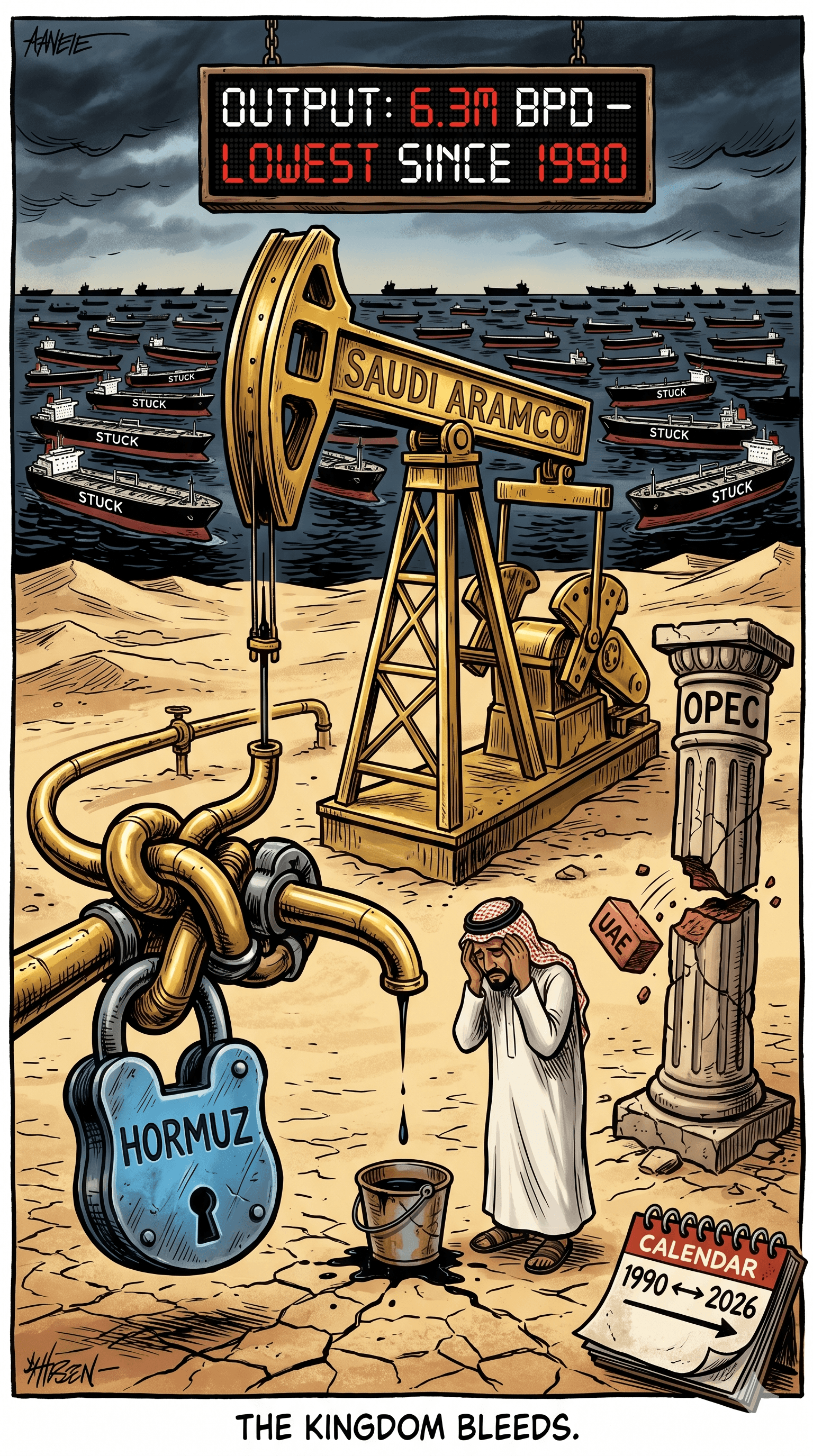
New data submitted by Riyadh to OPEC and obtained by Bloomberg confirms what energy markets have been dreading for weeks. Saudi Arabia's crude oil production collapsed further in April to its lowest level since 1990, as the Iran war choked off exports from the Persian Gulf. Output fell by another 651,000 barrels a day to just 6.316 million barrels a day — a loss of 42% since February, marking the lowest level since the Gulf War 36 years ago, when Iraq invaded Kuwait.
The number is staggering. But it is only the beginning of the story.
A Kingdom Built on Oil — Strangled by One Strait
Saudi Arabia is not merely an oil producer. It is an oil state — a nation whose entire social contract, government budget, foreign policy, and global influence rests on its ability to extract, export, and profit from crude. The Vision 2030 diversification programme was supposed to change that dependency. It has not changed it fast enough.
Since the start of the Iran war in late February, total OPEC production has fallen by 9.7 million barrels a day — a drop of more than 30%. April's output decline of 1.7 million barrels a day came on top of the 7.9 million barrel-a-day collapse recorded in March. Saudi Arabia was not alone in its pain — but it bled the most.
Iraq cut production threefold to 1.389 million barrels per day, while Kuwait's output collapsed more than four times to just 600,000 barrels per day. The entire Gulf oil complex — the engine of the global energy economy — has been reduced to a fraction of its former output.
The culprit is singular and unambiguous: the Strait of Hormuz.
The Bottleneck That Broke the Market
The 2026 Hormuz crisis has been described as the largest disruption to the energy supply since the 1970s oil crises — and as the largest in the history of the global oil market. The numbers bear this out in brutal detail.
Saudi Aramco CEO Amin Nasser told investors the disruption to shipping has caused the biggest energy supply shock ever recorded. The strain on global supplies "intensifies with each passing day," he warned. More than 600 ships — mostly oil and product tankers — are currently stuck in the Gulf, while around 240 ships are waiting outside Hormuz. The tanker fleet is "mixed up," with vessels stranded in the wrong places.
The International Energy Agency, in its monthly report, put the total supply shortfall from Gulf producers at over one billion barrels, with the Hormuz closure responsible for knocking more than 14 million barrels a day offline. Oil stockpiles have been shrinking by 250 million barrels across March and April — a rate of 4 million barrels a day, the fastest drawdown ever recorded.
The IEA's forecast carries a dark warning: it projects a 420,000-barrel-a-day contraction in global oil demand this year — a drop that would be the sharpest since the Covid pandemic year of 2020. When even demand is collapsing under the weight of the supply shock, the economic feedback loops become very difficult to stop.
Saudi Arabia's Lifeline: The Pipeline That Bypasses Hormuz
Riyadh has not been entirely without options. Saudi Arabia operates an east-west pipeline network — known as the Petroline — that connects its Gulf coast oil fields to Red Sea export terminals at Yanbu, entirely bypassing the Strait of Hormuz.
Aramco has ramped up the pipeline's capacity to 7 million barrels per day in response to the crisis. It is a genuine lifeline — but a limited one. The pipeline can only carry so much, and Saudi Arabia's full production capacity far exceeds what the Petroline alone can export. The gap between what the Kingdom can produce and what it can actually sell is costing Riyadh billions of dollars every week.
Saudi Arabia has partially mitigated the impact of the closure by rerouting some exports through its east-west pipeline network — but the partial mitigation cannot close the gap left by 42% of production that has effectively gone offline.
If Hormuz Stays Closed: A Warning for 2027
The Aramco CEO was unusually direct about what comes next if the stalemate persists. The oil market will not normalize until 2027 if the disruption in the Strait of Hormuz persists past the middle of June. "If the Strait of Hormuz opens today, it will still take months for the market to rebalance, and if its opening is delayed by a few more weeks, then normalization will last into 2027," Nasser said. The market will lose 100 million barrels of supply every week Hormuz is closed — and the total net loss so far already stands at 880 million barrels.
Oil inventories are rapidly drawing down, particularly for products like gasoline and jet fuel. "This may reach critically low levels ahead of the summer driving and travel season," Nasser warned.
For ordinary consumers — from Mumbai to Manchester, São Paulo to Seoul — that warning translates into one thing: higher prices at the pump, higher costs for flights, and higher inflation in everything that moves by truck, ship, or plane.
The Bigger Picture: OPEC's Perfect Storm
The production collapse comes at the worst possible moment for an organisation already in crisis. The report comes amid a historic development inside OPEC itself, as the UAE officially announced it would leave the organisation starting May 2026, following prolonged disputes with Saudi Arabia over production quotas. Analysts say the UAE's departure represents one of the most serious blows to OPEC unity since the organisation's founding
OPEC has revised its 2026 global oil demand growth estimate down to 1.17 million barrels a day from 1.38 million barrels a day — a significant downward revision that reflects the economic damage radiating outward from the Gulf.
The cartel that once moved markets with a single communiqué is now struggling to manage a crisis it did not create and cannot control. Saudi Arabia — historically the stabilising force, the swing producer, the world's oil policeman — finds itself producing less crude than at any point since the Gulf War, its revenues gutted, its tankers stranded, and its most powerful institutional alliance fracturing in real time.
The Kingdom built its future on oil. Right now, a 21-mile strait is deciding how much of that future remains.