There is a particular kind of viral moment that tells you everything about modern media and nothing about the truth. It arrives pre-packaged — a short clip, a dramatic gesture, a headline that writes itself. It spreads before context has had time to put its shoes on. And by the time the full picture emerges, the narrative has already moved in, hung its curtains, and made itself at home.
The Oslo moment involving Prime Minister Narendra Modi on May 18, 2026 was one such moment.
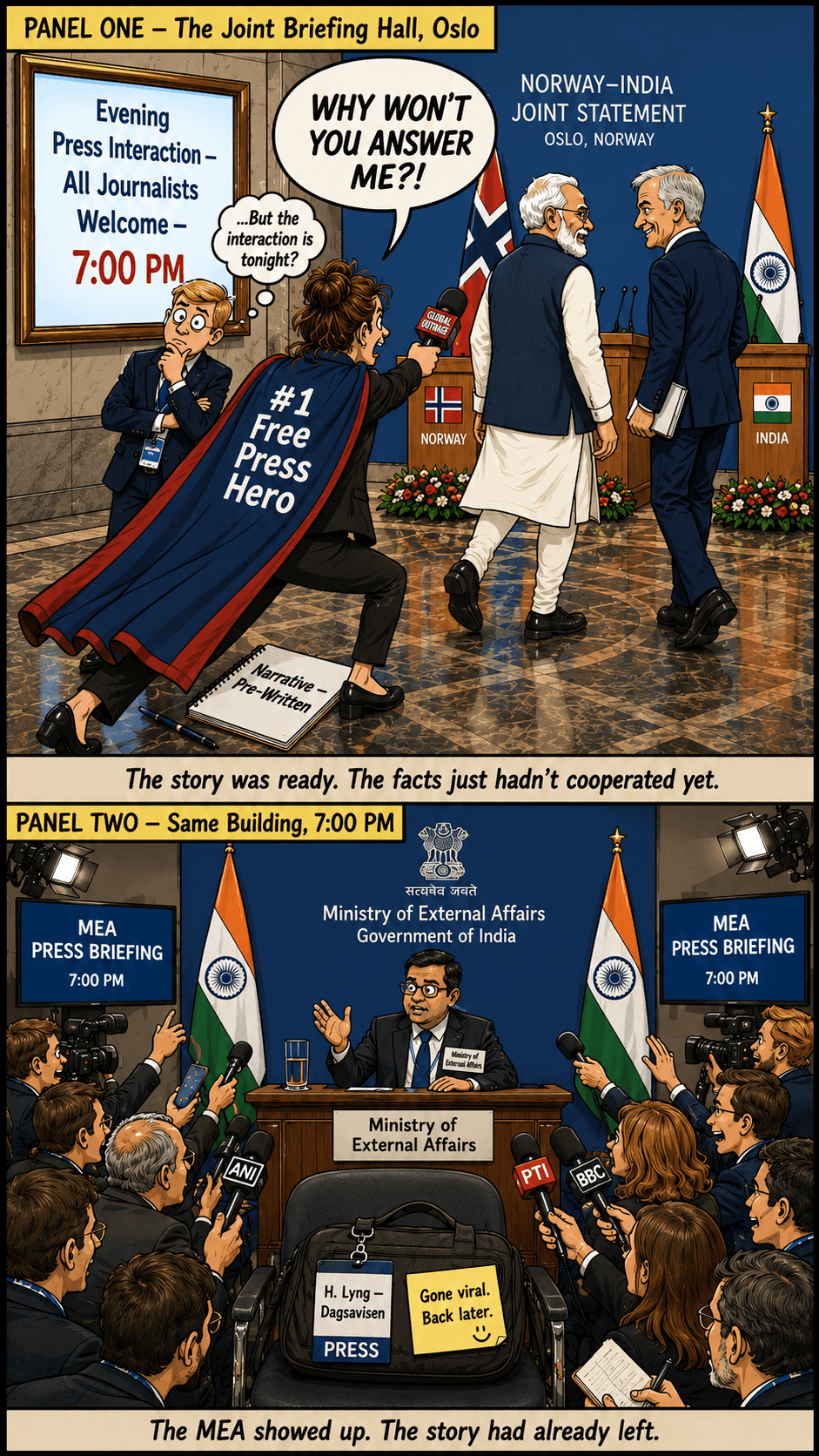
You have seen the clip. Modi concludes a joint briefing with Norwegian Prime Minister Jonas Gahr Støre, turns to leave, and a journalist — Helle Lyng of Oslo's Dagsavisen — calls across the room: "Prime Minister Modi, why don't you take some questions from the freest press in the world?" He does not respond. The door closes. The clip goes viral. Norway is ranked #1 on the World Press Freedom Index. India is ranked #157. The internet does the math, draws the conclusion, and moves on.
Except the math was missing a variable. A rather important one.
What the Clip Did Not Show
The event in question was a joint briefing — a standard diplomatic format used by virtually every government on the planet, including Norway's. Joint briefings are not press conferences. They are not open question sessions. They are structured diplomatic communications where leaders make coordinated statements on bilateral matters. No leader — not the American President, not the British Prime Minister, not the German Chancellor — is expected to field open journalist questions at a joint briefing exit. It is not the format. It never was.
More critically, what the viral clip did not show — what most of the breathless coverage chose not to mention — was that a separate media interaction had been scheduled for the evening, where journalists including Lyng had the opportunity to ask questions directly. The access was there. The platform existed. The moment had simply been chosen elsewhere, at a different time, in the correct format.
Lyng's dramatic call-out across the room was not a journalist fighting for access. It was a journalist who already had access, choosing instead to create a moment.
The Architecture of a False Narrative
This distinction matters enormously, and its erasure was not accidental.
The clip was shared with the framing that Modi had fled accountability in the world's freest press nation. Rahul Gandhi amplified it. International outlets picked it up. The Press Freedom Index rankings were cited as moral verdict. Within hours, a diplomatic visit focused on energy cooperation, green investment, and 43 years of renewed bilateral engagement had been reduced to a single door creak.
Consider what was actually happening during that visit. India and Norway were discussing substantive partnership on offshore energy, sovereign wealth fund investment, and Arctic cooperation frameworks — issues of genuine long-term consequence for both nations. The Norwegian PM himself engaged warmly and constructively throughout. The visit, by any diplomatic measure, was productive.
None of that travelled. The door did.
The Press Freedom Index Is Not a Courtroom
The repeated citation of India's #157 ranking on the RSF World Press Freedom Index deserves scrutiny too. The index is a useful advocacy tool, but it is not an objective measurement. It relies heavily on journalist surveys, legal framework assessments, and RSF's own methodology — which has been critiqued across the political spectrum for inconsistent weighting and regional bias.
India has thousands of newspapers, hundreds of television channels, and one of the most raucous, combative, multilingual media environments on earth. Opposition voices, investigative journalists, and regional press operate daily. The picture is genuinely complex. Reducing it to a number and using that number to morally condemn a leader for not answering a shouted question at a joint briefing exit is not analysis. It is arithmetic deployed as rhetoric.
What Accountability Actually Looks Like
Real press freedom advocacy is important work. Journalists facing genuine suppression — legal harassment, physical danger, loss of accreditation — deserve serious attention and solidarity. That work is undermined, not supported, when a pre-scheduled media interaction gets ignored in favour of a more cinematically satisfying corridor confrontation.
Lyng had her evening. The questions could have been asked. The answers could have been reported. Instead, the clip exists, the narrative exists, and the evening interaction sits quietly in the part of the story nobody shared.
The story was ready before Oslo.
The ranking was queued. The contrast was loaded. All it needed was a door to close at the right moment. It did. And the truth, as usual, arrived just slightly too late to matter. Because in 2026, the first draft of history isn't written by journalists. It's written by whoever posts the clip first.