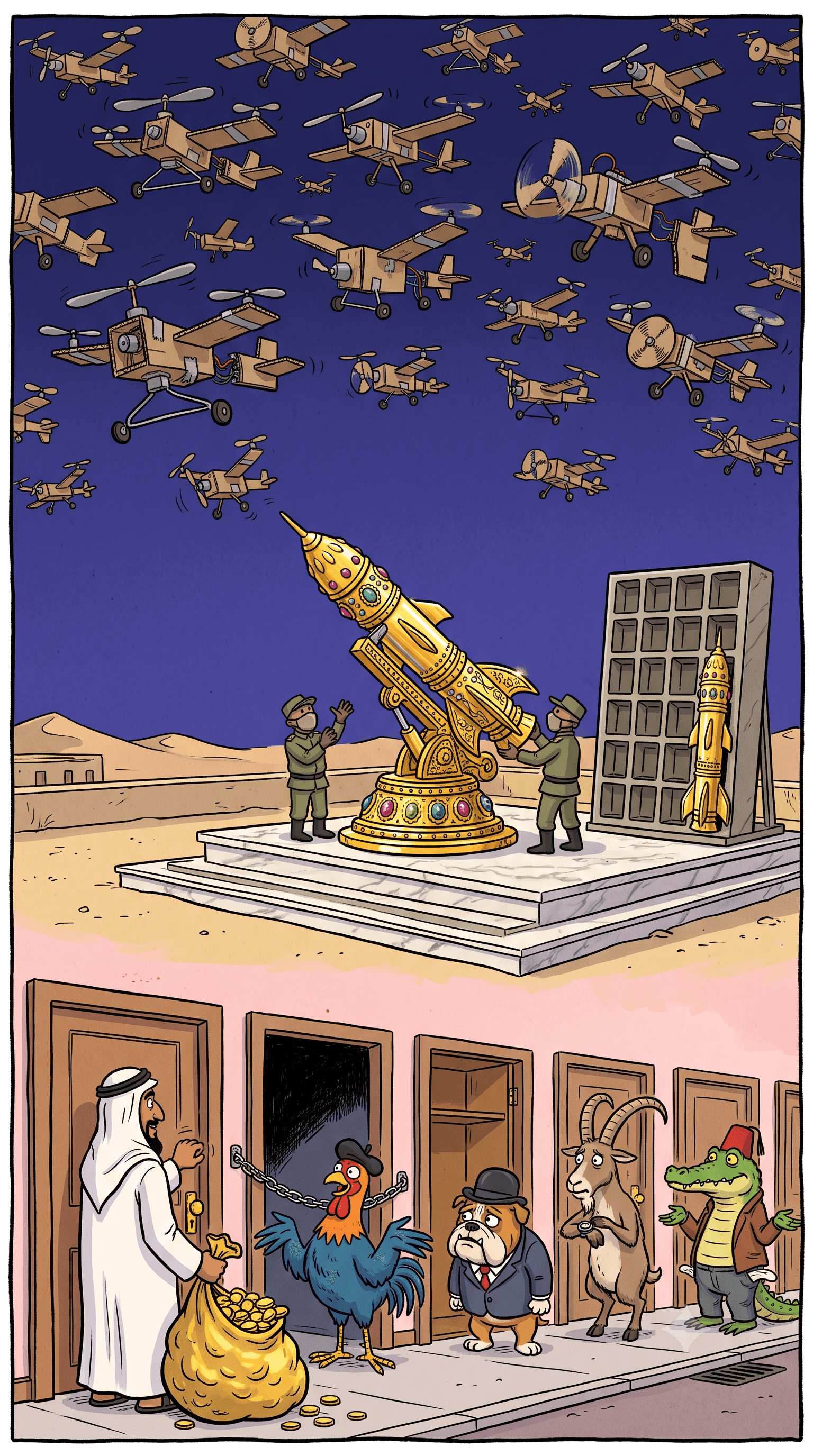
Saudi Arabia is not short of money. It is short of a component made in one building in Alabama.
On 17 September 2026, two regional officials told the Associated Press that Saudi Arabia has asked France, Britain, Pakistan and Egypt for air-defence assistance, because the kingdom is running low on missile interceptors. Both officials spoke on condition of anonymity, not being authorised to brief the media. Saudi officials declined to comment.
The obvious question is why the best-funded air force in the Gulf is canvassing four governments rather than simply placing an order. The answer has almost nothing to do with Saudi Arabia and almost everything to do with how interceptors are made.
The trade is losing on every exchange
Start with the arithmetic that governs modern air defence.
A one-way attack drone of the Shahed class is a lawnmower engine, a warhead and a guidance package. It is built in quantity, by hand, for a price measured in tens of thousands of dollars. The interceptor sent to meet it is a precision missile with an active radar seeker, priced in the millions.
Intercepting works. That is not in doubt — the kingdom says it stopped the drone aimed at Mecca on 16 September, and Saudi air defences have intercepted a great many others. But each success spends a scarce, slow-to-build round to destroy a cheap, fast-to-build one. Win every engagement and you still empty the rack.
This is the reason air-defence campaigns are decided by inventory rather than by hit rate. The relevant number is not how many you stopped. It is how many you have left, and how quickly the next one arrives.
How quickly the next one arrives: not quickly
Lockheed Martin delivered 620 PAC-3 interceptors in 2025. Across the entire allied network, that is roughly 1.7 missiles per day.
Set that against consumption. During the first four days of the war with Iran, coalition forces are estimated to have expended Patriot rounds at around 225 per day. Against 1.7 a day of production, that is a consumption-to-production ratio of roughly 132 to 1.
No inventory survives that ratio for long, and Saudi Arabia has now been drawing on its stocks through a sustained Houthi campaign on top of it.
Why you cannot simply build more
The bottleneck is not assembly lines in general. It is two specific chokepoints.
Seekers. Boeing manufactures every PAC-3 active radar seeker at a single facility in Huntsville, Alabama, and delivered somewhere around 650 to 700 of them in 2025. The Pentagon signed a framework in April 2026 to triple that capacity. Tripling a specialised electronics line is not a matter of a second shift.
Solid rocket motors. L3Harris's Aerojet Rocketdyne supplies motors across multiple programmes, and the Pentagon has put roughly $1 billion into the firm while acknowledging its position as a single-source supplier is a unique vulnerability.
Then there are the lead times, which are the part that makes this irreversible in the short run. Missile assembly runs about 24 months from order to delivery. Solid rocket motors run about 30 months, and are therefore the binding constraint. Rounds funded under the emergency contract signed in April 2026 will probably not arrive before mid-2028.
A framework agreement in January 2026 aims to lift PAC-3 MSE output from 600 a year to 2,000 a year by 2030. That is a genuine and substantial expansion. It is also four years away.
The queue is already full
Here is the part that closes off the obvious solution.
The combined order backlog from more than a dozen allied states — Saudi Arabia among them, alongside Germany and Poland — stands at over 4,300 Patriot rounds. At 2025 production rates that is roughly seven years of global output, already spoken for.
Foreign Military Sales accounted for 94 percent of the funding in the April 2026 contract. Allies are not waiting to place orders. They placed them, and they are in line.
And the supplier of last resort has its own problem: the United States, Saudi Arabia's principal arms source, has drawn down its own interceptor stocks across six months of war with Iran. Washington is not sitting on a reserve it can release.
Which is why four doors, not one
Seen against that, the approach to France, Britain, Pakistan and Egypt stops looking like diplomacy and starts looking like procurement of last resort.
It is also why the request is awkward in a way a simple purchase would not be. These four do not operate a common system. Asking several countries with different radars, different command-and-control and different missiles to contribute to one air picture is not the same as buying more of what you already field. Mixed inventories do not simply add together; they have to be made to talk to one another, and that is measured in months of integration work, not in signatures.
The United States, meanwhile, is keeping a deliberate distance. Vice President JD Vance has said the administration is in "constant contact" with the Saudis and has "engaged in direct conversations with the Houthis," while Central Command has stood up a task force for intelligence sharing and planning support. Intelligence and planning are things Washington can supply immediately. Interceptors are not.
What to watch
Three things will tell you whether this becomes an arrangement or stays a request.
Whether any of the four actually transfers hardware rather than offering training, radar data or a liaison cell — the cheap forms of help that cost no inventory.
Whether the kingdom shifts spending toward cheaper counter-drone layers: guns, electronic warfare, interceptor drones. These are the only responses that fix the cost ratio rather than absorbing it, and the shift, if it comes, will show up in procurement notices before it shows up in statements.
And whether anyone, publicly, puts a number on Saudi interceptor stocks. Nobody has. The shortage is sourced to two anonymous officials and a declined comment, and until that changes, its depth is an inference rather than a fact.