The Week Xi Jinping Held All the Cards
In the span of six days in May 2026, Beijing hosted two of the world's most powerful leaders — first the President of the United States, then the President of Russia. The sequence was not accidental. The scheduling was not diplomatic housekeeping. It was, by any measure, the most consequential week of Chinese foreign policy in recent memory — and possibly a preview of how Beijing intends to navigate the next decade of great power competition.
The Trump-Xi Summit: Grand Theatre, Thin Substance
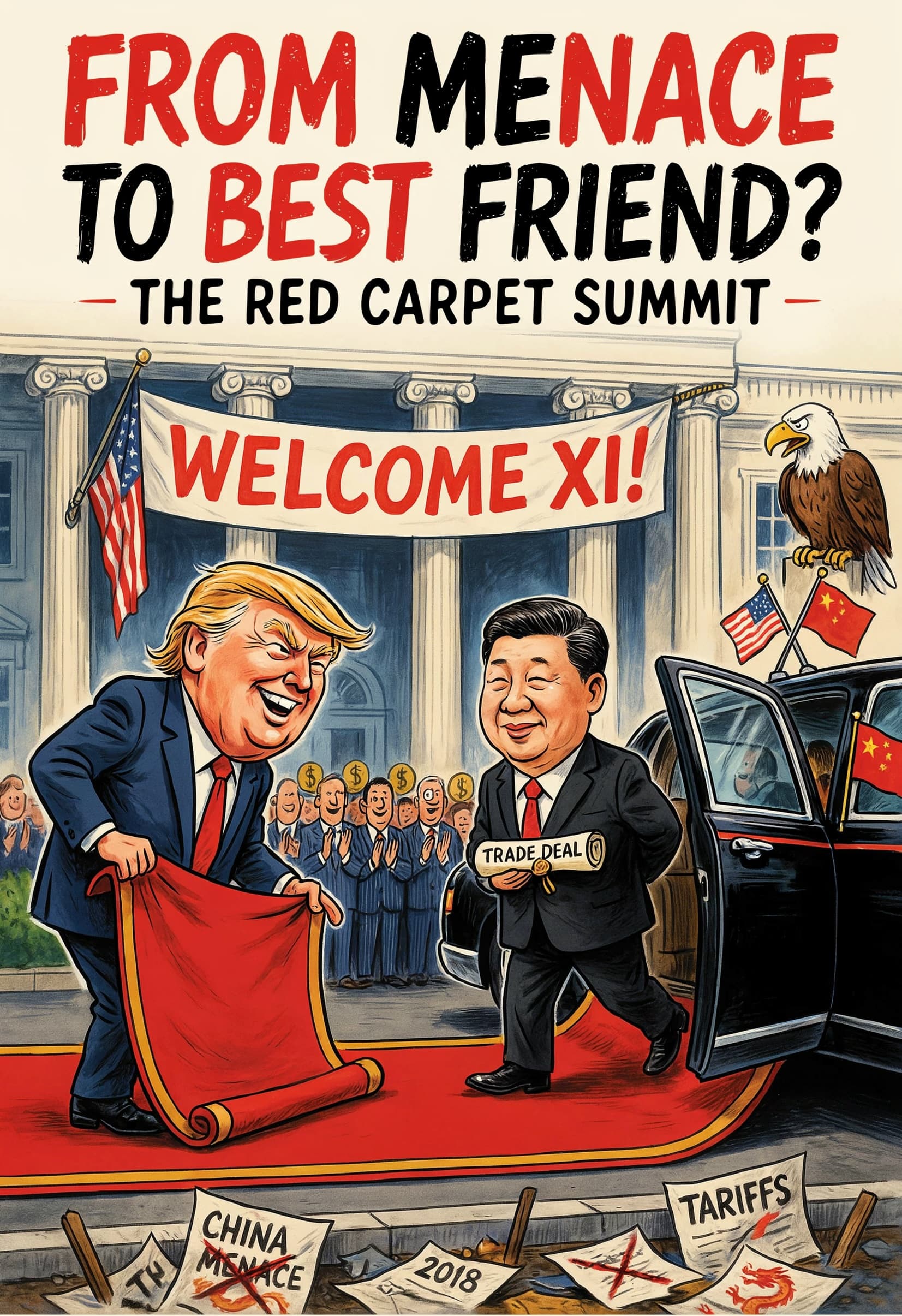
On May 14–15, US President Donald Trump arrived in Beijing for a long-anticipated bilateral summit with Chinese President Xi Jinping. The reception was lavish. The optics were carefully choreographed. China extended diplomatic courtesies that signalled genuine interest in de-escalation — and Trump, for his part, appeared to welcome the warmth.
But judged by concrete outcomes, the summit produced little. The two sides agreed on the broad framing of "constructive strategic stability" — a phrase that commits neither country to anything specific — and Trump made rhetorical concessions on Taiwan that Beijing interpreted as meaningful but Washington's own officials quickly sought to walk back. No major trade framework was signed. No binding commitments on technology restrictions or tariffs emerged.
For Beijing, however, the optics were enough — and perhaps even the point. Xi had given Trump a moment of prestige on Chinese soil. In doing so, China had temporarily lowered the temperature of a rivalry that, in 2025, had nearly tipped into financial warfare.
Putin Arrives — and the Timing Speaks
Less than a week later, on May 20, Russian President Vladimir Putin landed in Beijing for a state visit. The date was not chosen carelessly. In Mandarin, "5-2-0" is a homophone for "I love you" — a widely understood cultural signal that Beijing, with its acute attention to diplomatic symbolism, deployed with deliberate precision.
The message was multilayered: after receiving the American president, China turned immediately to its closest strategic partner. The sequencing told a story that no joint communiqué could have conveyed as clearly — that Beijing's engagement with Washington does not come at the expense of its partnership with Moscow.
The summit itself produced 40 agreements spanning trade, education, nuclear energy, and technology cooperation. But the headline deal that Moscow had been pushing for — a major new natural gas pipeline connecting Siberian fields to Chinese industrial centres — remained unsigned. For all the warmth, China continues to manage its relationship with Russia with one eye on Western sanctions risk and one eye on long-term leverage.
Both leaders used the occasion to criticise the United States' proposed "Golden Dome" missile defence architecture and lamented the expiration of the New START arms control treaty. They framed their partnership as a stabilising force against what they characterised as Western-led disorder.
The Uncomfortable Arithmetic for Washington
The week laid bare an uncomfortable reality for US foreign policy: the idea that America can simultaneously stabilise relations with China and isolate Russia is, at best, optimistic — and may be structurally impossible.
Beijing has spent the past four years constructing a foreign policy that does not force it to choose. It engages Washington when engagement serves its interests. It deepens Moscow ties when strategic convergence is useful. It courts the Global South through trade, infrastructure, and rhetoric about multipolarity. And it does all of this while running a domestic economy that remains deeply integrated with the very Western markets it is strategically challenging.
The Trump-Xi summit gave Beijing a moment of diplomatic normalcy. The Putin-Xi summit gave Beijing a moment of strategic solidarity. Together, they gave Xi Jinping something rarer: the position of the indispensable interlocutor — the leader that every other major power feels it must engage.
What Comes Next
The Strait of Hormuz remains effectively closed. The US-Iran ceasefire is fragile. Oil prices are elevated. European economies are contracting. NATO's eastern flank remains under pressure. In each of these crises, China occupies a unique position — neither fully inside the conflict nor fully outside it.
Beijing has no intention of mediating its way to a resolution that strengthens Washington's hand. But it also has no interest in a world so destabilised that its own supply chains, export markets, and Belt and Road investments suffer. China is playing for time, for position, and for optionality.