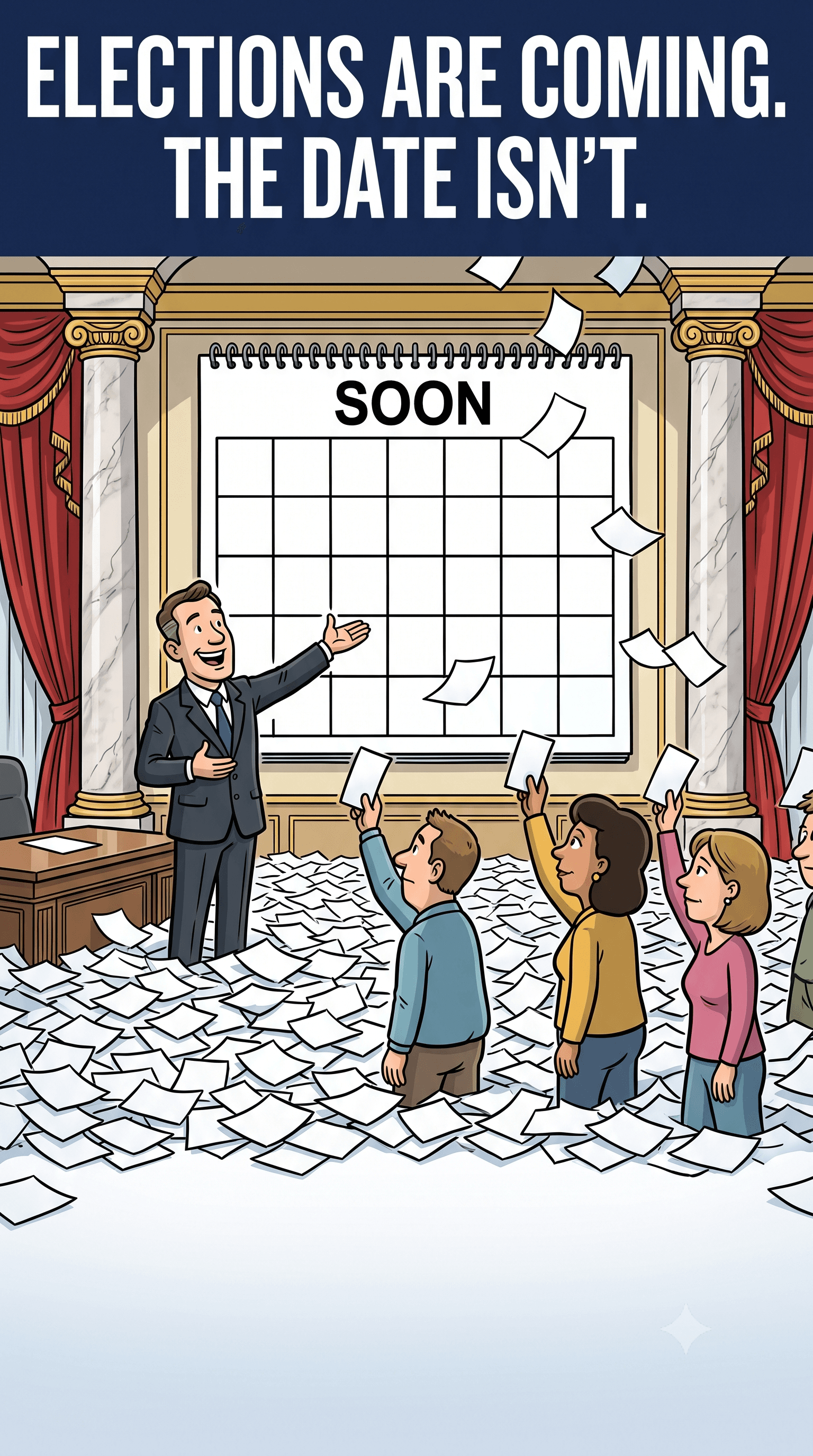
Standfirst: Venezuela's constitution says a presidential vacancy triggers elections within 30 days. A court decided there wasn't a vacancy — there was an absence. Nine months later, there is still no date.
On 23 September 2026, Delcy Rodríguez addressed the UN General Assembly as Venezuela's interim president. She said three things about elections, and it is worth taking them in order.
"En Venezuela habrá elecciones." There will be elections in Venezuela.
"El pueblo venezolano, con su sabiduría ancestral, determinará el momento correcto." The Venezuelan people, with their ancestral wisdom, will determine the correct moment.
And then: "La democracia no se mide por la existencia de elecciones." Democracy is not measured by the existence of elections.
No month was given. No year was given. In Caracas, opposition groups protested. María Corina Machado, the opposition leader, has been blocked from entering the country three times.
But the interesting part of this story is not the speech. It is what happened nine months earlier, and it turns on the choice of a single word.
The thirty-day clock
Venezuela's constitution is not vague about this. A permanent absence — a vacancy in the presidency — obliges the state to hold a new election within thirty days. That is the mechanism. It is short, it is specific, and it is the sort of provision constitutions include precisely because the moment after a leader is removed is the moment when nobody wants to hold an election.
In early January 2026, Nicolás Maduro was ousted. On the ordinary reading, that is a vacancy. Thirty days. Clock starts.
The Supreme Tribunal instead classified the situation as a "forced absence" rather than a vacancy.
That is the whole story. "Vacancy" starts the clock. "Absence" does not. One is a permanent condition requiring a successor chosen by voters; the other is a temporary condition requiring somebody to mind the shop. A court chose the second word, and the thirty days never began.
Under that classification, Rodríguez took office as interim president with a 90-day term.
That term expired on 5 April
This is the detail that does the most work, and it is a date rather than an opinion.
Ninety days from early January runs out on 5 April 2026. There is no documented parliamentary debate extending it.
As of the UN address, she had been in office for roughly nine months — about three times the length of the mandate the court gave her — and was telling the General Assembly that the timing of elections would be determined by the people's ancestral wisdom.
It is a magnificent sentence. It is also, structurally, a way of saying that the decision belongs to nobody in particular, which means it belongs to whoever is currently holding the office.
Why "democracy is not measured by the existence of elections" is the giveaway
The third quotation is the one to sit with, because taken literally it is not even wrong.
Elections alone genuinely do not make a democracy. Plenty of states hold them on schedule and remain authoritarian; the vote is a necessary condition, not a sufficient one. Any political scientist would agree.
But notice when the observation was deployed. It was made by someone who has not held an election, in answer to the question of when she will. In that position, the true statement "elections are not sufficient for democracy" is doing the work of the false statement "elections are not necessary for democracy."
This is a reliable tell, and it is not confined to Venezuela. When a government starts explaining that democracy is a richer concept than merely counting ballots, it is usually not about to count any.
The pattern this fits
Interim governments are supposed to be short. The word means what it says. In practice, the distinguishing feature of a transitional authority is that the transition is defined by the people running it, and the incentive runs one way.
The things to look for are always the same three, and they are all visible here.
A legal reclassification that stops a clock. Not a refusal to hold elections — nobody refuses. A technical finding that the provision requiring them doesn't apply yet.
A mandate that lapses without anyone marking it. The 90 days ended in April. No announcement, no extension debate, no new legal basis. The office simply continued.
And the substitution of a condition for a date. "The right moment" is not a delay, because a delay implies a schedule. It is the removal of the schedule, phrased as respect for the public.
None of this predicts that elections won't happen. It describes what you are looking at while you wait.
What the case for the government is
It should be stated, because it is not nothing.
A country that has just removed a long-serving leader is genuinely unstable, and rushing to a vote inside thirty days with damaged institutions, a fractured opposition and an economy in difficulty is a real argument, made in good faith by serious people in many countries. Elections held too early have produced disasters before.
The problem is not that the argument is absurd. It is that it is unfalsifiable. There is no condition attached to it — no benchmark, no register, no institution to be rebuilt by a stated date — which means there is no point at which anyone could say the argument has been satisfied. An argument that cannot be met is not a reason for delay. It is a description of the delay.
What to watch
Any date. Any date at all. Not a month, not a season — a date. The single most informative thing that could happen next is the naming of one, and the second most informative is another six months without one.
Whether Machado is allowed to enter. She has been blocked three times. Election preparation that excludes the principal opposition figure from the territory is not election preparation.
Whether the National Assembly ever debates the expired mandate. A parliament that does not ask about a lapsed 90-day term has answered a different question about itself.
And whether anyone in the region presses for a date. Neighbouring states have more leverage here than the Security Council does, and their silence or otherwise will tell you how this is expected to end.
Sourcing note: Rodríguez's three quotations, the date of the address and the absence of any named election date are from reporting on her 23 September 2026 UN General Assembly speech. The constitutional 30-day requirement following a permanent presidential vacancy, the Supreme Tribunal's classification of Maduro's removal as a "forced absence" rather than a vacancy, the resulting 90-day interim term and its expiry on 5 April 2026 with no documented parliamentary extension are as reported; this piece has not examined the tribunal's ruling directly and readers should treat the legal characterisation as reported rather than verified from primary documents. The Caracas protests and the three occasions on which María Corina Machado was blocked from entering Venezuela are from same-week reporting. The analysis of what the third quotation is doing is argument, not sourced fact, and is offered as such.