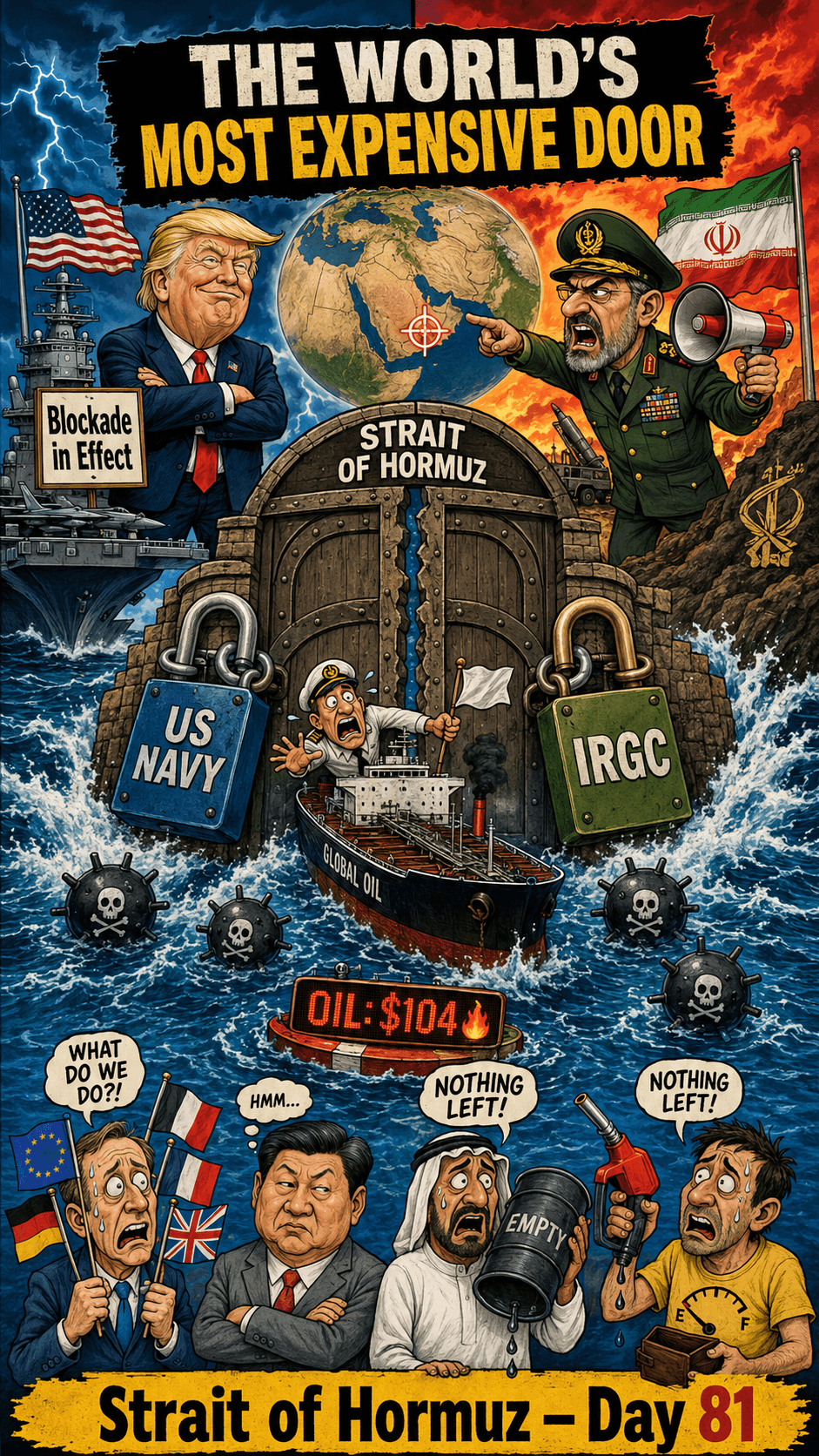
Imagine a stretch of water so narrow you could almost shout across it — roughly 33 kilometres at its tightest point. Now imagine that tiny corridor carries 20% of the world's oil, 20% of its liquefied natural gas, and the economic heartbeat of dozens of nations. Welcome to the Strait of Hormuz: the world's most valuable, most argued-over, and now most dangerous strip of sea.
In 2026, the Strait of Hormuz stopped being a trade route and became a geopolitical weapon. What was once a busy maritime highway — with nearly 3,000 vessels passing through monthly — has been reduced to a ghost lane, operating at roughly 5% of its normal traffic. Tankers sit idle. Oil prices have surged past $100 per barrel. And two of the world's most powerful militaries are essentially staring each other down across a 33-kilometre gap.
How Did We Get Here?
The crisis began on 28 February 2026, when the United States and Israel launched a series of coordinated air strikes against Iran, targeting its nuclear programme and ballistic missile infrastructure. Iran's Supreme Leader, Ali Khamenei, was killed in the strikes — a moment that sent shockwaves across the entire Middle East and beyond.
Iran's response was swift and severe. The Iranian Revolutionary Guard Corps issued warnings forbidding passage through the Strait of Hormuz, began boarding and attacking merchant vessels, and laid sea mines across the navigable channels. Major shipping companies — including Maersk, CMA CGM, and Hapag-Lloyd — suspended all operations through the strait almost immediately.
By mid-March, US President Donald Trump was claiming Iran's military had been "destroyed" and that the strait was open. It wasn't. By late March, he was threatening to destroy Iranian infrastructure entirely. By April 8, a temporary ceasefire had been agreed — one that was supposed to include reopening the strait. Instead, Iran began charging tolls of over one million dollars per ship to pass through.
On April 13, the United States launched a counter-blockade of Iranian ports, creating what observers have called a "dual blockade" — Iran blockading the Gulf, the US blockading Iran. The Strait of Hormuz had officially become a two-way chokepoint.
The Human Cost Behind the Headlines
It is easy to talk about percentages and barrels and naval manoeuvres. It is harder to sit with what those numbers actually mean.
When the Strait of Hormuz is effectively closed, energy prices spike globally. Petrol prices rise in Mumbai, Jakarta, Nairobi, and São Paulo. Electricity bills climb in homes that had nothing to do with this conflict. Factories slow down. Inflation bites harder into already strained household budgets. The people who suffer most are rarely the ones making the decisions that caused the suffering.
Several Arab states — including the UAE — were forced to cut or suspend oil production entirely after Iranian drone and missile attacks on their territory. Schools and universities across the Persian Gulf shifted to online learning when the war broke out. Cargo ships sat ablaze off the coast of Oman. Cruise passengers reported rockets splashing nearby in international waters.
This is not an abstract geopolitical chess match. It is a crisis with a very real human address.
The Diplomacy of Delay
Throughout April and May, Pakistan stepped in as a mediator, hosting talks between US and Iranian representatives in Islamabad. Those talks failed. Trump paused the US military's effort to guide stranded vessels through the strait, citing "great progress" toward a deal — progress that the White House declined to elaborate on further.
China and Russia vetoed a United Nations Security Council resolution calling for an end to Iranian attacks on shipping. China, which depends heavily on energy flowing through the strait, simultaneously called for "freedom of navigation" to be guaranteed — a position that managed to be both reasonable and deeply convenient.
The UK and France hosted separate conferences on reopening the strait, gathering 38 countries willing to sign a statement calling for safe passage. The strait remained closed.
Meanwhile, more than 100 US military aircraft were reported patrolling the skies above the strait. US Navy destroyers entered its waters for the first time since the war began, conducting what they described as mine clearance operations. Iran accused them of violating the ceasefire.
At every turn, escalation has outpaced resolution.
The Cartoon in All of This
There is something almost absurdly theatrical about the world's most powerful nations holding the global economy hostage over a strip of water that — on a map — looks like a footnote. It would be funny, if the consequences were not so serious.
The Strait of Hormuz crisis of 2026 is a masterclass in how geopolitical ego, energy dependency, and military miscalculation can combine to produce a situation where nobody wins, everybody loses, and the world watches with a mixture of horror and disbelief.
The padlocks are real. The gas cans are empty. And the people holding the keys are too busy arguing to notice.
What Happens Next?
Negotiations continue. The ceasefire — extended multiple times — remains fragile. Oil markets are volatile. European nations are scrambling to diversify energy supplies, while tanker traffic around the Cape of Good Hope has surged to record levels as ships avoid the Persian Gulf entirely.
One thing is clear: the Strait of Hormuz has moved from being a geographic fact to a geopolitical symbol. Whoever controls it — or whoever reopens it — will have made a defining statement about the balance of power in the post-2025 world order.
The world is watching. And waiting.