WHAT HAPPENED
On 20 October 2026, a polling firm called Wedgewood Polls issued a statement describing itself as a "fictional entity" that had published "fabricated numbers." Then it deleted its website and its social media accounts.
It had published more than a dozen surveys. It had been exposed by FiftyPlusOne, a data-journalism outlet, which put the allegations to the firm shortly before it confessed.
Wedgewood called the whole thing an experiment meant to expose weak oversight of public polling. Two things make that defence hard to accept: it had lied to news outlets about its methods, and it appears to have charged clients for surveys. An experiment in transparency does not usually invoice.
Two days later, on 22 October, FiftyPlusOne reported that a third firm, SoCal Strategies, may also have manipulated data. Another firm, Median Strategies, had already admitted fabricating survey data earlier this year.
WHY NOBODY CAUGHT IT — AND THIS IS THE REAL STORY
The obvious headline is that a fake poll wrecked a campaign. The truth is stranger and worse.
On 29 June, Wedgewood published a Michigan Senate primary poll putting state senator Mallory McMorrow at 9%. She suspended her campaign six days later, on 5 July. This week she said of the poll: "That killed us." And: "Donations dried up." And: "Polling is broken."
Now look at what the real pollsters had.
PollsterDateMcMorrowMitchell Research16 June6%Susquehanna9–14 June9%Wedgewood (fabricated)29 June9%Quantus Insights1 July8%
The made-up number was indistinguishable from the real ones.
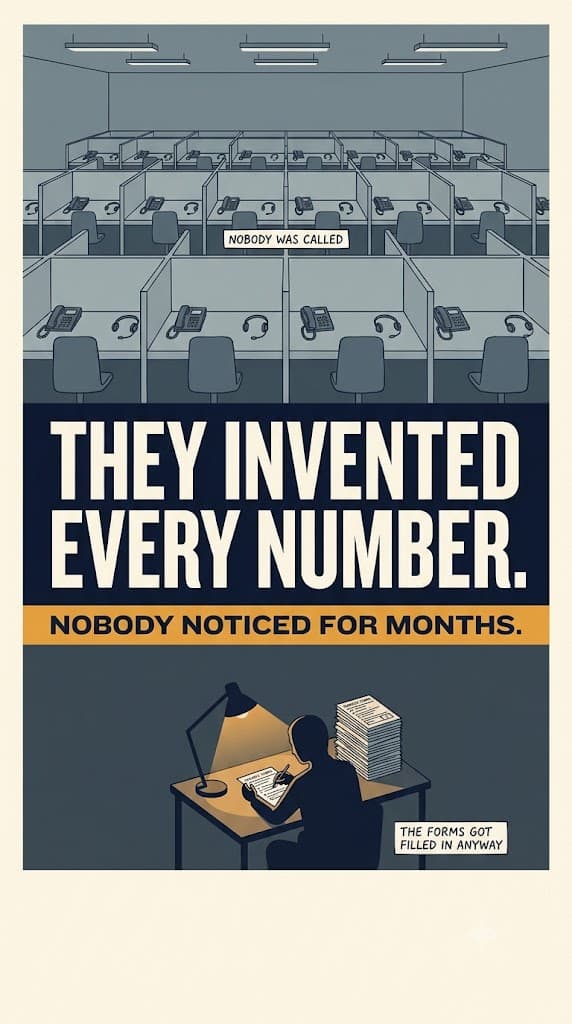
That is why nothing flagged for months. A fabricator who invents implausible numbers gets caught in a week. One who invents plausible ones is invisible, because the only test most consumers of polling apply is whether a result looks roughly like the others.
The fraud survived because it was good at its job.
THE DAMAGE ISN'T WHAT YOU'D GUESS
McMorrow says the fake poll ended her campaign. The evidence does not clearly support her, and we are going to say so.
AP reported that a person with direct knowledge of her decision said the biggest factor was outside spending supporting her rival Haley Stevens, reportedly including millions from AIPAC. In an interview in August — before anyone knew Wedgewood was fake — McMorrow herself cited outside spending as decisive. And the legitimate polls already had her in single digits before the fabricated one appeared.
So the fake poll probably didn't end her campaign. But notice what has happened anyway: it is now impossible to prove that it didn't.
That is the actual damage. Not a stolen race — an unfalsifiable one. Every candidate who underperformed in 2026 can now point at Wedgewood, sincerely, and nobody can settle it. The fabrication didn't only corrupt the data. It corrupted the ability to explain what happened afterwards.
And the money moved in several directions. In Wisconsin, Francesca Hong cited a Wedgewood poll in a fundraising pitch arguing her campaign had momentum — a fake number used to raise money, not suppress it. She lost narrowly. In Mississippi, a Wedgewood poll showing Scott Colom within four points of Senator Cindy Hyde-Smith was followed by Democrats increasing funding to his campaign, according to Politico.
Real money, moved by numbers that did not exist.