On the evening of 8 October 2026, three hundred and five people boarded a boat on the coast of Djibouti. It sank soon afterwards, close to shore, near Guehere, north of the town of Obock. IOM dates the sinking to the early hours of Friday 9 October; survivors told AP it capsized on Thursday night or early Friday.
At least 139 people died. At least fifteen were children — nine girls and six boys among the bodies recovered. Eighty-four were still missing as of 11 October, and remain so. Around eighty-two survived, all Ethiopian nationals, and are being treated at the International Organization for Migration's response centre in Obock after swallowing seawater.
Both of those tolls are floors. The confirmed count covers only the bodies buried by Djibouti's authorities; others, buried by migrants themselves, are not yet verified. The child count has not been revised since the total stood at 109, so it will likely rise too.
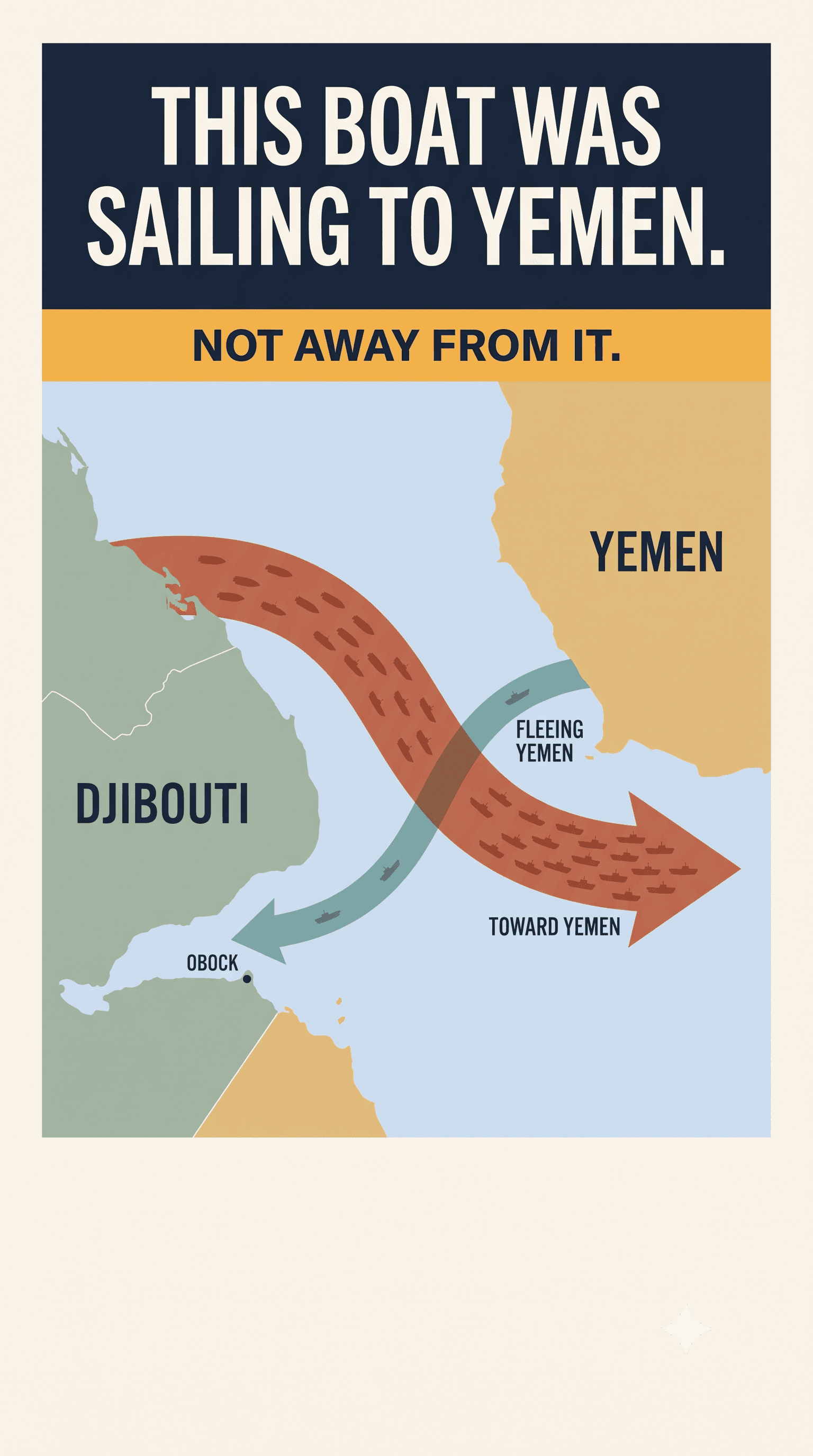
The boat was sailing to Yemen.
Why that sentence is the story
Yemen is in the twelfth year of a war that began with the Houthi capture of Sana'a in 2014 and was internationalised by the Saudi-led coalition in March 2015.
Fighting escalated on Yemen's west coast in early September 2026. Since then, the UN reports, more than 217,000 people have been newly displaced — on top of a country that already had around 5.2 million internally displaced before this escalation began.
And the traffic runs both ways. In the three weeks to 6 October, the UN recorded more than 3,700 refugees arriving in Djibouti from Yemen. UNHCR separately counted 3,601 new Yemeni arrivals as of 18 September; AP reported that at least 2,000 Yemenis had received aid in Djibouti in recent weeks. The figures are not all measuring the same thing, and we are giving you all three rather than picking the largest.
What is not in doubt is the shape: a small flow leaving Yemen westward, and a much larger one moving east, into it.
That is not a paradox to marvel at. It has a straightforward explanation, and the explanation is what's worth understanding.
This is a transit route, not a destination
The people on that boat were not, in the main, seeking refuge in Yemen. On this route, people are trying to get through it.
The destination is the Gulf — principally Saudi Arabia, and also the UAE and Oman — and the work is the kind that has always drawn migrants across dangerous ground. Yemen is the land bridge between the Horn of Africa and the Arabian Peninsula. To reach a Saudi worksite overland from Ethiopia, you cross the strait and then you cross Yemen.
The numbers support the characterisation. Roughly 98% of the migrants IOM encounters at Obock are Ethiopian. Around 90% of arrivals in Yemen are Ethiopian, and the Mixed Migration Centre describes Yemen as largely a transit point toward Saudi Arabia and other Gulf states. About 95% of people on the route cite economic reasons for travelling.
That last figure cuts both ways, and we should say so. Ninety-five per cent is not one hundred. IOM's Obock office encounters people from Tigray and western Ethiopia; IOM itself cites "poverty, insecurity and the growing impacts of climate change" as drivers; Yemen hosts roughly 65,000 Somali and Ethiopian refugees and asylum seekers, and Djibouti over 36,000. IOM, UNHCR and MMC all treat this as mixed migration — migrants, asylum seekers and refugees travelling together. Calling everyone on that boat an economic migrant is nearly right and not right.
The war did not close this route. It made it cheaper, more lawless and far more dangerous, and people kept using it, because the alternative is not a safer route — the alternative is no route. That is what IOM Director-General Amy Pope meant in saying migrants board these vessels only when they see "no other safe way."
The scale, which is the part nobody reports
A shipwreck is an event. The route is a structure, and the structure is far larger than any event in it.
About 506,000 people moved along the Eastern Route in 2025 — an 18% increase on 2024.
922 died or disappeared on it in 2025, against 558 in 2024. That is a 65% rise, and the highest annual figure since IOM began monitoring the route.
IOM recorded more than 20,000 incoming movements into Djibouti from Ethiopia between 10 September and the Geneva briefing on 6 October. Note what that counts: arrivals in Djibouti, not sea crossings. In the same period IOM counted over 3,000 migrants stranded in Djibouti and 539 Ethiopians returning from Yemen.
In late March 2026 another boat went down near Guehere with 320 aboard: nine dead, forty-five missing.
Put 922 against 506,000 and you get the real character of the route. It is not a catastrophe that happens occasionally. It is a continuous cost of about one death for every 550 journeys, which sounds survivable until you remember that half a million people make it.
One correction to a line we nearly published: it would be neat to say those 922 deaths went unreported because they happened in small, unnoticed increments. That is not true. IOM records that many of them occurred in three mass shipwrecks, each killing more than 180 people, and those were covered. The 8 October sinking is not an aberration in a quiet statistic. It is the fourth of a kind.
What we cannot tell you about why it sank
IOM's stated cause is overcrowding. Coissac said the boat sank "mainly because it was overcrowded." Three hundred and five people is a great many for a vessel on this crossing.
There is a second explanation circulating, and we want to be careful with it because it is the kind that sounds explanatory and may not be. In March 2026, Al Jazeera reported that smugglers were "reportedly" using more remote coastal paths through Djibouti to evade police checkpoints. That was reported around the March sinking, it is hedged in the original, and it describes overland approaches at least as much as launch beaches.
Nothing published says the 8 October boat launched from such a site. We are telling you the theory exists, that it is thinly sourced, and that we cannot connect it to this sinking.
And a claim we are withdrawing
We drafted an argument that enforcement pressure doesn't reduce crossings, it only pushes them somewhere less observed — a tidy line that fits the Mediterranean literature well.
On this route, the evidence does not support it, and some of it points the other way.
The Mixed Migration Centre attributes a 3% fall in movements into Djibouti in late 2025, and a 23% fall in migrant returns recorded at Obock, to increased military and police controls in Gelileh and in the Afar districts of Walhemat and Elidar. Running in the same direction: IOM linked higher arrivals in Abyan in June 2026 to the suspension of security campaigns against smuggling networks. Enforcement up, recorded movement down; enforcement down, arrivals up.
MMC's substantial research finding that deterrence does not deter covers the Central and Western Mediterranean, the Atlantic and the Channel — not this route. Its older Eastern Route work does describe a Djiboutian crackdown pushing departures toward Bossaso, but calls that evidence anecdotal and attributes the shift mainly to kidnapping and abuse.
On the current escalation, MMC's own position is that it is "too early to tell" whether it will reduce crossings, shift landing points, or change little.
We think the Mediterranean argument is probably right in general. We are not going to assert it here on evidence that runs against it. That is the whole point of publishing the tier.
What this has to do with everything else we've been writing
For weeks this page has covered the Red Sea and the Bab al-Mandeb as a shipping story: Houthi attacks, war-risk premiums, cancelled sailings, diesel prices, the cost of a chokepoint closing.
That coverage is correct and it is incomplete. The same strait — about 20 kilometres across at its narrowest, twelve miles — also moves people, in open boats, at night, with no insurance, no registry and no Cirium figure counting the cancellations.
There is a bleak wrinkle here. By September 2026 the strait had become an active military theatre: the Houthis seized Perim island, and Yemen's Saudi-backed government subsequently said it had retaken the Bab al-Mandeb. So this was, in one sense, among the most closely watched stretches of water in the region. The watching was aimed at warships and tankers. A wooden boat with three hundred and five people on it at night was not what anybody's sensors were for.