WASHINGTON D.C. — As the military conflict between the United States, Israel, and Iran enters its fourth week, the initial promise of a "swift and surgical" operation has dissolved into a complex regional crisis. What began on February 28, 2026, as Operation Epic Fury—a massive joint U.S.-Israeli aerial campaign—has rapidly evolved into a multifaceted war that critics argue is outpacing the White House’s ability to manage its consequences.
Despite the early assassination of Supreme Leader Ayatollah Ali Khamenei and the "obliteration" of several nuclear facilities, the conflict has entered a volatile phase where horizontal escalation by Tehran and its proxies is challenging President Donald Trump’s stated desire to "wind down" military efforts.
A "Mission Accomplished" Narrative Meets Regional Reality
In the first forty-eight hours of the conflict, the Trump administration signaled a triumphant tone. Pentgon briefings highlighted the destruction of nearly 900 targets, including air defense systems, IRGC command centers, and missile silos. President Trump, speaking from the White House, suggested that the Iranian regime was on the verge of collapse and urged the Iranian people to "take over your government."
However, three weeks later, the geopolitical landscape tells a different story. Instead of a popular uprising or a swift surrender, the Iranian leadership—now under the swift appointment of Mojtaba Khamenei—has pivoted to an asymmetric strategy designed to maximize the economic and political costs for Washington and its allies.
The Economic Toll: Oil, Gas, and the Strait of Hormuz
The most significant "slip" in U.S. control involves the global energy market. Despite U.S. naval dominance, Iran has successfully disrupted transit through the Strait of Hormuz, a chokepoint responsible for 20% of the world's oil and liquefied natural gas (LNG).
Fuel Rationing: Several Asian nations have already begun fuel rationing as tankers refuse to brave the "gauntlet" of Iranian drone and missile strikes.
Infrastructure Attacks: Retaliatory strikes have hit oil facilities in Kuwait, the UAE, and a major Qatari gas hub, the latter of which knocked out 17% of Qatar’s LNG export capacity.
Market Slump: Global stock markets have slumped amid fears of a prolonged energy shock, with the WTO warning that continued high prices could slash 2026 global GDP growth by 0.3%.
In an effort to stabilize domestic gas prices, the U.S. Treasury Department recently announced a temporary lifting of sanctions on Iranian oil already at sea—a move analysts describe as a "pragmatic retreat" that contradicts the war's initial goal of total economic isolation of the regime.
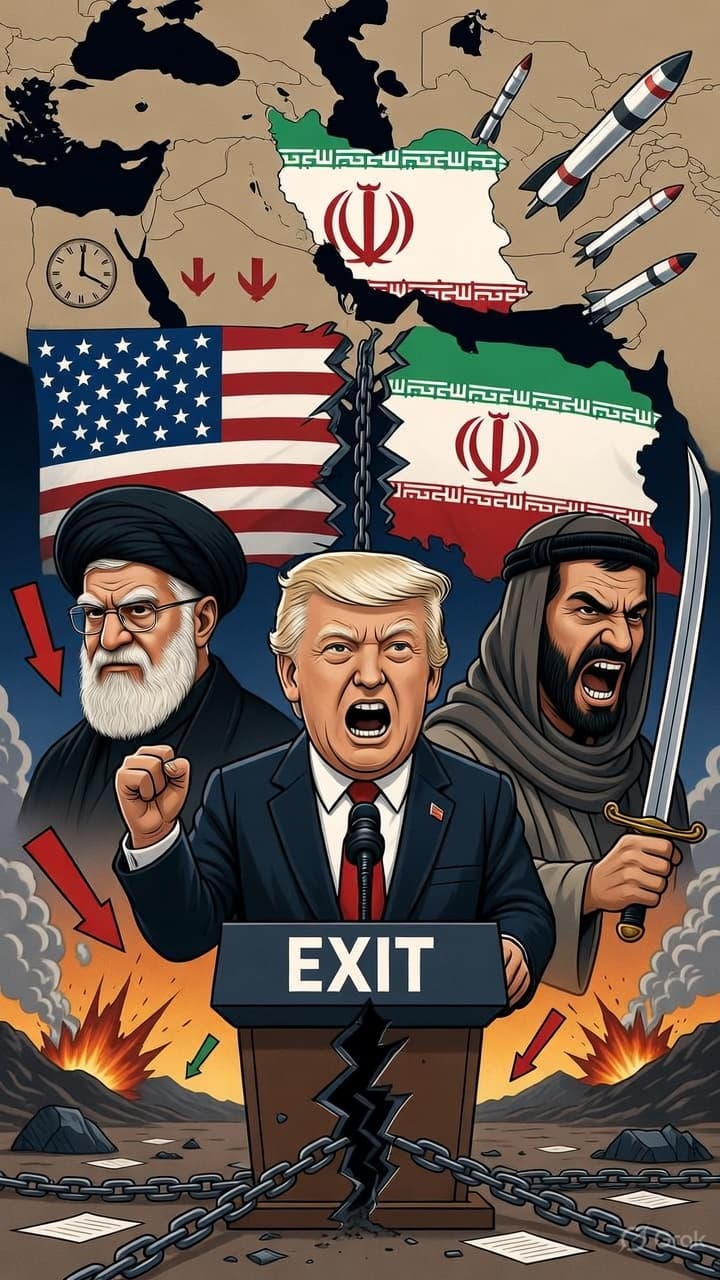
Strategic Myopia and the "Exit Strategy" Gap
The core of the current crisis lies in the disconnect between military objectives and an achievable exit strategy. While Defense Secretary Pete Hegseth has maintained that Iran’s offensive capabilities are "permanently degraded," the regime continues to launch intermediate-range ballistic missiles, recently targeting the joint U.S.-UK base at Diego Garcia.
The Trump administration’s strategy appears to be wavering between two poles:
Regime Change: Pushing for a total collapse of the Islamic Republic.
The "Maduro Model": Acknowledging the regime’s survival while forcing it into extreme concessions, similar to the 2025 U.S. approach in Venezuela.
"The President is dealing with a man-made storm of his own making," says one senior European diplomat. "He wants to declare victory and leave, but the Iranian side gets a vote in when the war ends. By targeting the leadership and infrastructure so aggressively, the U.S. has left the regime with nothing to lose and every incentive to escalate."
Strained Alliances and Global Pushback
The war has also exposed significant rifts within traditional alliances. President Trump has publicly lashed out at NATO members, labeling them "cowards" for refusing to send warships to escort tankers through the Strait. Meanwhile, regional partners like Saudi Arabia and the UAE are bearing the brunt of Iranian retaliation, leading to back-channel appeals for a ceasefire that Washington has so far rejected.
Furthermore, the humanitarian cost—including the accidental strike on a school near Bandar Abbas and the deaths of over 200 children in Iran—has fueled international condemnation and complicated the moral standing of the operation.
Impact and Outlook: A "Forever War" Redux?
As the conflict moves into its second month, the risk of a ground invasion looms. While President Trump has posted on Truth Social that the U.S. is "very close to meeting our objectives," the arrival of 2,200 additional U.S. Marines in the Middle East suggests a preparation for more than just aerial strikes.
The primary concern for the White House is now the Midterm Elections. With rising energy costs and "body bags coming home," the domestic appetite for another Middle Eastern entanglement is rapidly evaporating. If a diplomatic "off-ramp" is not found soon, the 2026 Iran War may become the defining—and most destabilizing—legacy of the second Trump term.
#News #Geopolitics #IranWar2026 #Trump #MiddleEastConflict #OilPrices #StraitOfHormuz #ForeignPolicy #BreakingNews #GlobalEconomy #MilitaryAction #IsraelIran