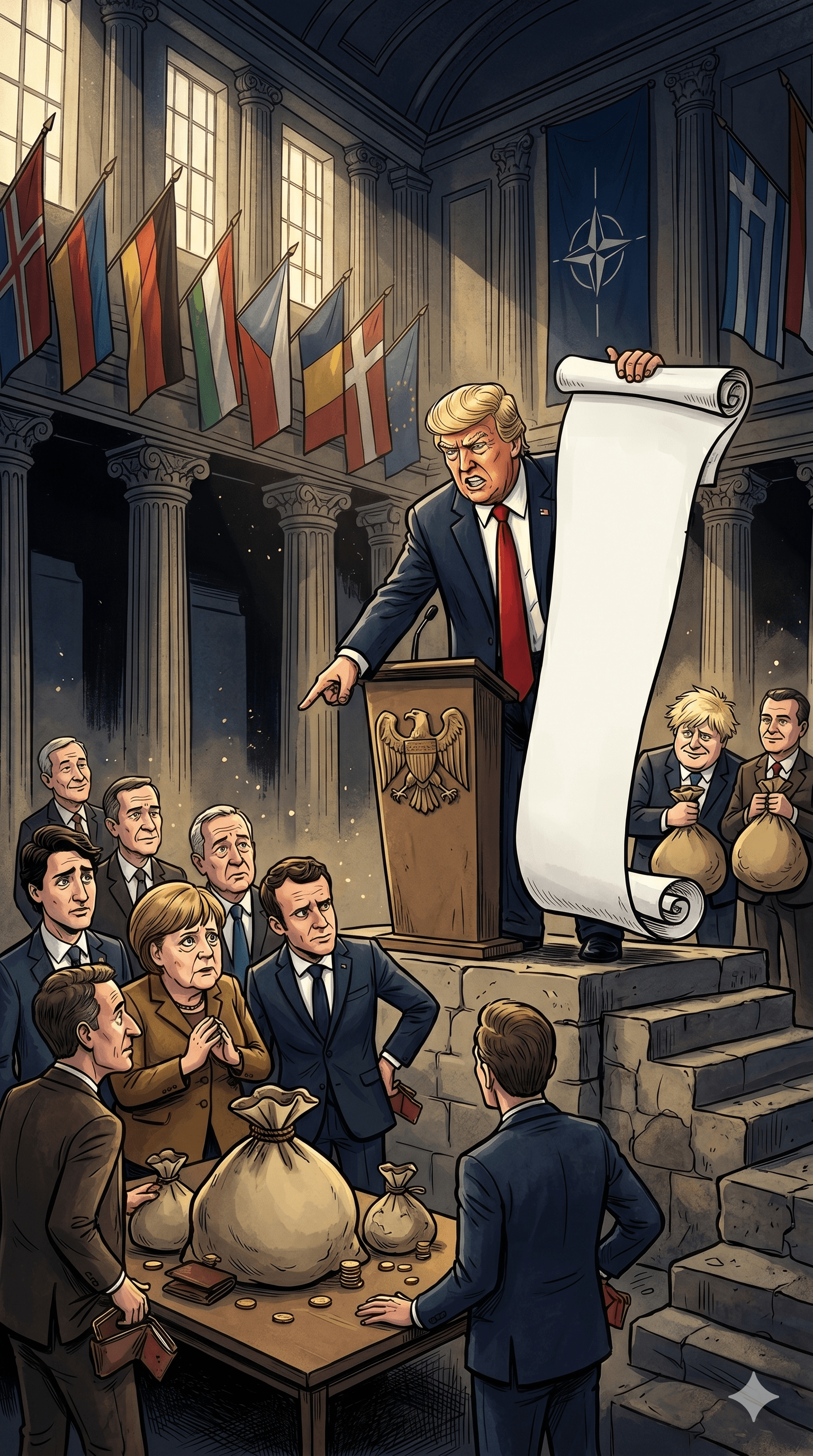
Washington, D.C. — In a move that underscores deepening transatlantic fractures, the White House has reportedly developed a tiered "naughty and nice" list to categorize NATO allies. According to recent reports citing European diplomats and U.S. defense officials, the Donald Trump administration is formally ranking member nations based on their military contributions and, crucially, their diplomatic and logistical support during the recent U.S. conflict with Iran, dubbed "Operation Epic Fury." This unprecedented approach to alliance management marks a significant shift in U.S. foreign policy, explicitly tying bilateral defense cooperation to participation in unilateral American military operations.
The existence of the Trump NATO naughty list was first brought to light ahead of NATO Secretary-General Mark Rutte’s recent diplomatic visit to Washington. As the alliance attempts to navigate a fragile geopolitical landscape, this new tier system threatens to formalize the rift between Washington and its traditional European partners.
The Roots of the 'Naughty and Nice' Tier System
The conceptual foundation for this tiered categorization is not entirely new. The framework appears to be the operationalization of an idea introduced by U.S. Secretary of Defense Pete Hegseth in late 2025. During a defense forum, Hegseth explicitly warned that the era of unconditional American military umbrellas was coming to an end.
"Model allies that step up... will receive our special favor," Hegseth stated, specifically citing Israel, South Korea, Poland, and the Baltic states. Conversely, he warned that allies failing to meet collective defense obligations would "face consequences." A European diplomat familiar with the ongoing White House discussions noted that the administration's current working paper closely mirrors Hegseth's earlier rhetoric, sorting nations into distinct categories of reliable and unreliable partners.
Historically, the administration has aggressively lobbied NATO allies to increase their domestic defense spending. However, the metric for being a "model ally" has now evolved. It is no longer just about meeting the standard 2% or newly proposed 5% GDP defense spending targets; it is heavily dependent on active alignment with Washington’s broader geopolitical maneuvers outside the traditional NATO purview.
Operation Epic Fury: The Ultimate Litmus Test
The primary catalyst for the new NATO allies ranking system is the recent U.S. military engagement with Iran. The conflict sharply divided the military alliance, with the Trump administration expecting its European partners to provide immediate logistical and strategic support. When that support failed to materialize from several key capitals, the White House moved to officially evaluate its partnerships.
On the so-called "nice list," nations like Poland and Romania are reportedly receiving highly positive assessments from the Pentagon. Poland has consistently been recognized for its robust defense expenditures and modernization efforts. Romania, significantly, permitted U.S. forces to utilize its airbases to facilitate operations directly connected to the hostilities with Iran. Smaller nations, such as Bulgaria, which quietly supported U.S. logistics in the Middle East, are also expected to receive favorable standing.
Conversely, the "naughty list" is heavily populated by traditional Western European powerhouses. Countries including Spain, France, and the United Kingdom reportedly delayed or outright rejected U.S. requests for military and logistical assistance during the Gulf hostilities. These nations, already under scrutiny by the administration for their defense spending levels, are now facing the brunt of the administration's diplomatic pressure.
The White House Defense of the Strategy
The Trump administration has been unapologetic about its transactional approach to the alliance. White House Deputy Press Secretary Anna Kelly recently defended the administration's stance, drawing a sharp distinction between true partners and "so-called allies."
"While the United States has always been there for our so-called allies, countries we protect with thousands of troops have not been there for us throughout Operation Epic Fury," Kelly stated, adding that "President Trump has made his thoughts on this unfair dynamic clear, and as he said, the United States will remember."
President Trump echoed this sentiment vividly during a recent event in Arizona. Recounting a belated offer from NATO to assist in reopening the Strait of Hormuz, Trump revealed his blunt response: "I told them I would have liked your help two months ago, but now I really don't want your help anymore, because you were absolutely useless when we needed you." He further asserted that the conflict proved the U.S. does not need NATO, adding, "But actually, we never needed them. They needed us."
Potential Penalties and Geopolitical Implications
Landing on the Trump NATO naughty list is not expected to be purely symbolic. The White House and the Pentagon are reportedly weighing a variety of tangible consequences for non-compliant members. Potential punitive measures include the strategic relocation of U.S. military personnel out of penalized countries, reduced participation in joint military exercises, and the restriction of advanced American defense technology sales.
However, the feasibility and strategic wisdom of these penalties are heavily debated. Several European officials have quietly questioned whether these actions would ultimately undermine American interests more than they would punish European capitals. "They don't seem to have very concrete ideas when it comes to punishing bad allies," one European official remarked to the press. "Moving troops is one option, but it mainly punishes the U.S., doesn't it?"
Redirecting troop deployments alters the U.S. military's forward-operating posture, potentially creating logistical bottlenecks and altering the overall deterrence architecture. Despite these concerns, the administration seems determined to leverage its military footprint as a diplomatic tool.
A History of Deepening Frictions
The current standoff over the Iran war is just the latest chapter in a series of escalating diplomatic disputes. Tensions were already running remarkably high prior to the Gulf conflict. Recent disagreements over European defense spending and diplomatic spats—including President Trump’s renewed interest in acquiring Greenland and his subsequent dismissal of pushback—have left the alliance deeply frayed. Following his meeting with Mark Rutte, Trump took to social media to declare: "NATO WASN'T THERE WHEN WE NEEDED THEM, AND THEY WON'T BE THERE IF WE NEED THEM AGAIN."
Outlook: The Future of Transatlantic Relations
The drafting of a "naughty and nice" list represents a profound paradigm shift in how Washington manages its most important military alliance. By linking the security guarantees of NATO to participation in out-of-area, unilateral conflicts like the U.S.-Iran war, the Trump administration is effectively attempting to reshape NATO from a collective defense pact into a coalition built around immediate American strategic demands.
As the White House finalizes its tiers of "model allies" and "bad allies," the global geopolitical landscape remains highly volatile. The immediate impact will likely be a deeply fractured Europe, split between Eastern European nations eagerly aligning with Washington for security guarantees, and Western European states increasingly seeking strategic autonomy. In the long term, this policy shifts the mutual trust that has historically bound the transatlantic community together, leaving both the United States and Europe navigating an increasingly complex world under a new set of transactional rules.