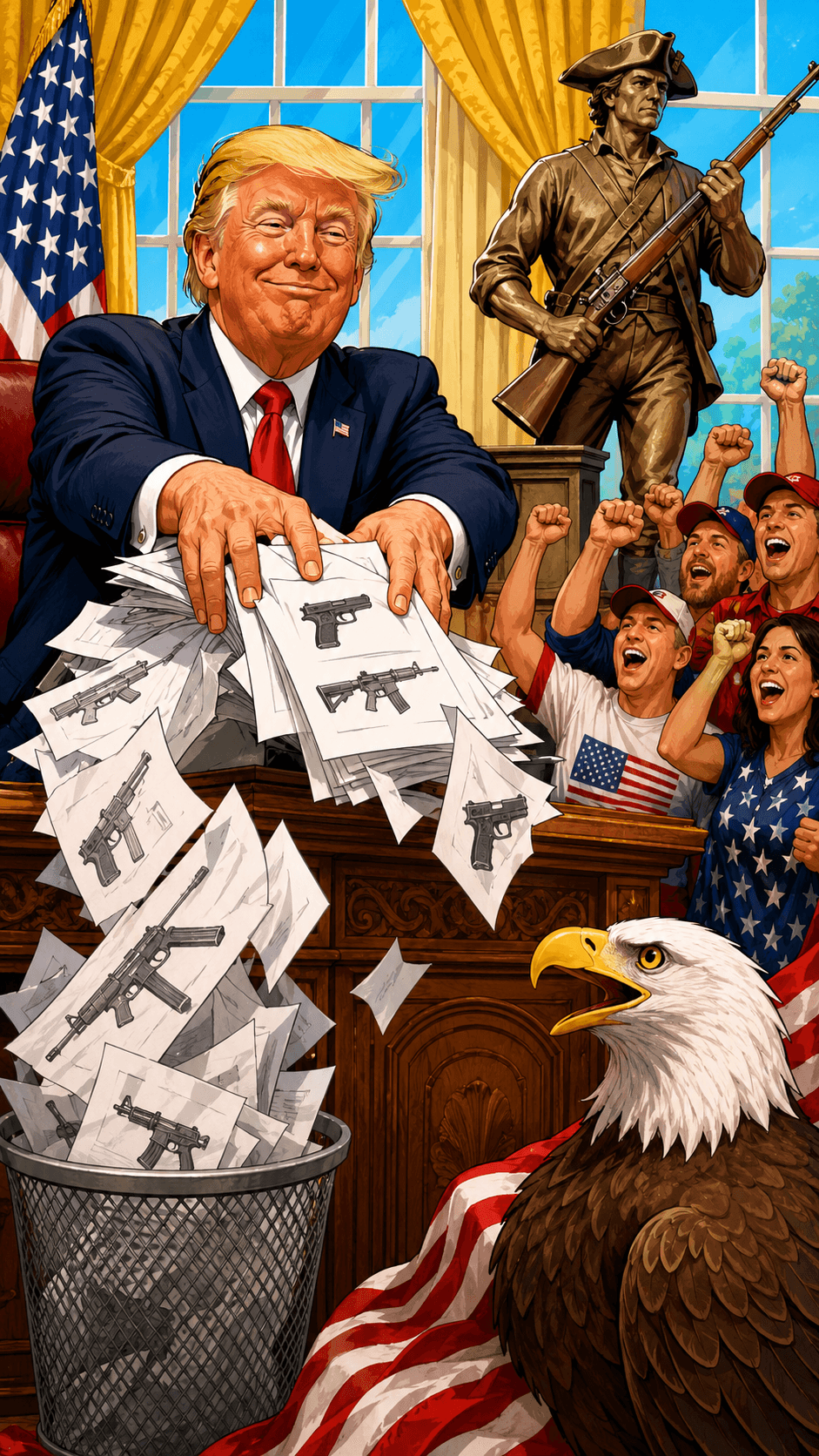
The Trump administration is pursuing a broad rollback of more than three dozen federal firearms regulations, framing the effort as a restoration of Second Amendment protections and a reduction in regulatory burdens on gun owners, dealers, and manufacturers. The initiative, led primarily by the Bureau of Alcohol, Tobacco, Firearms and Explosives (ATF) and the Department of Justice, reverses a number of policies adopted during the previous administration and fulfills a major campaign commitment by President Donald Trump.
The package of 34 proposals, announced in April 2026, affects firearm sales, licensing, manufacturing, recordkeeping, and ownership requirements, prompting strong reactions from both gun rights advocates and gun control organizations.
Background
Since returning to the White House in January 2025, President Trump has made expanding protections for the Second Amendment a central element of his administration's firearms policy.
A February 2025 executive order titled "Protecting Second Amendment Rights" directed Attorney General Pam Bondi to review firearm regulations adopted under the Biden administration and identify policies considered to unnecessarily restrict lawful gun ownership.
Administration officials describe the review as an effort to eliminate unnecessary bureaucracy and ensure federal firearms regulations align with recent Supreme Court interpretations of the Second Amendment.
Attorney General Todd Blanche has characterized the proposals as the most comprehensive regulatory reform package in ATF history, saying they modernize firearms regulations while remaining consistent with constitutional protections.
Major Regulatory Changes
Repeal of the ATF "Zero Tolerance" Policy
One of the most significant changes eliminates the Biden administration's "Zero Tolerance" policy, which required license revocation for federally licensed firearms dealers found to have willfully violated certain federal firearms laws.
The administration is replacing it with a revised enforcement framework that officials say provides greater flexibility when addressing violations that do not directly affect public safety.
Supporters argue the previous policy unfairly punished dealers for administrative errors, while critics contend the repeal weakens oversight of businesses that violate federal gun laws.
Reversal of Expanded Background Check Requirements
The administration also proposes repealing a 2024 regulation that expanded background check requirements for many firearms sellers operating at gun shows and similar venues.
Supporters say the previous rule exceeded federal authority and burdened private sellers, while opponents argue its repeal could increase the number of firearm transfers conducted without background checks.
Stabilizing Brace Rule
Another proposal would rescind regulations governing stabilizing braces—attachments that can allow certain pistols to be fired more like rifles.
Gun rights organizations have long argued that the previous rule improperly reclassified many legally owned firearms, while gun control advocates say removing the restrictions increases public safety risks.
Mental Health-Related Firearm Restrictions
The administration also plans to restore firearm eligibility for some individuals previously prohibited because of certain mental health-related federal designations.
Supporters argue the previous policies unnecessarily restricted constitutional rights without individualized judicial review.
Critics point to internal government assessments suggesting such changes could increase risks in some cases, including the possibility of serious public safety consequences.
Firearm Recordkeeping
The proposed reforms would reduce the length of time federally licensed gun dealers must retain certain sales records—from indefinite retention to 20 or 30 years, depending on the records involved.
Law enforcement organizations have expressed concern that shorter retention periods could make tracing firearms used in crimes more difficult.
Simplified Purchase Forms
The administration also intends to shorten the federal firearm transaction form from seven pages to four, arguing the revised form will simplify lawful firearm purchases while maintaining legally required information.
Mailing Firearms
Separately, the U.S. Postal Service has proposed revising long-standing restrictions on mailing firearms within states.
If adopted, the proposal could expand who is permitted to mail certain firearms under federal law, though the exact practical effects would depend on the final rule and existing statutory requirements.
Bump Stocks
The administration has formally repealed the federal ban on bump stocks following the Supreme Court's decision invalidating the previous regulation.
Officials describe the repeal as compliance with the Court's ruling rather than the creation of new policy.
Support and Opposition
The administration says the reforms are intended to protect constitutional rights while reducing unnecessary regulatory burdens on law-abiding Americans and firearms businesses.
Gun rights organizations, including the National Rifle Association (NRA) and the National Shooting Sports Foundation (NSSF), have welcomed the changes, saying they restore protections they believe had been weakened by previous federal policies.
Gun control organizations, including Everytown for Gun Safety and the Brady Campaign, strongly oppose the rollbacks, arguing they could weaken safeguards designed to prevent firearms from reaching prohibited individuals and increase the risk of gun violence.
Public Safety Debate
The proposed changes have intensified debate over the balance between constitutional rights and public safety.
Opponents argue that loosening regulations governing dealer oversight, background checks, stabilizing braces, and certain mental health-related restrictions could increase gun violence and make firearms more difficult to trace during criminal investigations.
Supporters counter that lawful gun owners should not face unnecessary restrictions because of actions committed by criminals, and that constitutional protections should remain the guiding principle for federal firearms policy.
The administration has also shifted some ATF resources toward immigration enforcement and challenged several state gun control laws through litigation, reflecting a broader policy shift in federal firearms enforcement.
Outlook
The Trump administration's firearms regulatory overhaul represents one of the most significant shifts in federal gun policy in recent years.
With Robert Cekada serving as the permanent Director of the ATF, implementation of the regulatory changes is expected to continue, although many proposals are likely to face legal challenges and administrative review.
The debate over how to balance Second Amendment protections with efforts to reduce gun violence is expected to remain one of the most consequential issues in U.S. politics, with ongoing litigation, federal rulemaking, and state-level legislative battles likely to shape the future of American firearms policy.