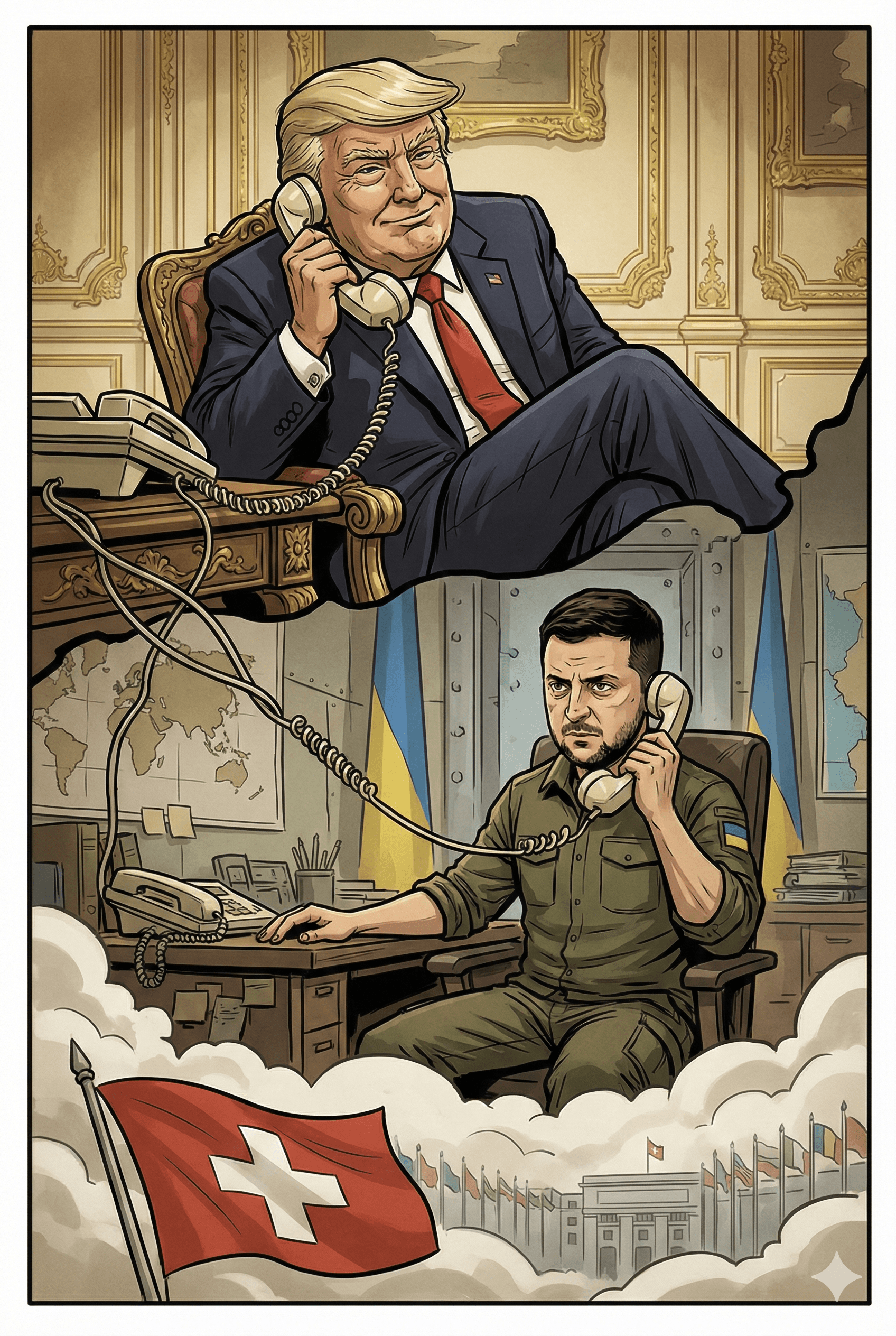
U.S. President Donald Trump and Ukrainian President Volodymyr Zelenskyy engaged in a pivotal phone conversation on Wednesday, February 25, 2026, setting the stage for a critical new round of diplomatic negotiations. As the devastating Russo-Ukrainian war enters its fifth year, this high-level dialogue underscores a renewed, intensive push by Washington and Kyiv to establish a framework for ending Europe’s deadliest conflict since World War II. The call took place just a day before U.S. and Ukrainian envoys were scheduled to meet for crucial bilateral discussions in Geneva, Switzerland.
The Push for a Diplomatic Breakthrough
The telephone conversation, which also included U.S. Special Envoy Steve Witkoff and Trump senior adviser Jared Kushner, lasted approximately 30 minutes and was characterized by an urgent diplomatic focus. According to official statements from both Kyiv and Washington, the primary objective of the call was to align the U.S. and Ukrainian positions ahead of the February 26 Geneva talks.
President Zelenskyy publicly acknowledged the conversation, expressing gratitude for the Trump administration's active involvement in the peace process. "Our teams are working intensively, and I thanked them for all their work and for their active involvement in the negotiations and the efforts to end the war," Zelenskyy noted in a statement released on his official social media channels.
The immediate goal of the Geneva meeting is to iron out a unified bilateral strategy before transitioning to a highly anticipated trilateral summit involving Russian representatives, slated for early March.
Key Stakeholders and the Geneva Agenda
The Negotiating Teams
The bilateral talks in Geneva feature a high-profile lineup of geopolitical stakeholders. Ukraine is represented by its lead negotiator, Defense Minister Rustem Umerov. The U.S. delegation is spearheaded by Steve Witkoff and Jared Kushner, who have been designated as President Trump’s primary envoys for the Ukraine peace process.
What is on the Table?
While the precise details of the negotiating text remain closely guarded, diplomatic sources indicate that the Geneva agenda is multifaceted:
Security Guarantees: Kyiv is seeking "ironclad" security assurances from the United States and NATO allies to prevent any future Russian aggression before committing to any ceasefire.
Economic Recovery: Discussions are expected to feature a "prosperity package" aimed at stabilizing Ukraine's war-torn economy and funding massive post-war reconstruction efforts.
Territorial Integrity vs. Concessions: The most contentious issue remains the status of occupied territories. Russia continues to demand full control over eastern regions like Donetsk, while Ukraine steadfastly refuses to formally cede its sovereign land to the occupying forces.
Russian state media has also reported that the Kremlin’s economic affairs envoy, Kirill Dmitriev, plans to be in Geneva to pursue parallel negotiations with American officials on economic issues, highlighting the complex, multi-track nature of these diplomatic efforts.
Context: Four Years of War and the PURL Initiative
The timing of this phone call is highly symbolic, arriving just after the fourth anniversary of Russia's full-scale invasion, which commenced on February 24, 2022. Earlier in the week, President Zelenskyy marked the somber milestone by emphasizing Ukraine's resilience. "We have defended our independence, we have not lost our statehood; Putin has not achieved his goals," Zelenskyy declared in a national address.
In a recent video address commemorating the invasion's anniversary, Zelenskyy also extended an invitation for Trump to visit Kyiv. He suggested that witnessing the devastation firsthand might clarify "who the aggressor is here and who must be pressured," reinforcing Kyiv's stance that major concessions should be demanded from Moscow, not just Ukraine.
Despite the renewed push for peace negotiations, the reality on the ground remains brutal. During his call with President Trump, Zelenskyy highlighted the acute challenges Ukraine faces this winter, which he described as the most difficult yet.
A critical component of Ukraine's current defense strategy, which was heavily discussed during the call, is the Prioritised Ukraine Requirements List (PURL). This initiative allows Ukraine to purchase vital U.S. weaponry, particularly air defense missiles, which have been instrumental in protecting civilian infrastructure and saving lives amidst ongoing Russian aerial bombardments. The continuation of this program remains a vital lifeline for Kyiv as it balances high-intensity combat with high-stakes diplomacy.
Motivations: Bridging the Geopolitical Gap
The motivations of the primary actors reveal a complex geopolitical puzzle.
For President Donald Trump, brokering a peace deal between Ukraine and Russia would represent a massive foreign policy victory. His administration has repeatedly signaled a desire for a swift conclusion to the conflict, applying pressure on both sides to make compromises and come to the negotiating table. Domestically, the Trump administration faces pressure from various factions within the U.S. political spectrum. Influential Republican lawmakers on Capitol Hill have been urging the White House to expand military support—such as providing long-range precision weapons and imposing crushing sanctions—to gain maximum leverage at the bargaining table against Moscow.
For President Volodymyr Zelenskyy, the challenge is immense. He must navigate the Trump administration's push for a rapid settlement while protecting Ukraine's territorial integrity and satisfying a domestic population that has sacrificed immensely over the last four years. Zelenskyy has made it clear that lower-level working groups cannot resolve the most sensitive territorial disputes. Instead, he views the Geneva talks and the subsequent trilateral meetings as stepping stones toward a direct leaders' summit. "This is the only way to resolve all the complex and sensitive issues and finally end the war," Zelenskyy stated following his call with Trump.
Meanwhile, Russian President Vladimir Putin has maintained maximalist demands, showing little public willingness to soften his stance on territorial acquisitions or Ukraine's political alignment.
Impact and Outlook: Will Diplomacy Succeed?
As envoys gather in Geneva, the international community watches with cautious optimism heavily tempered by realism. Previous U.S.-brokered talks have managed to align certain secondary issues, but the core disputes regarding land, sovereignty, and long-term security remain deeply unresolved.
The immediate outlook hinges entirely on whether the U.S. and Ukrainian delegations can forge a unified front in Geneva that is robust enough to bring Russia into meaningful trilateral negotiations in March. If the Geneva talks collapse, or if the subsequent trilateral meeting fails to produce a viable roadmap, the conflict is likely to remain in a devastating war of attrition.
However, if Trump's envoys and Zelenskyy's team can successfully establish a framework that moves the dialogue to a direct leaders' summit, it could mark the most significant turning point in the war since the initial invasion four years ago. The coming weeks will be decisive in determining whether this diplomatic push will finally silence the guns or merely become another footnote in a protracted conflict.
#news #geopolitics #UkraineWar #TrumpZelenskyy #GenevaTalks #USForeignPolicy #PeaceNegotiations #RussiaUkraine #GlobalEconomy #Diplomacy #InternationalRelations