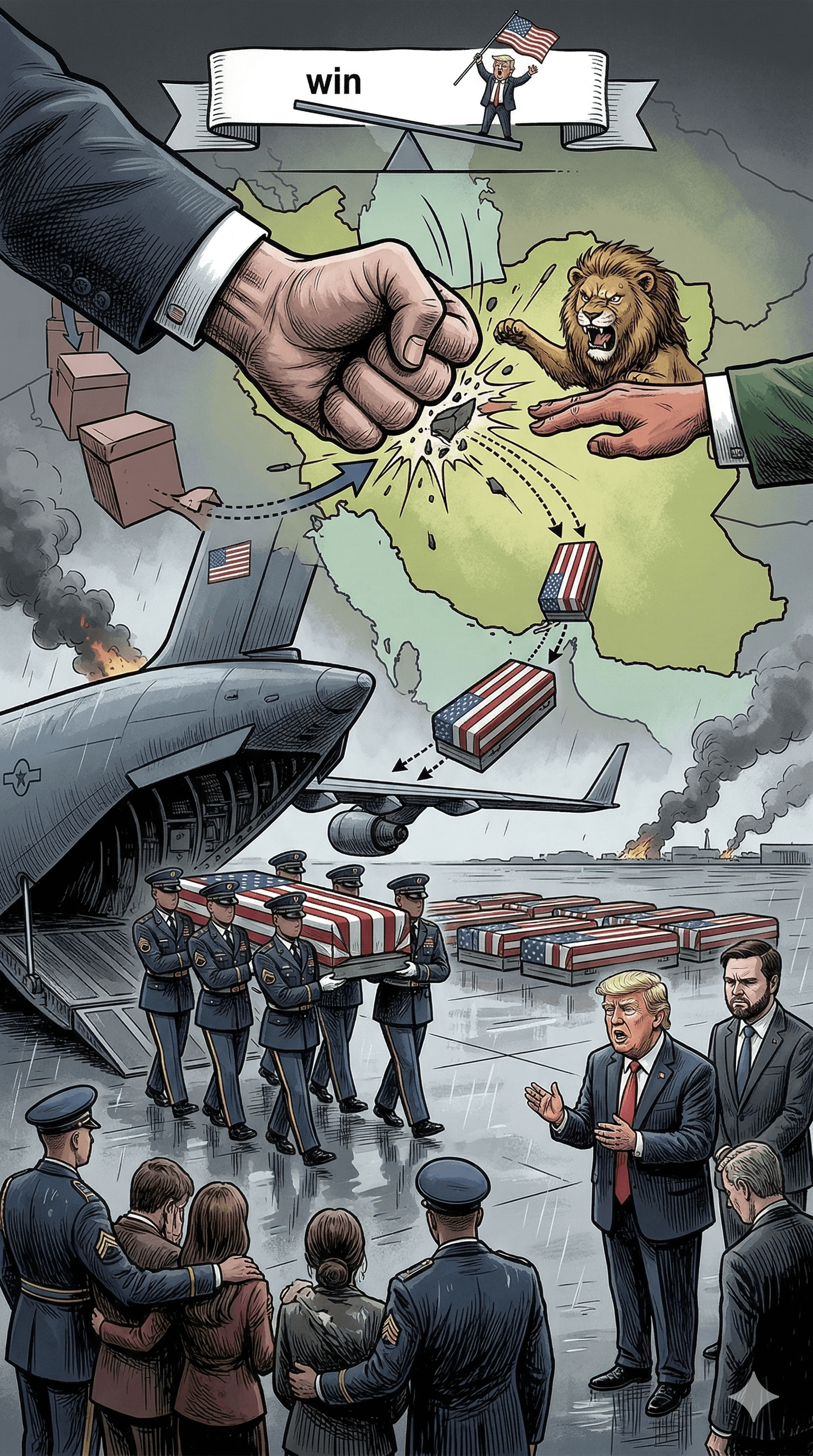
DOVER AIR FORCE BASE, Del. — In a somber ceremony marking the first American military casualties of the newly launched U.S. war with Iran, President Donald Trump attended the dignified transfer of six fallen U.S. service members at Dover Air Force Base on Saturday.
The flag-draped transfer cases carrying the remains of the U.S. Army Reserve soldiers were met by a silent delegation of the nation’s top leaders and grieving families, underscoring the immediate and lethal human cost of the expanding Middle East conflict known as Operation Epic Fury.
Addressing reporters aboard Air Force One shortly after the solemn ritual, President Trump acknowledged the grim reality of the ongoing military campaign. “I hate to do them, but it’s a part of war, isn’t it?” the president stated when asked if he expected to return for future transfers. “It’s a sad part of war, it’s the bad part of war.”
Honoring the Fallen Heroes at Dover Air Force Base
The dignified transfer is one of the most solemn duties a commander in chief can undertake. On Saturday afternoon, beneath the gray skies of Delaware, a U.S. Army team carefully carried the remains of the six soldiers off a C-17 Globemaster transport plane.
The six service members, all belonging to the U.S. Army Reserve’s 103rd Sustainment Command based in Des Moines, Iowa, were killed on Sunday, March 1. The Department of Defense confirmed they died when an Iranian unmanned aircraft system (drone) struck their logistics and operations center in Port Shuaiba, Kuwait.
The fallen heroes have been identified as:
Chief Warrant Officer 3 Robert M. Marzan, 54, of Sacramento, California
Maj. Jeffrey R. O’Brien, 45, of Indianola, Iowa
Sgt. 1st Class Noah L. Tietjens, 42, of Bellevue, Nebraska
Sgt. 1st Class Nicole M. Amor, 39, of White Bear Lake, Minnesota
Capt. Cody A. Khork, 35, of Winter Haven, Florida
Sgt. Declan J. Coady, 20, of West Des Moines, Iowa
President Trump, wearing a dark blue suit, a red tie, and a white “USA” baseball cap, stood in a silent salute for over 30 minutes as the transfer cases were moved. He was accompanied by First Lady Melania Trump, Vice President JD Vance, Defense Secretary Pete Hegseth, and Middle East Special Envoy Steve Witkoff. Prior to the ceremony, the president spent more than an hour meeting privately with the families of the fallen soldiers.
The Commander in Chief on the Realities of Conflict
The arrival of the first casualties from the Iran conflict places President Trump in a fundamentally different position than during his first term. Previously, Trump presided over dignified transfers for service members killed in legacy conflicts he had promised to end. Now, he is navigating the domestic and emotional fallout of a preemptive war his administration chose to initiate.
Earlier on Saturday, before departing for Delaware, Trump addressed Latin American leaders gathered in Doral, Florida. He spoke bluntly about the escalating situation, framing the military action against Tehran as a long-overdue necessity.
“This is a short excursion into something that should have been done for 47 years,” Trump said, comparing the U.S. military operation to "taking out a cancer." While acknowledging that the fallen soldiers were “coming home in a different manner than they thought they’d be coming home,” he assured the audience that his administration intended to keep American casualties “to a minimum.”
However, when pressed by a reporter on Air Force One about the likelihood of more American deaths as the campaign intensifies, Trump offered a candid assessment: “Oh yeah, I’m sure.”
The Broader Geopolitical Context: Operation Epic Fury
The deaths of the six service members in Kuwait highlight the rapid regionalization of the U.S.-Iran war. Launched merely a week prior, the conflict has quickly spiraled beyond targeted strikes, drawing in neighboring states and testing international alliances.
Iran has responded to U.S. and Israeli bombardments by targeting regional bases housing American personnel and allied infrastructure. Reports indicate that the Islamic Revolutionary Guard Corps (IRGC) has launched massive strikes against strategic locations across the Gulf, including the Al-Dhafra airbase in the United Arab Emirates. The fallout has heavily disrupted commercial aviation, with Dubai International Airport facing significant operational suspensions over the weekend amidst missile alerts.
Meanwhile, the theater of war continues to broaden. Israeli jets, backed by recent U.S. arms approvals, have intensified their bombing campaigns across Lebanon and Iranian military sites. Iranian President Masoud Pezeshkian recently apologized to neighboring Gulf nations for the regional disruptions but firmly rejected the Trump administration's demands for unconditional surrender, dismissing the notion as a “dream.”
The White House faces intense international scrutiny regarding civilian casualties. During his flight on Saturday, President Trump flatly denied without evidence that the U.S. was responsible for a bombing at an Iranian girls' elementary school that killed over 175 people, instead suggesting Iran was to blame.
Economic and Domestic Implications
As the geopolitical crisis deepens, the economic reverberations are being felt acutely at home and abroad. The conflict has severely rattled global energy markets. With the Persian Gulf essentially turning into a combat zone, oil prices have surged, prompting immediate pain at the pump for American consumers.
Gas prices across the United States are climbing rapidly, forcing the administration to evaluate emergency measures. Over the weekend, the U.S. Department of Justice released a legal opinion suggesting the president could invoke the Defense Production Act to bypass state-level environmental regulations—such as those in California—to aggressively expand offshore oil operations and stabilize fuel costs.
Politically, the Iran conflict serves as a massive test for the Trump-Vance administration. Vice President JD Vance and Defense Secretary Pete Hegseth, both veterans of the post-9/11 wars in Iraq and Afghanistan, built much of their political brands on opposing "endless wars" and Middle Eastern nation-building. Now, they are key architects of a massive military intervention aimed at deposing the Iranian regime.
Outlook
The coming weeks will be critical for the trajectory of the U.S.-Iran war. Despite classified U.S. intelligence reports suggesting that a large-scale war is "unlikely" to smoothly oust Iran's regime, the Trump administration appears resolute in its strategy of maximum military pressure.
For the American public, the dignified transfer at Dover Air Force Base serves as a stark reminder of the human toll behind geopolitical maneuvers. As global markets brace for further instability and regional allies navigate the crossfire, the administration must balance its aggressive military objectives with the sobering realities of American casualties—the very "bad part of war" the president witnessed firsthand on Saturday.
#USPolitics #IranConflict #Geopolitics #MiddleEastCrisis #USEconomy #DoverAFB #MilitaryNews #GlobalSecurity #OperationEpicFury #DonaldTrump #DefenseNews #EnergyMarkets