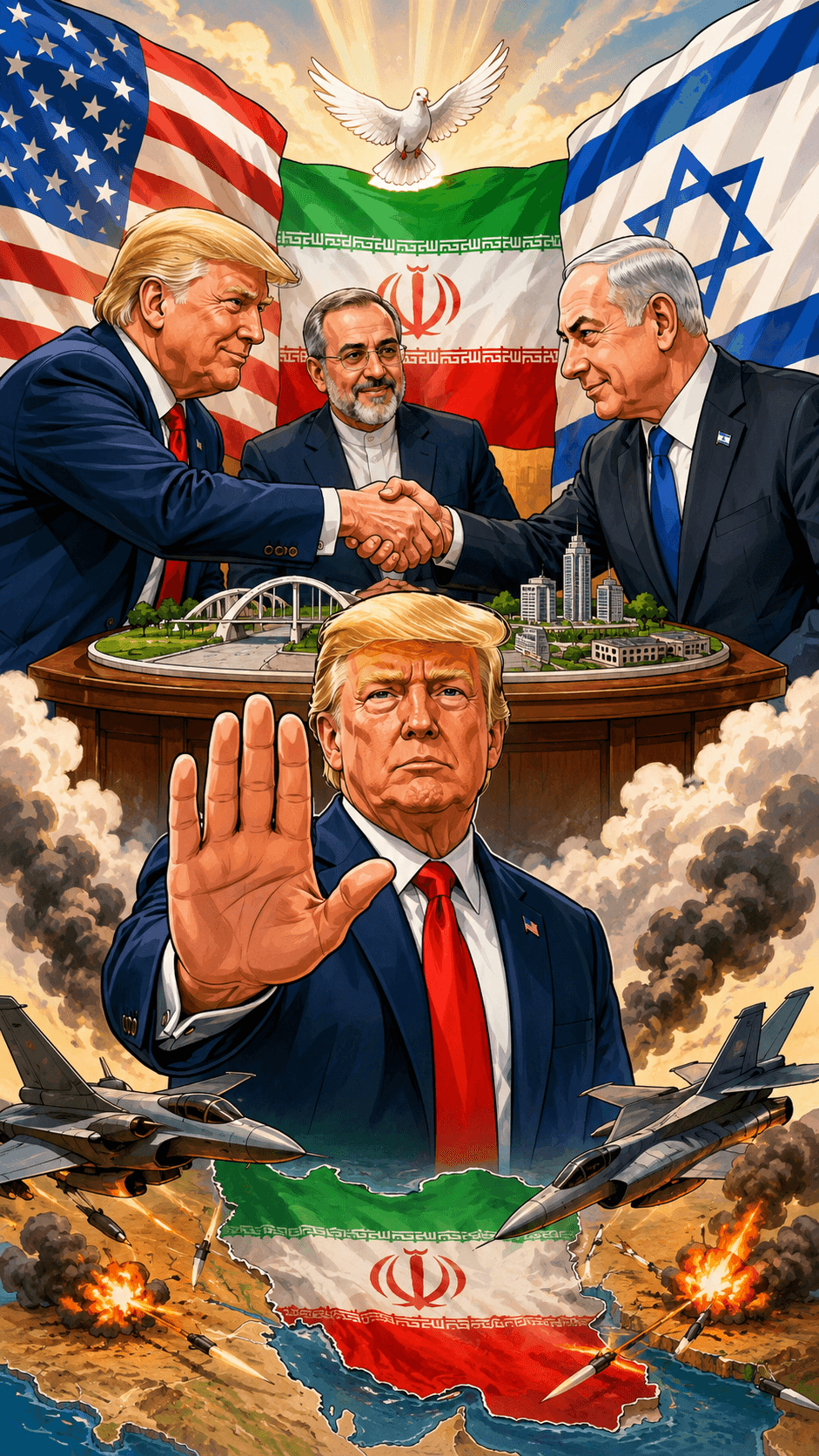
WASHINGTON — U.S. President Donald Trump announced that he has called off a planned joint military strike against Iran following urgent diplomatic appeals from Tehran and key regional partners. In a post published to Truth Social, the president revealed that the basic "perimeters of a deal" have been established to de-escalate the months-long conflict in the Middle East, claiming that Israel is also aligned with the decision to pause military action.
The sudden reversal comes amid heightened regional tensions and intense international diplomacy intended to prevent a broader war that threatened global energy markets and critical maritime transit corridors.
========================================================================================
                      PROPOSED U.S.–IRAN DIPLOMATIC FRAMEWORK
========================================================================================
   [ U.S. / ISRAEL ]                                            [ IRAN ]
   * Halt Joint Military Strikes  <------------------------>  * Immediate Opening of
   * Preserve Regional Stability                              Strait of Hormuz
   * Diplomatic De-escalation                                 * Verifiable End to Nuclear Threat
========================================================================================
High-Stakes Brinkmanship: The Prelude to the Announcement
Leading up to the president's late-night social media post, multiple intelligence and military sources reported that American and Israeli armed forces were preparing a major bombing campaign against Iranian targets. The planned operations reportedly focused on key Iranian energy infrastructure and military installations, raising fears of catastrophic damage to global crude oil supplies.
In the hours preceding the announcement, U.S. force posture in the region was described by administration officials as fully deployed.
"The USA is locked and loaded and ready to go against the Islamic Republic of Iran, at levels of Military Terror, Strength, and Power not seen since World War II," President Trump wrote on Truth Social. "Despite this, we have just been asked by Iran, and other Middle Eastern Countries, to hold off any attack in that the perimeters of a deal has been agreed to."
Despite the aggressive posturing, intense behind-the-scenes negotiations spearheaded by regional mediators—including Saudi Arabia, Turkey, Pakistan, and Qatar—helped forge a tentative opening for diplomacy. U.S. officials confirmed that Saudi Crown Prince Mohammed bin Salman engaged directly with President Trump to express concern over potential regional instability and urged Washington to prioritize a negotiated settlement over military intervention.
Core Pillars of the Draft Agreement
While full details of the negotiating text remain under tight security, the broader framework targets two fundamental issues that have fueled confrontation between Washington, Tel Aviv, and Tehran:
Maritime Access in the Strait of Hormuz: The draft agreement demands the immediate, complete, and unhindered opening of the Strait of Hormuz. As a bottleneck for nearly a fifth of global petroleum consumption, previous Iranian threats and disruptions in the waterway had driven global energy prices upward and destabilized international shipping routes.
Nuclear Non-Proliferation Commitments: The proposal mandates a verifiable mechanism to resolve concerns over Iran's nuclear enrichment capabilities. Washington has repeatedly asserted that any long-term peace agreement must permanently end Iran's path to acquiring nuclear weapons technology.
┌──────────────────────────────────────────────────────────────────────────────────┐
│                             KEY STAKEHOLDERS & POSITIONS                         │
├──────────────────────┬───────────────────────────────────────────────────────────┤
│ Stakeholder          │ Strategic Position / Role                                 │
├──────────────────────┼───────────────────────────────────────────────────────────┤
│ United States        │ Pauses military action contingent on a rapid final deal.   │
│ Iran                 │ Warns against aggression while negotiating via mediators. │
│ Israel               │ Aligned with U.S. conditions; maintains regional stance. │
│ Regional Mediators   │ Saudi Arabia, Turkey, and Pakistan pushed for pause.     │
└──────────────────────┴───────────────────────────────────────────────────────────┘
President Trump stressed that the hold on U.S. military strikes remains strictly conditional on how quickly negotiators can turn the initial outline into a binding treaty.
"Based on this request, I have agreed, for the future benefit of the WORLD and, likewise, the survival of a successful and prosperous Iran, to cancel the attack, subject to being able to rapidly make a DEAL," Trump added, noting that Israel joined in the commitment to explore the diplomatic route. "Get to work, everybody, and get it DONE."
Mixed Signals and Regional Reaction
The response from Tehran has highlighted the delicate nature of the negotiations. Official state channels and military spokespersons adopted a cautious, highly skeptical stance. Iranian Foreign Minister Abbas Araghchi reiterated that Tehran treats all military threats as real and warned that any direct action against Iranian territory by U.S. or Israeli forces would meet a decisive and proportionate military response. Semi-official Iranian news outlets initially characterized Washington's statements as psychological warfare, underscoring the trust deficit between the two nations.
Simultaneously, the geopolitical and economic pressures surrounding the conflict remain acute:
Strategic Interceptor Stocks: Defense analysts note that months of high-intensity operations and missile interceptions in the Middle East have placed significant pressure on Western air defense inventories, prompting senior military commanders to urge caution regarding prolonged engagements.
Economic Vulnerability: Both Western economies and Persian Gulf nations have faced growing pressure from elevated oil price volatility and supply chain friction caused by maritime uncertainty.
Domestic Politics: Recent U.S. public opinion polling revealed widespread fatigue with Middle Eastern conflicts, with a clear majority of Americans expressing skepticism regarding extended foreign war commitments.
Strategic Outlook
The coming days will test whether the announced consensus can survive implementation details. Delegations and international diplomatic envoys are working urgently to formalize draft terms regarding nuclear oversight, maritime guarantees, and mutual security parameters.
If negotiators successfully establish a binding agreement, the deal could secure the free flow of global trade through the Persian Gulf and reduce regional military risks. However, should negotiations stall, President Trump's explicit warning that U.S. forces remain positioned for action leaves open the possibility of a swift return to direct confrontation. For now, the region sits at a precarious crossroads between diplomatic de-escalation and potential escalation.