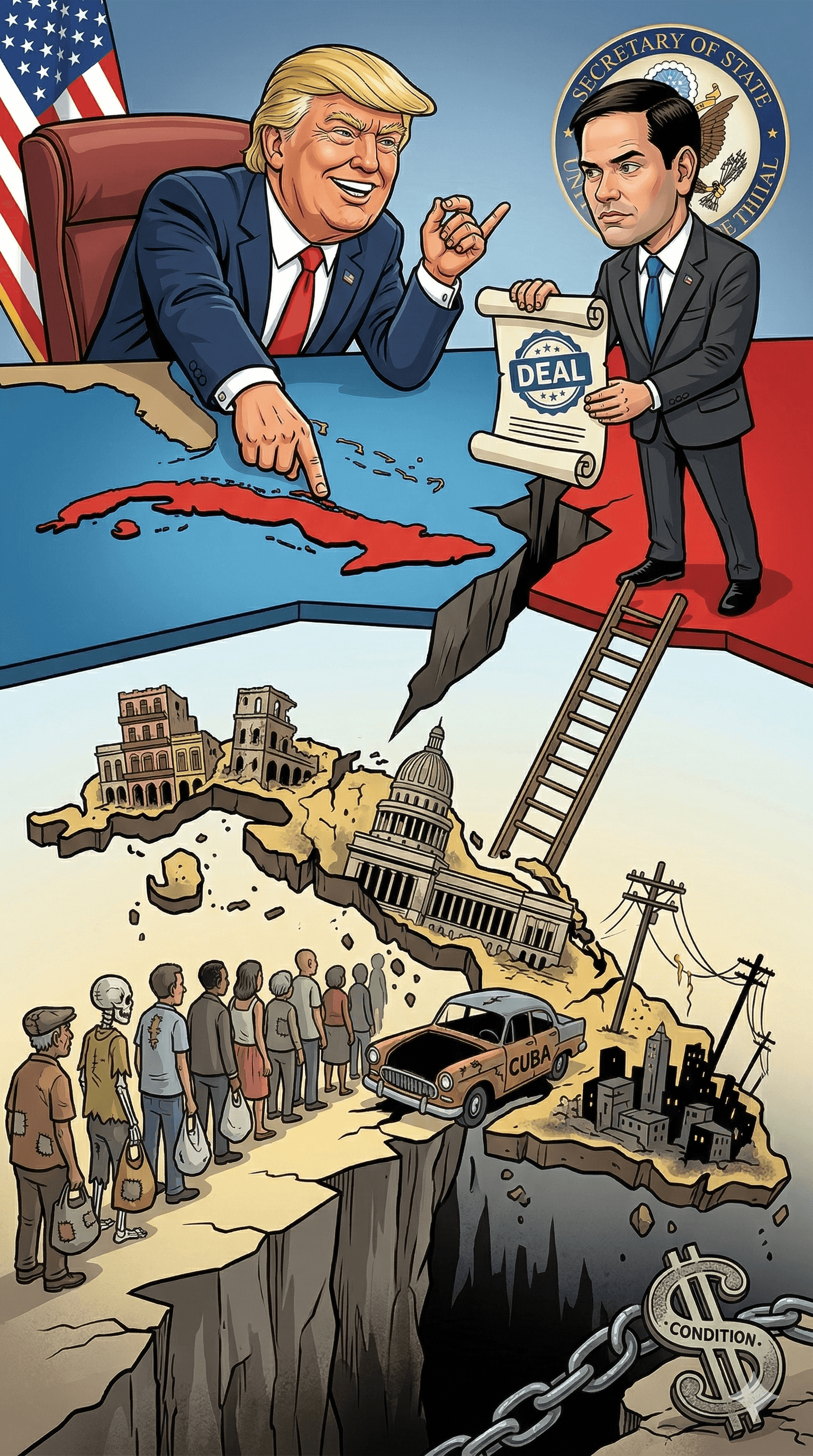
President Donald Trump has announced a major escalation in U.S. foreign policy toward Latin America, boldly declaring that the Cuban government "is going to fall pretty soon." In a decisive move aimed at accelerating a political transition in Havana, the President has tapped Secretary of State Marco Rubio to oversee and negotiate a deal focused on regime change. This development comes at a moment of profound vulnerability for the island nation, which is currently grappling with widespread power grid failures, deepening economic turmoil, and seismic political shifts in neighboring allied countries.
Trump's Bold Assessment of the Cuban Regime
Speaking to the press on Friday, President Trump signaled that the long-standing communist government in Havana is reaching its absolute breaking point. Trump stated unequivocally that the island’s leadership "is going to fall pretty soon," indicating that his administration is actively preparing for a post-communist Cuba.
"We've got plenty of time, but Cuba's ready – after 50 years," Trump noted, underscoring the administration's belief that the conditions for a democratic transition are riper now than at any point in recent decades.
The strategy appears to pivot from standard economic pressure to active diplomatic engineering. By seeking to negotiate a "deal" aimed at regime change, the administration is taking a highly proactive approach. It remains to be seen what a negotiated exit for the current Cuban leadership would entail, but the rhetoric points to a high-stakes diplomatic effort designed to pressure Havana's top brass into relinquishing power peacefully.
Secretary of State Marco Rubio Takes the Helm
To execute this ambitious U.S. foreign policy objective, President Trump has assigned Secretary of State Marco Rubio as the lead negotiator. Rubio’s appointment as the point man for this initiative carries immense political and personal significance. As the son of Cuban immigrants who fled the island following the rise of Fidel Castro, Rubio has built much of his political career on a staunchly anti-communist platform.
For years, Rubio has been one of Washington's most vocal critics of the regime in Havana, consistently advocating for maximum pressure campaigns, tightened embargoes, and unwavering support for Cuban dissidents. Now, acting with the full authority of the State Department, Rubio is positioned to directly influence the fate of the nation his family left behind.
Political analysts note that placing Rubio in charge of a Cuba deal sends an unyielding message to the Cuban leadership. It suggests that the United States will not settle for incremental reforms but is actively seeking the complete dismantling of the current political system.
The Catalyst: Cuba's Unprecedented Domestic Crises
Trump’s prediction of Cuba’s imminent fall is not occurring in a vacuum; it is deeply rooted in the island's severe and compounding domestic crises. Cuba is currently enduring one of the darkest periods in its modern history—quite literally.
Millions of Cubans remain without power following a massive, nationwide blackout that severed electricity to more than half of the island. The collapse of the power grid is symptomatic of broader systemic failures. The nation is facing critical shortages of food, medicine, and fuel. Infrastructure is crumbling, and the tourism industry, a vital economic lifeline, has failed to recover amid strict U.S. sanctions and a struggling global economy.
These dire living conditions have fueled unprecedented levels of public dissent. In recent years, and escalating into the present, Cuban citizens have taken to the streets in historic protests, demanding freedom and basic necessities. The government's response has typically been swift and repressive, but the sheer scale of the current economic collapse has strained the state's ability to maintain total control. The Trump administration is seemingly calculating that this internal pressure has finally pushed the regime to the brink of collapse.
Regional Dominoes: The Fall of Maduro in Venezuela
The geopolitical landscape of Latin America has also shifted dramatically in ways that severely disadvantage Havana. Crucially, the recent U.S.-backed military operation in January that deposed former Venezuelan President Nicolás Maduro has cut off a vital lifeline for Cuba.
For decades, the socialist government in Venezuela provided Cuba with heavily subsidized oil in exchange for medical and military personnel. With Maduro ousted and the U.S. moving to reestablish diplomatic relations with a new transition government in Caracas, Cuba has lost its primary economic benefactor. The abrupt cessation of Venezuelan oil shipments has directly contributed to the current energy crisis paralyzing the island.
The Trump administration views the fall of Maduro as the first domino in the region. By applying coordinated pressure, Washington aims to capitalize on the momentum from Venezuela to force a similar collapse in Havana, effectively isolating the Cuban regime from all regional support.
Distractions and Global Conflict
It is worth noting that this aggressive push for regime change in Cuba coincides with major U.S. military engagements elsewhere, most notably the ongoing conflict with Iran. Despite the heavy focus of American military and diplomatic resources in the Middle East, the Trump administration is demonstrating a capacity to maintain intense pressure on its adversaries in the Western Hemisphere. The simultaneous execution of these foreign policy goals highlights a multifaceted strategy aimed at rapidly reshaping global alliances.
Outlook: What a "Deal" Could Mean for Cuba's Future
As Secretary of State Marco Rubio begins laying the groundwork for this negotiated transition, the future of Cuba hangs in the balance. A proposed "deal" for regime change could involve guarantees of safe passage or amnesty for current regime leaders in exchange for stepping down and allowing democratic elections. However, the deeply entrenched nature of the Cuban military and political elite means that any transition will be fraught with logistical and diplomatic challenges.
For the millions of Cubans suffering through blackouts and economic deprivation, the promise of change brings a complex mix of hope and anxiety. The coming months will be critical in determining whether the long-standing regime will finally bow to the combined weight of internal collapse and external diplomatic pressure, or if it will dig in for a bitter final stand.
#Cuba #DonaldTrump #MarcoRubio #RegimeChange #USForeignPolicy #CubaCrisis #Geopolitics #LatinAmerica #Havana #CubaBlackout #NewsUpdate