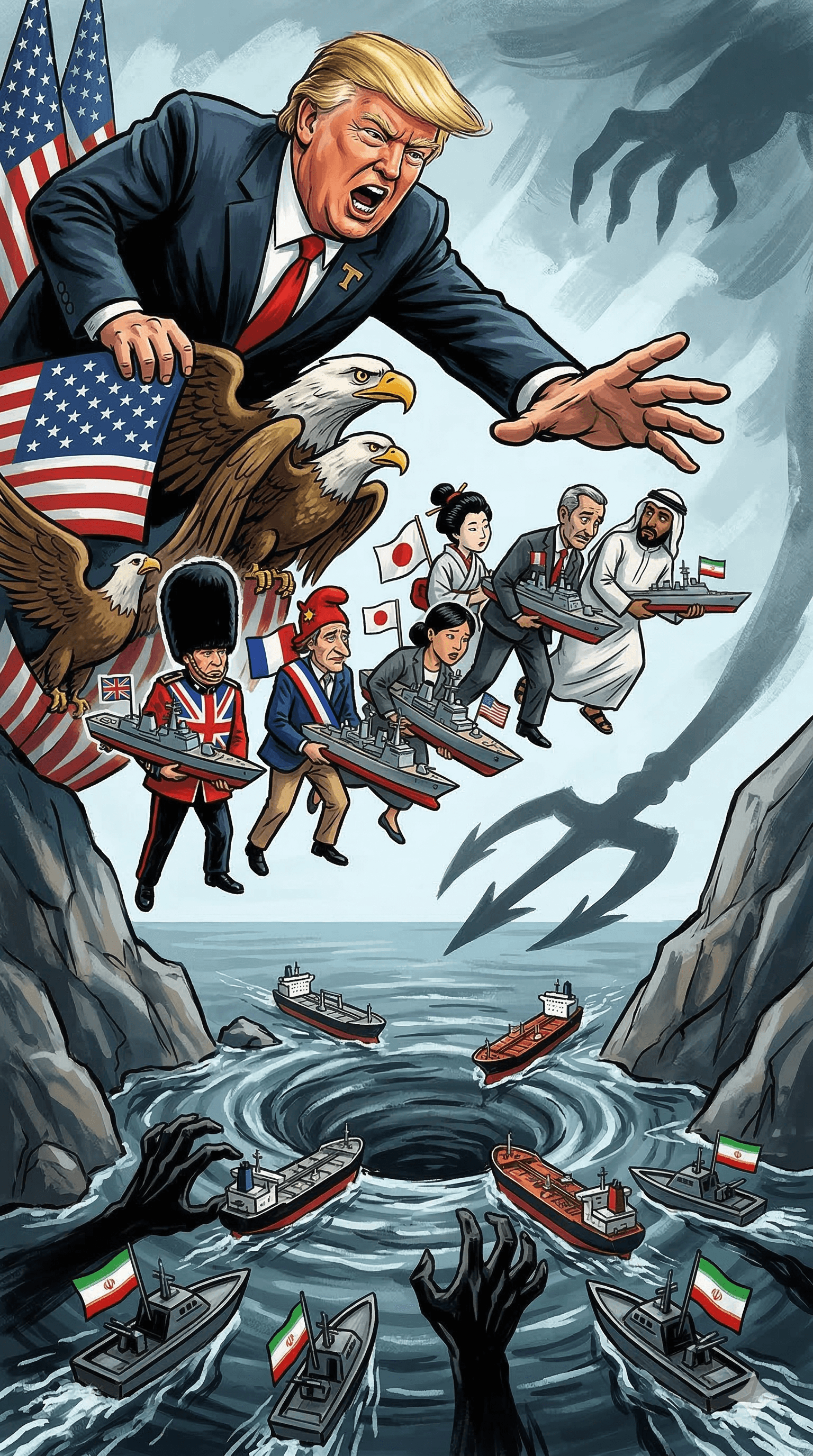
WASHINGTON — Amid an escalating conflict in West Asia and unprecedented disruptions to global energy markets, United States President Donald Trump has issued a direct appeal to international powers: deploy naval fleets to help secure the Strait of Hormuz. In a comprehensive statement released on Saturday, Trump called upon major economic players—specifically naming China, Japan, France, South Korea, and the United Kingdom—to actively participate in reopening the vital maritime chokepoint.
The international plea arrives as Iran’s retaliatory blockade of the waterway threatens to paralyze the global economy, already pushing benchmark Brent crude oil prices well past the $100 per barrel mark. With the United States actively engaged in military operations across the region, the call for a multinational maritime coalition underscores the immense logistical challenge of policing one of the world's most critical shipping lanes.
A Call for International Naval Support in the Gulf
Taking to his Truth Social platform on Saturday, President Trump emphasized that the burden of securing global trade routes should not fall solely on the American military. He projected confidence that international partners would step forward to combat what he described as an "artificial constraint" on global energy.
"Many countries, especially those who are affected by Iran’s attempted closure of the Hormuz Strait, will be sending War Ships, in conjunction with the United States of America, to keep the Strait open and safe," Trump wrote.
The direct naming of nations like China, Japan, and South Korea highlights a long-standing geopolitical friction point. For years, the U.S. has provided the primary security umbrella for Middle Eastern oil shipments, a significant percentage of which flows directly to Asian markets. By urging these nations to send ships "so that the Hormuz Strait will no longer be a threat by a Nation that has been totally decapitated," the administration is demanding that the world's biggest oil importers shoulder the military and financial responsibility of protecting their own economic lifelines.
The Strategic Importance of the Strait of Hormuz
To understand the gravity of the current maritime standstill, one must look at the geography and economics of the Strait of Hormuz. Measuring just 54 kilometers (34 miles) wide at its narrowest point, the strait is the sole sea passage connecting the Persian Gulf to the open ocean.
In times of peace, approximately 20% of the global petroleum supply and a massive volume of liquefied natural gas (LNG) pass through this narrow corridor every day. The conflict, which erupted aggressively in late February, has essentially halted international commercial shipping in the area. At least 14 commercial vessels have reportedly been struck by projectiles since the hostilities began, completely shifting the risk calculus for global shipping conglomerates.
Unprecedented Oil Supply Disruption
The economic fallout has been swift and severe. The International Energy Agency (IEA) recently characterized the ongoing fighting as the "largest supply disruption in the history of the global oil market." Global oil prices, which hovered around $72 a barrel just weeks ago, have skyrocketed.
The blockade has created a massive backlog of commercial ships anchored off the coast of the United Arab Emirates, unable or unwilling to risk the transit. Iran has further inflamed anxieties by threatening to target commercial ports in neighboring Arab states, including critical hubs in Dubai and Abu Dhabi, if they are used to harbor U.S. forces. This marks a dangerous expansion of the conflict, directly threatening non-U.S. civilian and economic infrastructure.
Decimated but Dangerous: The Iranian Threat in the Waterway
The military dynamic in the region has shifted drastically since the U.S. and Israel initiated joint strikes on February 28. President Trump asserted over the weekend that the allied offensive has "already destroyed 100% of Iran’s military capability." Heavy bombardments have targeted key Iranian assets, including military installations on Kharg Island, Iran's primary oil export terminal.
However, maritime security experts note that controlling the Strait of Hormuz does not require a conventional naval fleet. Iran’s Islamic Revolutionary Guard Corps (IRGC) has long specialized in asymmetric naval warfare.
Trump acknowledged this persistent tactical threat in his statement, noting that "it’s easy for them to send a drone or two, drop a mine, or deliver a close-range missile somewhere along, or in, this Waterway, no matter how badly defeated they are." The deployment of naval mines, swarms of fast-attack speedboats, and shore-based anti-ship missiles presents a complex, grinding challenge that cannot be solved by aerial bombardment alone. Neutralizing these threats requires painstaking mine-sweeping operations and constant maritime patrols.
To counter this, Trump issued a stark warning to the remnants of Iranian forces: "In the meantime, the United States will be bombing the hell out of the shoreline and continually shooting Iranian Boats and Ships out of the water."
US Military Escalation and Escort Plans
While the U.S. commands the world's most powerful navy, establishing a secure corridor for slow-moving oil tankers takes time and immense resources. Earlier in the week, U.S. Energy Secretary Chris Wright told CNBC that the military was "not ready" to immediately begin escorting oil tankers, as naval resources were currently prioritized for active combat operations against Iran. However, Wright noted that escort missions would likely begin "relatively soon," potentially by the end of the month.
To accelerate this timeline, the Pentagon has initiated a massive surge of forces. Defense officials confirmed the deployment of the Japan-based amphibious assault ship USS Tripoli, accompanied by approximately 2,500 Marines, to the Middle East. This deployment adds to the largest buildup of American military hardware in the region in decades, equipping forces with the necessary tools for complex maritime security, mine hunting, and potential coastal securing operations.
Outlook: A Tense Path to Reopening the Global Artery
As the conflict enters what Israeli defense officials have called a "decisive phase," the immediate focus of the global economy rests on the waters between Oman and Iran.
The coming weeks will reveal whether allied and rival nations heed Washington’s call to deploy their own naval vessels to the Gulf. A multinational coalition would not only distribute the military risk but also send a unified diplomatic message that the closure of global trade routes will not be tolerated by the international community.
For now, the standoff remains a volatile test of military endurance and economic resilience. President Trump left no room for ambiguity regarding the final objective, concluding his message with a definitive promise to global markets: "One way or the other, we will soon get the Hormuz Strait OPEN, SAFE, and FREE!"
#StraitOfHormuz #GlobalEconomy #Geopolitics #EnergyCrisis #OilPrices #USNavy #MiddleEastConflict #InternationalTrade #MaritimeSecurity #WorldNews