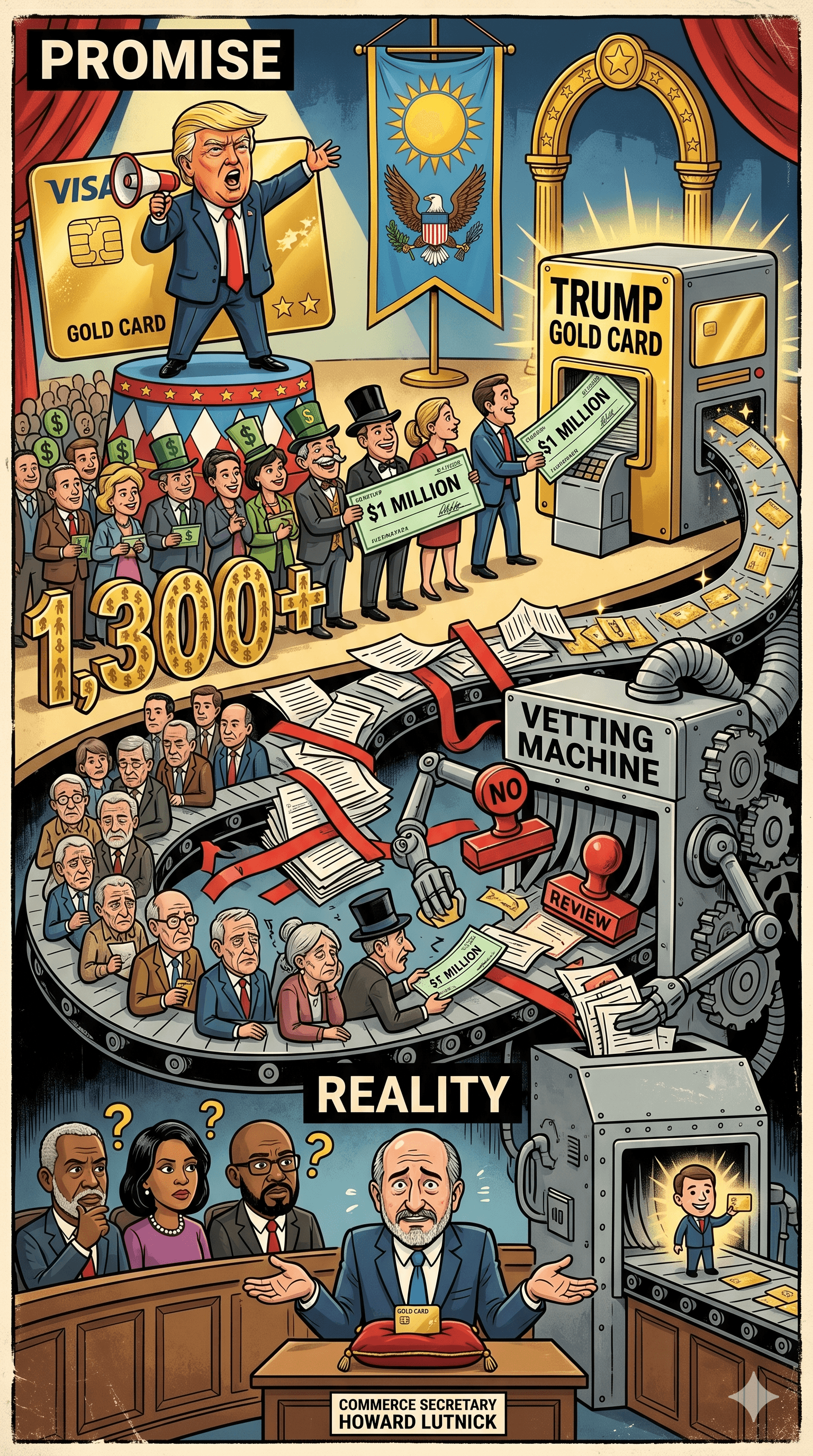
Commerce Secretary Howard Lutnick confirms a slow start to the expedited US residency program during a congressional hearing.
Four months after its highly publicized launch, the Trump administration’s ambitious "Gold Card" immigration program has hit a major speed bump. Billed as an expedited pathway to United States permanent residency for high-net-worth individuals, the $1 million visa program has seen exactly one approval to date.
Commerce Secretary Howard Lutnick confirmed the solitary approval during a congressional committee hearing in late April 2026. The revelation marks a stark contrast to previous claims from the administration, which suggested the program had immediately generated over $1.3 billion in revenue. As lawmakers and critics scrutinize the rollout, the Gold Card program stands at the center of a broader debate over the commodification of US immigration policy.
What is the Trump 'Gold Card' Visa Program?
Introduced via Executive Order 14351 in September 2025 and officially launched in December 2025, the Gold Card program was designed to rethink how the United States attracts foreign capital and talent. Billed by President Donald Trump as "the green card on steroids," the initiative allows wealthy foreign nationals to bypass traditional immigration hurdles by making a non-refundable financial "gift" to the US Department of Commerce.
Rather than proving extraordinary ability through traditional metrics or creating American jobs, applicants can effectively secure eligibility for EB-1 or EB-2 visa categories through sheer financial contribution. The baseline cost for an individual applicant is $1 million. Meanwhile, corporations looking to bypass standard H-1B or employment-based visa lines can sponsor a foreign-born employee by paying a $2 million contribution, plus a 1% annual maintenance fee.
The funds are deposited into a dedicated Treasury fund, which the administration claims will be utilized to promote American commerce and industry.
The Discrepancy: Billions Promised vs. Reality
The most glaring issue surrounding the Gold Card rollout is the massive gap between the administration's early boasts and the actual numbers presented under oath. Shortly after the program's official website went live in late 2025, Commerce Secretary Howard Lutnick publicly claimed that the government had sold $1.3 billion "worth" of the visas within a matter of days. He had previously projected the initiative could raise up to $1 trillion to help balance the federal budget and tackle the $31.3 trillion national debt.
However, when pressed by a congresswoman during the April 2026 committee hearing, Lutnick admitted that only a single applicant had fully cleared the process. While Lutnick sidestepped the direct discrepancy between his prior claims of rapid sales and the solitary approval, he defended the pace of the rollout. "They’ve just set it up, and they wanted to make sure they did it perfectly," Lutnick testified, adding that "hundreds" of applicants are currently sitting in the queue awaiting final adjudication.
The Stumbling Block: "Extraordinary Vetting"
According to the Department of Commerce, the bottleneck is not a lack of demand, but rather the intensive security and background checks required for each applicant. Before a foreign national can even transfer their $1 million gift, they must pay a non-refundable $15,000 processing fee to the Department of Homeland Security (DHS).
This fee covers what Lutnick described as "extraordinary vetting" and "rigorous" background checks, which include FBI name checks, biometrics, and deep-dive financial disclosures, including scrutiny of cryptocurrency holdings. Because the Gold Card offers an immediate path to lawful permanent residency—complete with unrestricted work authorization and a five-year track to US citizenship—authorities are taking immense precautions to ensure no security risks or individuals with criminal histories bypass the system.
Replacing the Traditional EB-5 Program
The Trump Gold Card is widely seen as a direct competitor—and potential replacement—for the decades-old EB-5 Investor Visa program. The traditional EB-5 route requires foreign nationals to invest at least $800,000 to $1 million into a new commercial enterprise that creates or preserves at least 10 full-time jobs for US workers.
By removing the job-creation mandate and the need to actively manage a business, the Gold Card offers a significantly more straightforward, albeit strictly transactional, route. Critics warn that this transition threatens to derail the domestic investments that the EB-5 program has historically funneled into rural and high-unemployment areas.
Political and Economic Implications
The Gold Card program has ignited intense political debate in Washington. Proponents argue it is a pragmatic, capitalist approach to immigration. By treating permanent residency as a premium asset, the United States can rapidly attract global wealth, siphon top-tier talent from international competitors, and directly inject billions into the federal treasury without raising domestic taxes.
Conversely, immigration advocates and legal experts have raised severe equity and fairness concerns. Opponents argue that the program explicitly commodifies US citizenship, allowing the global elite to jump the line while millions of family-sponsored and skilled immigrants languish in decades-long backlogs. Furthermore, the administration's proposed $5 million "Trump Platinum Card"—which would allegedly allow individuals to stay in the US for up to 270 days without paying taxes on non-US income—has raised alarm bells regarding international tax evasion and the creation of a two-tiered justice system.
Outlook and Impact
As the administration pushes further into 2026, the success of the Gold Card program hangs in the balance. The Department of Homeland Security must prove it can process the hundreds of backlogged applications efficiently without compromising national security. If the bottleneck clears, the initiative could fundamentally reshape global migration patterns for the ultra-wealthy, turning US residency into the world's most exclusive premium asset. However, if approvals remain stagnant, the $1 million Gold Card may be remembered not as a trillion-dollar economic engine, but as an ambitious administrative misfire that failed to deliver on its golden promises.