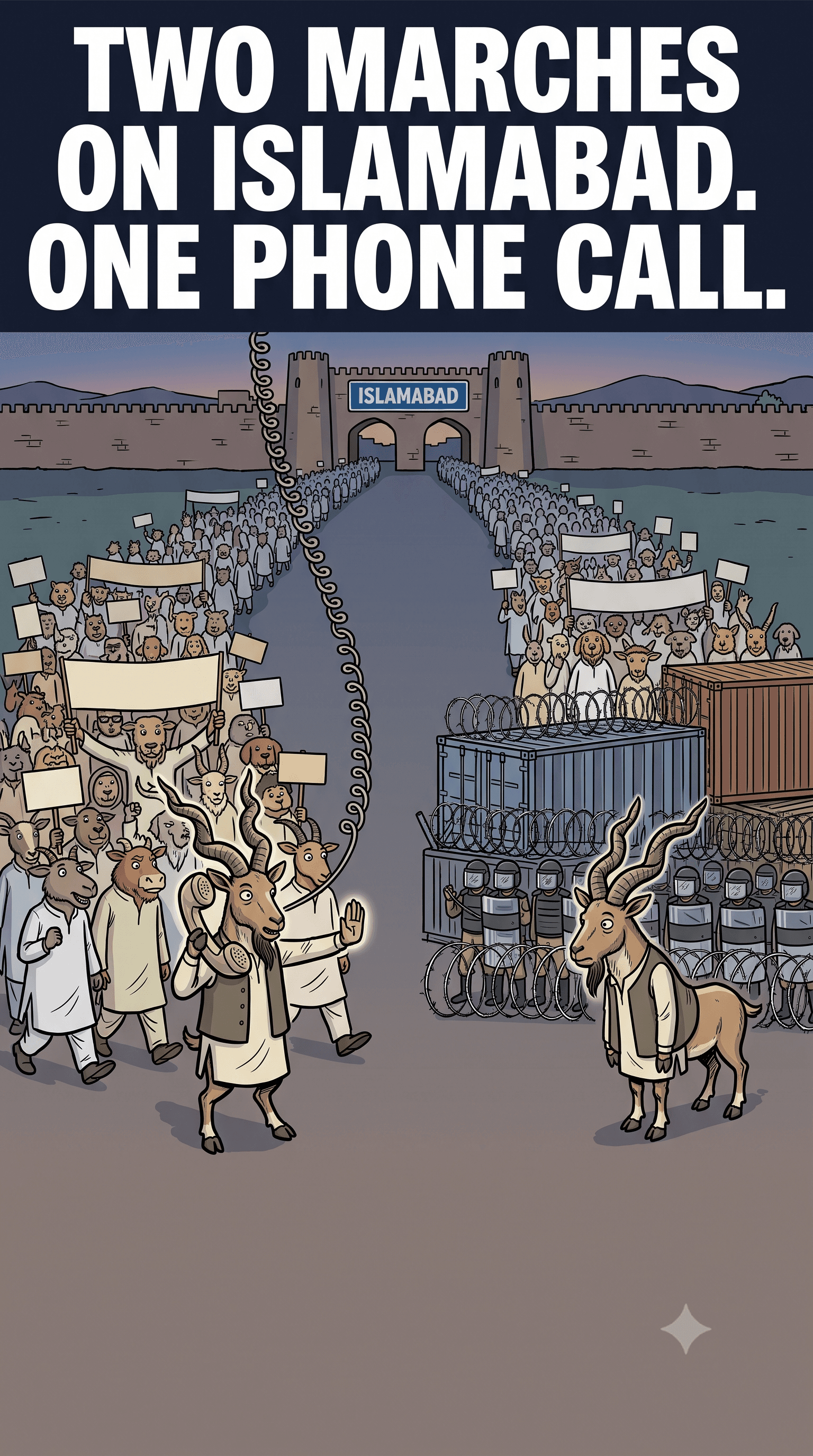
Jamaat-e-Islami and PTI are both moving on the capital this month. One was met with negotiation, the other with preventive detention — and the clearest explanation lies in what each of them is asking for.
On the evening of 21 September 2026, Prime Minister Shehbaz Sharif telephoned Hafiz Naeem ur Rehman, the emir of Jamaat-e-Islami, from New York, where he was attending the 81st session of the UN General Assembly. He asked him to postpone the long march then moving up the country toward Islamabad.
Rehman agreed. By the following day the caravan had halted at Multan, and he held a press conference to explain that the pause was not a retreat.
"We will not step back from our protests," he said. "We will not step back from our long march either." The party would meet the prime minister on his return from the United States. "If the prime minister provides relief in the meeting, it will be welcome. If there is a delay, the long march will proceed forward." He gave the government until roughly the first week of October.
He also offered a description of his own party that is worth holding onto: "We are a sensible party." And a warning: "the plans that we have made, ABC, according to them we won't be entering Islamabad from one place alone."
Six days after that scheduled meeting window opens, a different march is due to reach the same city. It has not been offered a phone call.
What Jamaat-e-Islami is marching about
The demand is narrow and entirely fiscal: scrap the petroleum levy.
Pakistan currently charges a levy of Rs114 per litre on petrol and Rs100 per litre on diesel. JI has been running sit-ins against it for about a month — Karachi, Lahore, Peshawar and elsewhere — before converting the campaign into a march on the capital.
The government's difficulty is that the levy is not a discretionary line item. The FY2026-27 budget sets a petroleum levy target of Rs1.6765 trillion, an increase of 11.8% — Rs178.5 billion — on the revised Rs1.498 trillion of the preceding year. The statutory cap on the levy was removed by amendment to the Petroleum Levy Ordinance. A separate Climate Support Levy is scheduled to rise from Rs2.50 to Rs5 per litre under an agreement with the International Monetary Fund.
In other words, the petrol pump is carrying a very large share of federal revenue, and the arrangement is externally supervised. When government negotiators met JI for a fifth round of talks on 19 September — Ahsan Iqbal, Rana Sanaullah and Khawaja Salman Rafique on one side, a JI delegation led by deputy emir Liaqat Baloch on the other — they said exactly that, citing IMF pressure and an expected IMF delegation visit, and promised that "practical measures would be taken soon to provide significant relief."
JI refused. Rehman's position was that talks required a written offer first: "If it comes with a formal and serious proposal to abolish the petroleum levy, only then will talks take place." The round ended without a breakthrough, and the march set out from Karachi.
Then the prime minister rang, and it stopped.
What happened to the other march
PTI has called its own march on Islamabad for 27 September, with a single demand: the release of Imran Khan, imprisoned since 2023.
The state's response has run on entirely different rails.
By 12 September, 106 PTI activists had been detained for thirty days under Section 3 of the Maintenance of Public Order Ordinance — a preventive-detention provision that requires no charge. The reported district breakdown was Attock 35, Rawalpindi 31, Chakwal 23, Jhelum 13 and Wah Cantt 4, with the orders issued on the recommendation of a District Intelligence Committee and the detainees received at Adiala Jail. More than thirty others had reportedly been held under the same provision earlier.
On 14 September, PTI chairman Barrister Gohar Ali Khan said around 700 workers had been arrested over the preceding four or five days and that lists had been drawn up for roughly a thousand more. That is the party's own figure and no official confirmation or denial was reported alongside it; it should be read as an allegation, not an established count. Further detentions of PTI figures in Punjab and Islamabad were reported in the following week.
Interior Minister Mohsin Naqvi — the same minister who has warned JI marchers against taking the law into their own hands — was considerably more explicit about PTI. The government would prevent the march "in every possible way." Law enforcement had instructions to block protesters from entering the capital, in line with an Islamabad High Court ruling prohibiting political parties from occupying public roads, highways or buildings.
"If someone comes out after the court's decision, we will first initiate contempt of court proceedings," he said. "Otherwise, we will not allow anyone to come out." He added that security forces had been given clear rules of engagement and would respond if fired upon, referring to previous protests in which firearms had been used.
The difference is in what is being asked for
Two opposition parties. One capital. One week apart. One interior minister. Two instruments that have almost nothing in common.
The most economical explanation is not about the parties. It is about the structure of their demands.
JI's demand is divisible. A tax can be cut by a rupee or ten rupees, phased, offset by a targeted subsidy, or suspended for a quarter. Every one of those is a settlement in which both sides can announce a win: the government keeps most of its revenue line and its IMF commitments, the party tells its workers it forced relief at the pump. There is a bargaining range, and a phone call is a cheap way to find it. Note what the prime minister actually offered — a meeting, not a concession. It was enough, because with a divisible demand the prospect of a number is itself worth something.
PTI's demand is not divisible. There is no partial release of Imran Khan. There is no version of that outcome in which the government gives 40% and calls it relief. It is also, formally, not the executive's to give — his imprisonment runs through the courts — which means the government can decline without appearing to decline anything.
A demand with no bargaining range cannot be negotiated, only conceded or blocked. And a demand that would reorder the central political question of the country is not one an incumbent concedes. What is left is the machinery of prevention: preventive detention under 3-MPO, a court order against road occupation, and contempt proceedings held in reserve.
The other explanation, stated fairly
PTI and its supporters give a simpler account: the difference is political persecution. On this reading, JI is a manageable opponent whose protest can be absorbed, while PTI is the government's principal electoral threat, and the law is therefore applied to it with a severity not applied to anyone else. Its candidates, barred from contesting under the party symbol, still won the largest bloc of National Assembly seats as independents in February 2024. Detaining 106 people without charge, on the recommendation of an intelligence committee, is a hard fact to fit into a purely procedural story.
The government's account is also coherent on its own terms. It says it is enforcing a High Court order that applies to all parties equally; that PTI's previous marches on Islamabad produced violence, including the use of firearms, which JI's sit-ins have not; and that preventive detention ahead of an anticipated breach of public order is a lawful instrument, however uncomfortable.
These explanations are not mutually exclusive, and this piece does not resolve which weighs more. What can be said is narrower: even if the intent were identical in both cases, the tools available would still differ, because one demand has a price and the other does not.
A note on what is solid and what is not
Firm: the prime minister's call and JI's postponement; the levy rates and the budget target; the composition and failure of the fifth round of talks; Naqvi's quoted statements; the 3-MPO detention of 106 activists with the district breakdown; the 27 September march date.
Contested or single-sourced: PTI's figure of 700 arrests and lists for a thousand more is a party claim without reported official response. Reports of further detentions, including of members of Imran Khan's family, rest on individual outlets. Outlets also differ on small details of the march itself — some date its departure from Karachi to 20 September, others to the 21st, and the prime minister's call is placed on Monday evening by one account and Tuesday by another.
Unknowable from here: what was actually said on the call, and what the government intends to offer when the meeting happens.
What to watch
Whether the meeting produces a number. If the government comes back with a specific reduction — even a small one — the divisibility argument holds and JI takes the win. If it offers only a subsidy scheme with no change to the levy, Rehman has already said what follows.
Whether the 27 September march happens at all. Prevention has two possible outcomes, and they look nothing alike: a march that never forms, or a confrontation at the edge of the capital.
Whether the IMF delegation's visit changes the arithmetic. The government has made the Fund its explanation for why the levy cannot move. That is a verifiable claim, and the review will test it.
And whether the two oppositions ever converge. They are marching on the same city, in the same month, against the same government, entirely separately. That separation is currently the government's largest asset.
Sourcing note: The prime minister's call, JI's postponement and Hafiz Naeem ur Rehman's quotations are reported by Dawn and Arab News (21–22 September 2026). Petroleum levy per-litre rates are from Arab News; the Rs1.6765 trillion FY2026-27 target, the 11.8% increase and the Climate Support Levy change are from Business Recorder's reporting on the budget. The fifth round of government–JI talks, its participants and Rehman's precondition are from The Express Tribune (19 September 2026). Mohsin Naqvi's statements on the PTI march are from The Nation (19 September 2026). The detention of 106 PTI activists under 3-MPO, with the district breakdown, is from Daily Pakistan (12 September 2026). The figure of approximately 700 arrests is Barrister Gohar Ali Khan's claim, reported by Samaa (14 September 2026), and is not independently confirmed. Where outlets differ on dates, both versions are noted above.