KYIV, Ukraine — The landscape of the ongoing conflict between Ukraine and Russia has shifted significantly toward the sea and energy sectors. In a series of high-precision operations, Ukrainian long-range maritime and aerial drones have successfully targeted Russian naval assets and critical oil infrastructure, marking a major escalation in what analysts are calling the "War of Attrition 2.0."
As of May 2026, the strategic focus has transitioned from frontline trench warfare to a systematic dismantling of Russia’s economic engine: its oil export capabilities. These recent strikes have not only disrupted logistics but have also sent ripples through global energy markets, forcing a recalculation of maritime security in the Black and Baltic Seas.
The Strategic Strike on Primorsk and Novorossiysk
Over the first weekend of May 2026, Ukrainian forces launched one of their most ambitious drone swarms to date. The primary target was the Port of Primorsk in the Leningrad Oblast—Russia's largest oil-loading hub on the Baltic Sea. Situated over 1,000 kilometers from the Ukrainian border, the facility represents a vital artery for Russian crude flowing to international markets.
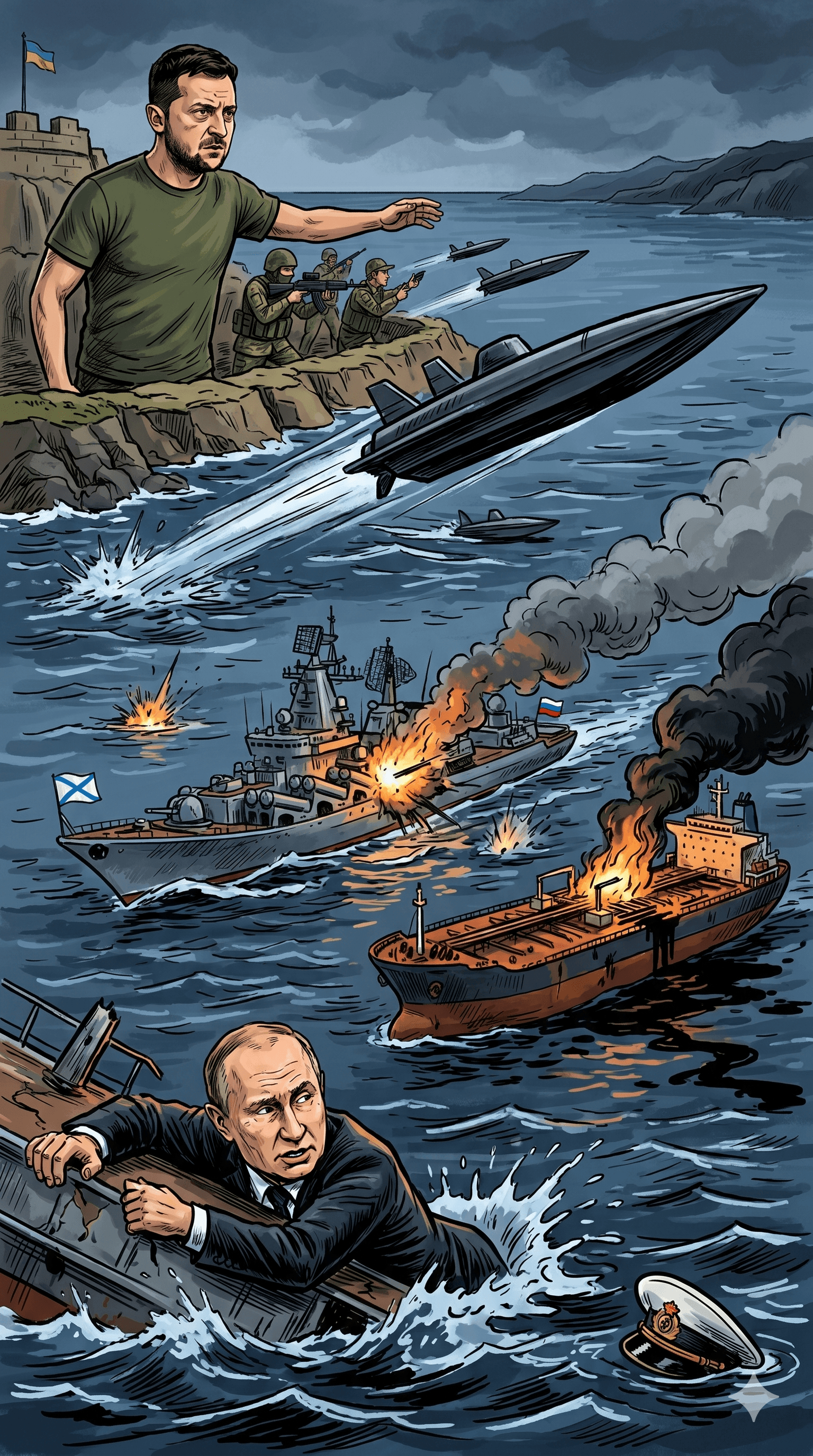
According to official statements from Kyiv, the operation utilized a new generation of domestically produced long-range UAVs. The strikes reportedly hit a Karakurt-class missile ship, a patrol boat, and at least one oil tanker docked at the terminal. While Russian regional authorities claimed the fires were quickly extinguished and denied significant environmental damage, satellite imagery and local reports suggested a much more chaotic scene, with thick plumes of black smoke visible for miles.
Simultaneously, in the Black Sea, maritime "sea baby" drones targeted the entrance to the Port of Novorossiysk. President Volodymyr Zelenskyy confirmed that two "shadow fleet" tankers—vessels used by Moscow to circumvent Western price caps and sanctions—were disabled during the raid. "These tankers had been actively used to transport oil – not anymore," Zelenskyy stated, emphasizing that Ukraine’s long-range capabilities are now being developed comprehensively across air, land, and sea.
Targeting the "Shadow Fleet": An Economic Necessity
The focus on oil tankers and the shadow fleet is a calculated move by the Ukrainian General Staff. For years, Russia has relied on an aging fleet of independently owned tankers to move oil without the oversight of G7-aligned insurance or shipping companies. By targeting these specific vessels, Ukraine is effectively increasing the insurance premiums and operational risks for any entity willing to transport Russian energy products.
Economically, the impact is mounting. Recent data indicates that Russia’s oil refinery capacity has dropped to its lowest level in 16 years, averaging approximately 4.69 million barrels per day. This decline is a direct result of more than 140 strikes on oil infrastructure throughout late 2025 and early 2026. Ukrainian intelligence estimates that these disruptions have already cost the Kremlin over $7 billion in lost revenue this year alone.
The Evolution of Maritime Drone Warfare
The "drone war" described in recent headlines refers to the rapid evolution of Unmanned Surface Vessels (USVs). Ukraine, which technically lacks a traditional navy, has managed to neutralize a significant portion of Russia’s Black Sea Fleet through the use of low-cost, high-impact suicide drones.
These USVs are now being equipped with advanced electronic warfare (EW) resistance, allowing them to bypass Russian naval defenses that were previously considered impenetrable. The psychological impact is as significant as the physical damage; Russian naval commanders have been forced to relocate many of their most valuable assets from the exposed port of Sevastopol to the eastern shores of the Black Sea.
Key Technological Advancements:
Increased Range: Drones are now capable of traveling over 1,200km, putting the entire Baltic coastline within reach.
Stealth Profiles: Low-to-the-water designs make radar detection extremely difficult in choppy seas.
Coordinated Swarming: AI-driven swarming logic allows multiple drones to distract point-defense systems while a "killer" unit strikes the hull's waterline.
Geopolitical and Global Energy Implications
The intensification of the drone war comes at a delicate time for global markets. Kremlin spokesperson Dmitry Peskov warned that continued attacks on energy infrastructure would inevitably lead to a spike in global oil prices, which have already hovered above $120 a barrel due to tensions in the Middle East.
However, Western analysts argue that the primary victim of these strikes is the Russian federal budget. While global prices may rise, Russia’s ability to export its specific grades of crude is being physically restricted. The damage to loading arms, pumping stations, and refinery towers is often difficult to repair quickly due to international sanctions on high-tech replacement parts.
Furthermore, the environmental risk is becoming a point of international concern. The Black Sea region, a major tourist destination and ecological haven, now faces the threat of significant oil spills. Russian President Vladimir Putin recently warned of "serious environmental consequences," though Kyiv maintains that the responsibility lies with the occupying force that continues to use civilian-adjacent infrastructure for military logistics.
Strategic Outlook: A New Phase of the Conflict
As we move further into 2026, the "asymmetric" nature of the war is likely to deepen. Ukraine’s strategy appears to be a "death by a thousand cuts," targeting the financial foundations of the Russian military-industrial complex. By hitting ships and tankers, Kyiv is not just fighting a battle for territory, but a battle for the very resources that sustain the conflict.
The coming months will likely see an expansion of this drone campaign. With Ukrainian domestic production of long-range systems scaling up, the distance between the front line and the "safe zones" of Russian industry continues to shrink. For the maritime industry, the Black and Baltic Seas have transitioned from routine trade routes to active combat theaters, requiring a total overhaul of global shipping logistics.
The intensification of the drone war serves as a stark reminder: in modern conflict, the most decisive blows are often delivered not by large standing armies, but by small, autonomous systems capable of striking the heart of a nation's economy.