The Strike That Stunned a Capital
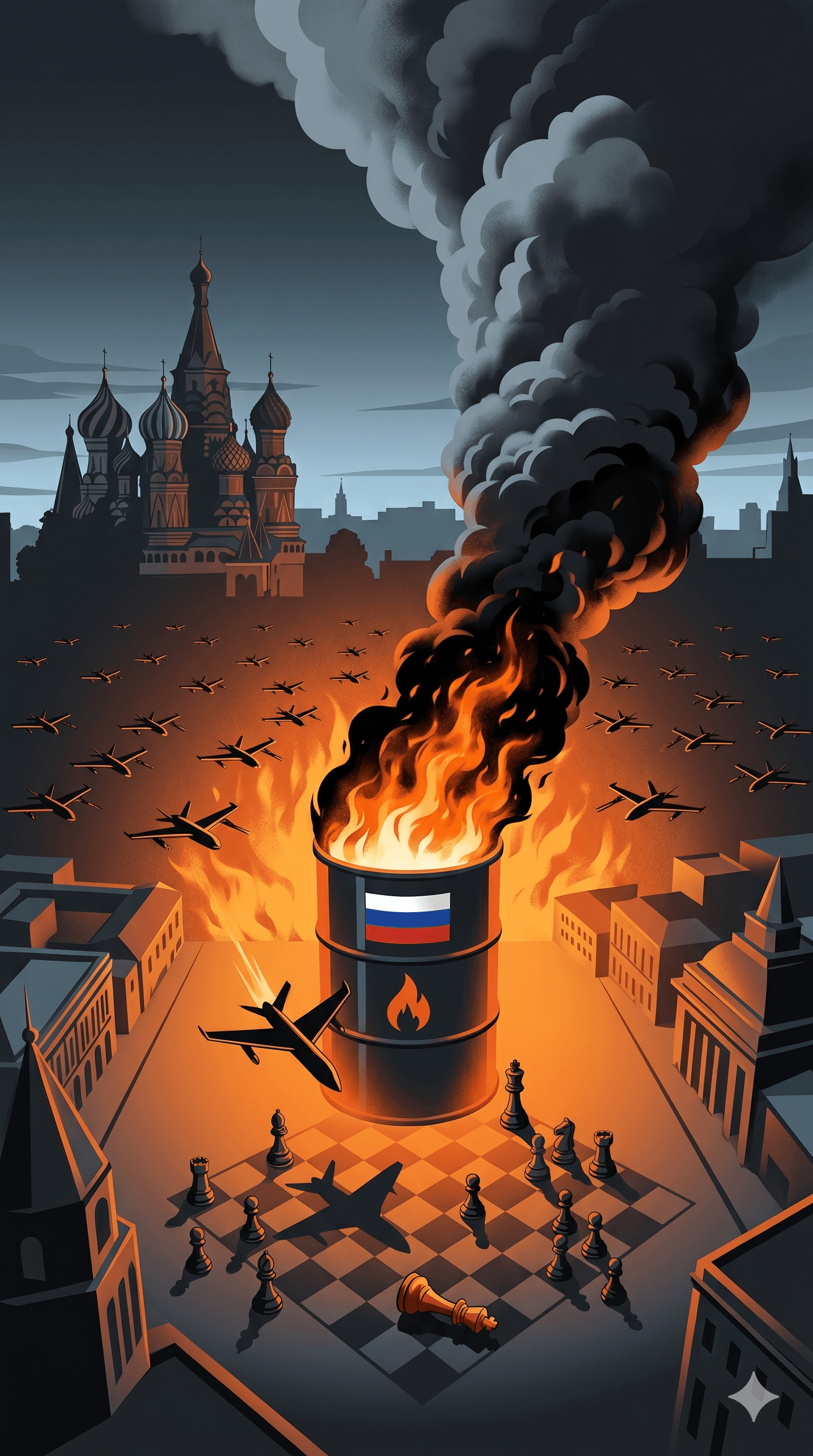
In the early hours of Thursday, June 18, 2026, Moscow woke to the sound of air defense guns and the sight of black smoke rising over its southern skyline. Ukraine had just launched the largest drone assault on the Russian capital since the war began more than four years ago — and this time, the target wasn't a distant airfield or a provincial city. It was the heart of Russia's energy infrastructure, just ten miles from the Kremlin.
The Gazprom Neft Kapotnya refinery, which supplies roughly a third of the fuel to the Moscow metropolitan region, was set ablaze for the second time in seventy-two hours. Russian air defenses claimed to have intercepted 555 Ukrainian drones across the country overnight — nearly 200 of them approaching Moscow alone. Some got through. Videos verified by international news agencies showed drones flying directly into the burning facility, explosions lighting up the pre-dawn sky, and plumes of black smoke engulfing residential neighborhoods.
It was not just a military operation. It was a message.
The Campaign Behind the Strike
This attack did not happen in isolation. Over the past several weeks, Ukraine has systematically escalated a long-range drone campaign targeting Russia's energy infrastructure — refineries, fuel depots, and the supply chains feeding Russia's war machine and domestic economy.
The logic is straightforward: hit the fuel, hit the funding. Russian oil revenues have long underwritten the Kremlin's ability to sustain the war in Ukraine. By targeting refinery capacity and fuel trucks supplying annexed Crimea, Kyiv has triggered gasoline rationing across dozens of Russian regions. Industry sources confirmed this week that Russia has been forced to import fuel from Asian markets by sea — a humiliation for the world's second-largest oil exporter.
The Kapotnya refinery had already been struck Tuesday. It was back in flames Thursday morning, with videos showing fire crews unable to contain the second blaze before it surpassed the first in scale.
Zelenskyy's Declaration
Ukrainian President Volodymyr Zelenskyy made no effort to be subtle in his response. "This is a fully justified response to Russian attacks on our cities and communities," he posted on social media, adding: "It is time the war ended, and Russia must take the necessary steps in diplomacy."
Ukrainian Foreign Minister Andrii Sybiha went further, addressing Muscovites directly on the platform X: "One of the most popular questions asked by Muscovites this morning is 'What is going on?' I can answer. Your country started a war of aggression against ours."
The attack came as revenge, Kyiv said, for Russian missile strikes on Kyiv earlier this week — including a strike that damaged a landmark thousand-year-old monastery, drawing international condemnation. Russia fired missiles on Kyiv on Thursday as well, marking the second such strike in a week.
Timing: The Brussels Factor
The assault was timed — whether by design or coincidence — to land on the same morning that NATO defense ministers gathered in Brussels for a summit where Ukraine's security guarantees were among the central agenda items.
It arrives as a significant diplomatic shift appears to be underway. At the G7 summit in Évian-les-Bains, France, U.S. President Donald Trump signaled renewed engagement with the Ukraine conflict, suggesting he may back tougher action against Russia to press it toward the negotiating table. Canadian Prime Minister Mark Carney described Trump's updated position as "more realistic" about the situation on the ground.
Western officials and analysts say Ukraine has been gaining battlefield momentum throughout May and into June — recapturing territory in western Zaporizhzhia and near Kupyansk at the highest rate since its 2023 offensive. The drone campaign has amplified that momentum beyond the frontlines and into the Russian heartland.
A Fuel Crisis Deepens
The consequences of Ukraine's campaign are no longer abstract. Gazprom Neft's Kapotnya plant — one of Russia's largest refineries — has now been struck twice in a single week and reportedly halted operations after the first hit. The facility supplies a third of the greater Moscow region's gasoline and diesel.
Sheremetyevo airport, Moscow's busiest, suspended flights and was evacuated during Thursday's attack. Major roads in and around the capital were closed. Seventeen people were injured in the Moscow region, including two children, according to regional governor Andrei Vorobyov. A residential building was struck in the town of Zhukovsky. A shopping mall roof caught fire from drone debris.
Russia launched roughly half as many drones at Ukraine overnight as Ukraine sent toward Russia — a reversal that illustrates the shifting technological balance in this war.
Putin's Dilemma
The attack is the latest in a string of embarrassments for President Vladimir Putin. Ukrainian drones recently struck his hometown of St. Petersburg. Now Moscow's skyline has been shrouded in smoke twice in one week. Internal discontent with Putin's leadership has been quietly building, and the images emerging from the capital Thursday morning — a woman walking past a mall as black smoke towers over the city — are exactly the kind of optics the Kremlin has worked for four years to prevent.
For more than four years, the Kremlin framed this as a contained "special military operation" far from ordinary Russian life. The fires burning over Moscow this morning suggest that framing is no longer sustainable.
What Comes Next
Ukraine's drone capability has undergone a technological leap that Western allies say has fundamentally shifted the conflict's dynamics. With NATO defense ministers meeting in Brussels and Trump signaling a harder line on Russia, Kyiv is pressing its momentum on every available front — military, diplomatic, and psychological.
The question now is whether Putin responds with further escalation, seeks a path to the table, or continues a war he increasingly cannot insulate his own capital from. Thursday morning's smoke over Moscow may prove to be a turning point — or the opening move of a far more dangerous escalation.
The war is no longer staying at the front.