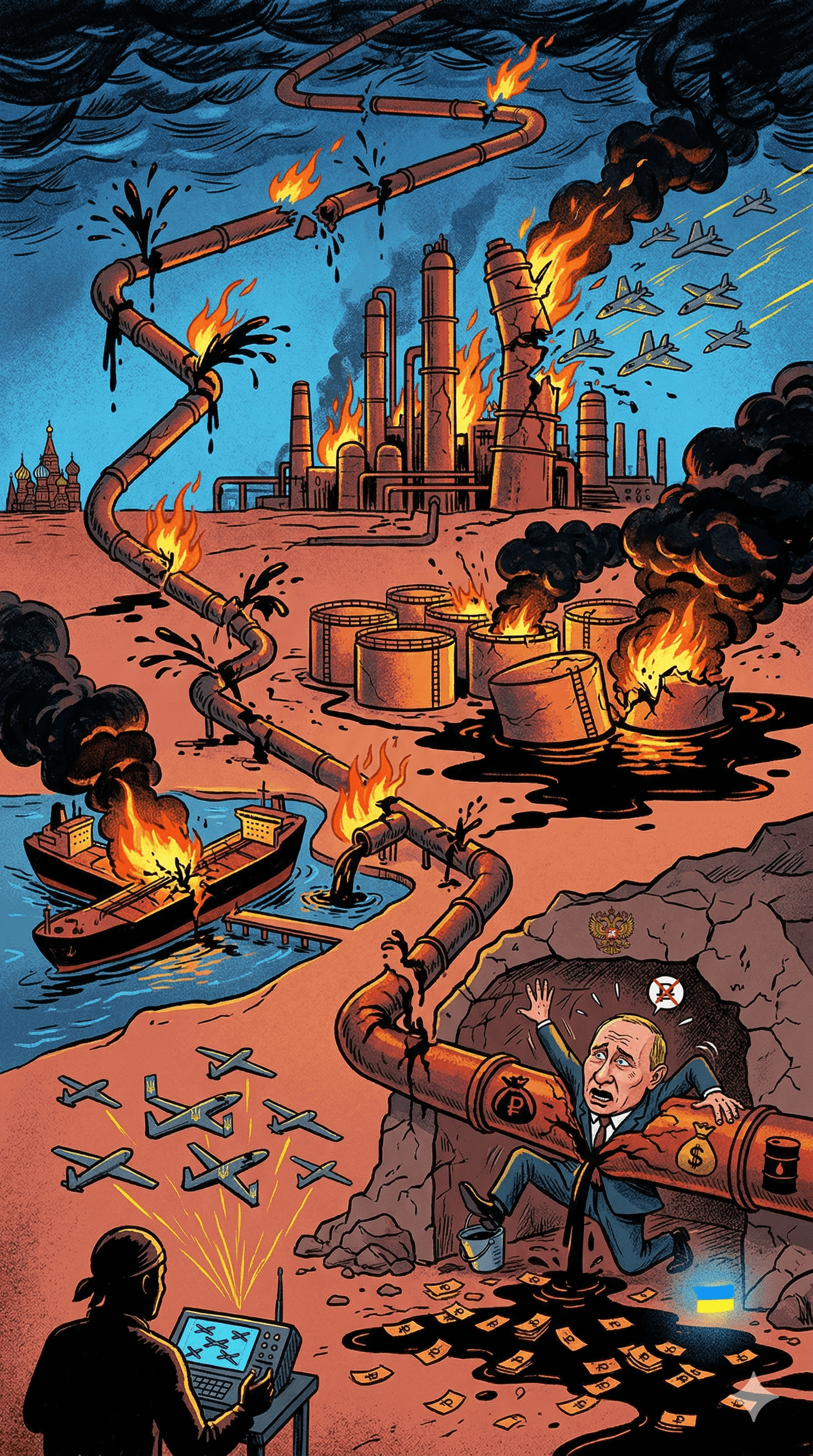
In a dramatic escalation of the ongoing conflict, Ukraine has renewed and intensified its drone campaign against Russian energy sites, executing what industry analysts are calling the most severe oil supply disruption in modern Russian history. By late March 2026, coordinated Ukrainian drone strikes have successfully knocked out an estimated 40% of Russia’s oil export capacity.
With roughly 2 million barrels per day of Russian oil currently offline, the strategic focus of the war has firmly shifted toward economic attrition. As Ukraine renews attacks on Russian energy sites, the global energy market is bracing for the fallout. But what exactly has been hit, and what is driving this aggressive tactical shift?
What Has Been Hit? Key Russian Energy Sites Targeted
Ukraine’s long-range drone program has systematically targeted the backbone of the Russian war economy: its oil refineries, export terminals, and logistical hubs. The most recent wave of strikes, occurring in late March 2026, successfully bypassed deep Russian air defenses to strike critical infrastructure.
The Saratov Oil Refinery
On March 21, 2026, Ukrainian drones struck the Saratov oil refinery, a strategic asset controlled by the state oil giant Rosneft. Located hundreds of kilometers from the Ukrainian border, the facility processes roughly 4.8 million tons of crude oil annually, supplying gasoline, diesel, and aviation fuel directly to the Russian military.
The strike severely damaged a secondary oil refining unit and ignited a 10,000-ton diesel fuel reservoir, triggering a massive blaze and forcing the refinery to suspend operations. The damage to these core processing installations is operationally significant, as replacing specialized refining equipment under heavy Western sanctions often takes months.
Baltic and Black Sea Export Terminals
Beyond inland refineries, Ukraine has expanded its targets to coastal export hubs. Drone strikes severely disrupted operations at Primorsk and Ust-Luga, Russia’s two largest Baltic Sea ports. Following a series of strikes that ignited storage tanks and damaged pumping infrastructure, crude loadings at both ports were suspended.
The immediate result was a massive logistical bottleneck. Ship-tracking data indicated that at least 50 oil tankers were left idling in the Gulf of Finland, unable to load their cargo. Simultaneously, operations at the Black Sea port of Novorossiysk—which typically handles about 700,000 barrels per day—have fallen significantly behind schedule due to ongoing security threats and previous infrastructure damage.
Pipeline Disruptions
Adding to the maritime disruptions, Russia’s pipeline exports to Central Europe have also been heavily compromised. The Druzhba oil pipeline, which traditionally transports Russian crude through Ukraine to Hungary and Slovakia, has seen its operations effectively halted since early 2026 due to sustained combat damage and targeted kinetic attacks along its route.
The Strategy Behind Ukraine's "Kinetic Sanctions"
The strategic logic behind these strikes is clear: Kyiv is implementing a campaign of "kinetic sanctions." While Western economic sanctions have attempted to cap the price of Russian oil and limit Moscow's revenues, enforcement has proven difficult. Ukraine’s direct military action against Russian oil refineries and export terminals achieves what diplomatic sanctions often cannot—physically halting the production and sale of Russian fuel.
By crippling facilities like the Saratov refinery and the Baltic ports, Ukraine achieves two primary objectives. First, it directly deprives the Russian military of the refined aviation fuel and diesel required to sustain its mechanized ground offensives. Second, it slashes the export revenues that fund the Kremlin's war budget.
This campaign relies heavily on Ukraine's rapidly advancing domestic drone technology. Upgraded unmanned aerial vehicles (UAVs), such as the Liutyi strike drone, now boast ranges exceeding 1,200 kilometers, allowing Ukrainian forces to bypass Western restrictions on using imported long-range missiles for deep strikes inside Russian territory.
Retaliation for Russia’s Assault on the Ukrainian Grid
Ukraine’s renewed attacks on Russian energy sites do not exist in a vacuum; they are a direct response to Russia's relentless campaign to freeze Ukraine into submission. Since late 2024 and throughout the bitter winter of 2025–2026, Russia launched thousands of drones and ballistic missiles at the Ukrainian power grid.
These attacks decimated Ukraine’s thermal and hydroelectric power generation. At its peak, the Russian campaign destroyed massive portions of Ukraine’s pre-war installed capacity, plunging millions of civilians into prolonged blackouts lasting up to 16 hours a day. The United Nations Human Rights Monitoring Mission in Ukraine repeatedly warned that the destruction of heating and water infrastructure put vulnerable civilian populations at severe risk during freezing temperatures.
Faced with a war of attrition against its own civilian infrastructure, Kyiv escalated its strikes on Russian energy sites to force Moscow to redirect its air defense systems away from the front lines and toward protecting domestic oil assets.
Geopolitical and Economic Implications
The implications of Ukraine knocking 40% of Russia’s export capacity offline extend far beyond Eastern Europe. These disruptions are colliding with a highly volatile global geopolitical landscape.
Global Oil Markets: The sudden removal of 2 million barrels per day from the global market has sent shockwaves through energy trading desks. This tightening of supply is exacerbated by simultaneous conflicts in the Middle East, specifically the escalating tensions between Iran and Israel that have threatened energy infrastructure in the Persian Gulf.
Impact on Asian Buyers: Following Europe's move to decouple from Russian hydrocarbons, India and China emerged as the primary buyers of discounted Russian Urals crude. However, with the Baltic Sea ports of Primorsk and Ust-Luga suspended, these vital supply lines are choked. If Moscow cannot physically load tankers, even willing buyers in Asia will face supply shortages, forcing them to look elsewhere and driving up global benchmark prices.
Outlook: A Deepening Energy War
As the spring of 2026 approaches, the energy war between Russia and Ukraine shows no signs of de-escalation. Russia is likely to respond to the devastation of its oil export capacity with renewed, concentrated strikes against Ukraine’s remaining gas storage and electrical substations.
For global markets, the outlook remains precarious. Repairing complex, specialized oil refining units takes considerable time, meaning the disruption to Russian oil exports will not be resolved overnight. As long as Ukraine maintains its capability to launch deep drone strikes, Russian energy sites will remain highly vulnerable, ensuring that the economic shockwaves of this conflict will continue to be felt worldwide.