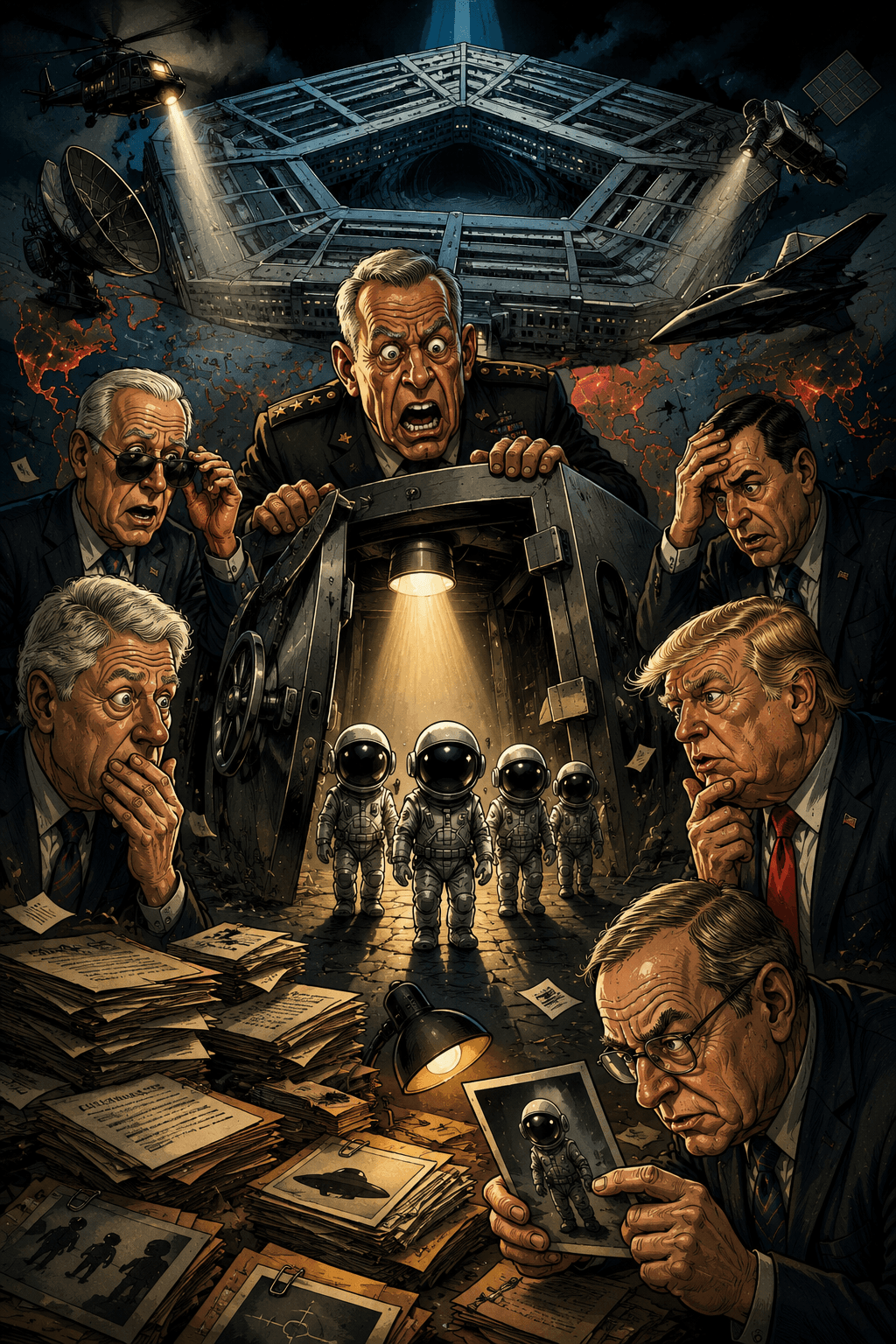
Recent discourse surrounding declassified military intelligence has reignited public fascination with historical Unidentified Anomalous Phenomena (UAP). Driven by viral headlines claiming that "Pentagon Files reveal witnesses seeing ‘four-foot-tall’ crewmen wearing space suits in 1996," geopolitical analysts and transparency advocates are once again scrutinizing the intersection of Cold War-era aerospace programs, witness testimonies, and government secrecy.
While sensationalized headlines often blur the line between science fiction and reality, the factual foundation of these claims rests on a complex history of classified military operations, global UAP lore—specifically the 1996 Varginha incident in Brazil—and the Pentagon’s official efforts to explain decades of civilian sightings. To understand the gravity of these reports, it is essential to separate extraterrestrial speculation from the geopolitical realities of aerospace defense.
The 1996 Connection: Witness Claims and the Varginha Incident
The year 1996 was a watershed moment for global UAP phenomena, driven by a mixture of highly publicized witness accounts and a booming cultural zeitgeist surrounding government cover-ups. The most notable international incident occurred in January 1996 in Varginha, Minas Gerais, Brazil. According to extensive media reports and civilian testimonies from the time, witnesses claimed to have encountered bizarre, "four-foot-tall" bipedal creatures with large red eyes and anomalous features.
The Varginha incident triggered massive military mobilization in Brazil, leading to persistent allegations that the Brazilian military, potentially in coordination with U.S. intelligence agencies, captured anomalous biological entities. While the Brazilian government officially attributed the civilian sightings to a misunderstood encounter with a local resident and the presence of mundane animals, the narrative of "four-foot-tall" beings became permanently embedded in global UAP history.
Simultaneously, in the United States, the mid-1990s saw immense public pressure on the Department of Defense to declassify files related to historical UAP sightings, culminating in a series of landmark reports that sought to explain what witnesses were actually seeing in the skies—and on the ground.
The Pentagon’s Official Stance: High-Altitude Space Suits and Crash Dummies
When analyzing claims of "crewmen wearing space suits," the empirical paper trail leads directly to the Pentagon’s official declassification efforts from the 1990s. In response to mounting public inquiries, the U.S. Air Force published The Roswell Report: Fact versus Fiction in the New Mexico Desert (1994) and its follow-up, The Roswell Report: Case Closed (1997).
These foundational "Pentagon files" thoroughly reviewed decades of witness testimonies describing small, anomalous crewmen. The military's declassified explanation was definitive: the "extraterrestrial entities" reported by civilians were actually anthropomorphic crash test dummies used in high-altitude balloon drops (such as Project Excelsior), or U.S. Air Force personnel wearing highly classified, full-body high-altitude pressure suits.
These early "space suits," heavily insulated and featuring reflective face shields to protect pilots from extreme temperatures and low atmospheric pressure, rendered the human form alien and unrecognizable to the average civilian. When classified aircraft or high-altitude balloons crashed, the subsequent retrieval operations by specialized military units were deeply secretive. Witnesses who stumbled upon these recovery sites saw short, bulky figures in bizarre suits, giving rise to decades of "alien crewmen" mythology.
More recently, the Pentagon’s All-domain Anomaly Resolution Office (AARO) released its Historical Record Report Volume 1, which reaffirmed these 1990s findings. AARO concluded that most historical UAP sightings and claims of "biologics" were the result of misidentifications of ordinary objects, or glimpses of heavily compartmentalized U.S. aerospace programs like the U-2 and A-12 reconnaissance aircraft.
Geopolitical and Strategic Implications
The geopolitical stakes behind these sightings and the subsequent government files are immense. During the Cold War and through the 1990s, the primary objective of the U.S. Department of Defense and allied nations was not to hide extraterrestrials, but to protect strategic technological supremacy from the Soviet Union and, later, other global adversaries.
Information Warfare and Compartmentalization: Allowing the public—and by extension, foreign intelligence agencies—to believe in alien spacecraft was, in some instances, a convenient smokescreen. It distracted from the rapid development of stealth technology, advanced drone platforms, and high-altitude surveillance systems.
International Alliances: Incidents like Varginha highlight the intricate defense networks in the Americas. The swift military response in Brazil and the rumors of U.S. involvement underscore the deep intelligence-sharing protocols that govern airspace security and material retrieval in the Western Hemisphere.
The Crisis of Public Trust: Today, the lingering secrecy has resulted in a domestic political challenge. U.S. lawmakers are currently battling over the UAP Disclosure Act, demanding that the Pentagon release unredacted files regarding anomalous aerospace threats. The withholding of information, originally designed to protect national security, has inadvertently fueled deep institutional distrust.
Economic and Social Context
The economic ripple effects of these historical UAP files are surprisingly tangible. In municipalities like Varginha, the 1996 incident transformed the local economy, creating a thriving "UFO tourism" industry that still operates today.
On a macroeconomic scale, the aerospace defense sector remains heavily influenced by the need to investigate uncharacterized incursions into restricted airspace. Billions of dollars are funneled into advanced radar systems, satellite tracking, and defense contracting to ensure that modern-day UAPs—which are now primarily recognized as foreign adversarial drones or advanced surveillance tech—are identified and neutralized.
Outlook: The Future of UAP Transparency
As the Pentagon continues to audit its historical archives through AARO, the narrative surrounding "four-foot-tall crewmen" and classified space suits serves as a crucial reminder of how human psychology and military secrecy intertwine. The reality revealed by declassified files is arguably more fascinating than the science fiction it inspired: a decades-long shadow war of aerospace innovation, hidden behind the reflective visors of high-altitude pressure suits.
Moving forward, the geopolitical pressure for total UAP transparency will only intensify. As global superpowers race to dominate the aerospace domain with next-generation stealth and hypersonic technology, the need for governments to clearly communicate what is in our skies has never been more critical.