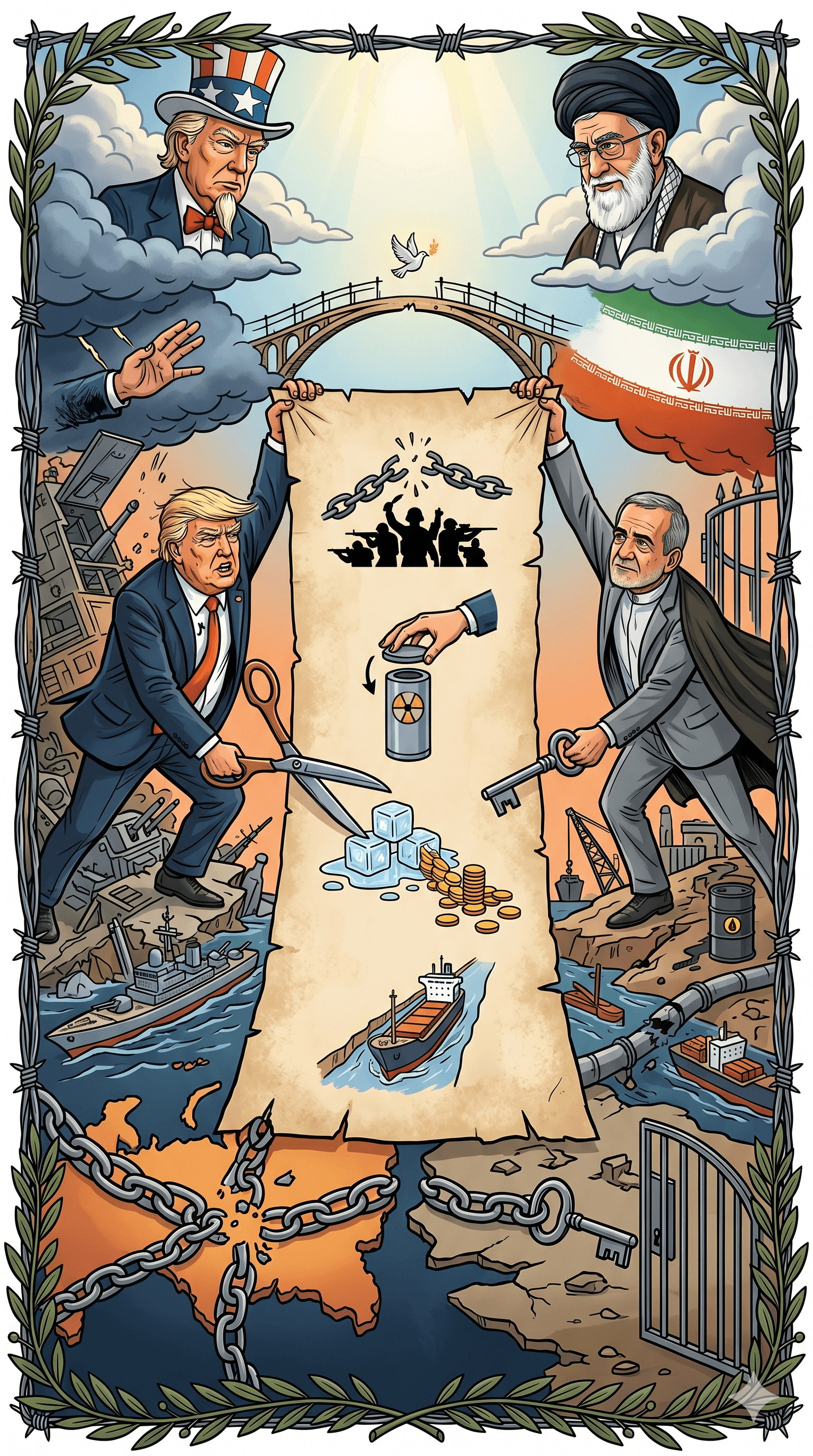
The United States and Iran are reportedly on the verge of a major diplomatic breakthrough that could reshape Middle Eastern geopolitics. According to recent reports, Washington and Tehran are closing in on a one-page memorandum of understanding (MOU) aimed at halting the ongoing military conflict and establishing a framework for comprehensive nuclear negotiations. As the international community watches closely, Washington anticipates a formal response from Iranian leadership on several critical issues within the next 48 hours.
While no final agreement has been formalized, U.S. officials consider this development the closest the two adversaries have come to ending hostilities since the war erupted on February 28 following joint U.S.-Israeli military strikes across the Islamic Republic. The potential deal has already sent significant ripples through global markets, triggering a drop in crude oil prices and prompting diplomatic appeals from major world powers like China.
The Breakthrough: What is in the Proposed One-Page Memo?
The preliminary framework currently under review is a 14-point draft negotiated through both direct channels and international mediators. The one-page memo is designed to formally declare an end to the war, which would immediately initiate a 30-day negotiation period aimed at finalizing a more detailed, long-term treaty.
If accepted by both nations, the terms of the memorandum would require major mutual concessions:
Nuclear Enrichment Moratorium: Iran would agree to a strict moratorium on uranium enrichment. The draft agreement also includes Iranian commitments to refrain from any weaponization-related activities, not to pursue nuclear weapons, and to accept expanded oversight, including snap inspections by United Nations inspectors. The duration of this enrichment pause remains a major sticking point; Iran initially proposed a five-year limit, while the U.S. demanded 20 years. Negotiators are currently discussing a compromise of at least 12 to 15 years. Additionally, there is discussion regarding the removal of highly enriched uranium from Iran, with one option being its transfer to the United States—a key U.S. demand previously rejected by Tehran.
Sanctions Relief and Financial Unfreezing: In exchange for verifiable nuclear concessions, the United States would agree to gradually lift crippling economic sanctions and release billions of dollars in frozen Iranian financial assets.
De-escalation of Blockades: Both sides would simultaneously ease their competing blockades. The U.S. would gradually roll back its naval blockade on Iranian ports, while Iran would remove its restrictions on shipping transits through the critical Strait of Hormuz.
Should the 30-day detailed talks—which may take place in Geneva or Islamabad—fail to produce a final agreement, Washington retains the right to reinstate its blockade and resume military action.
Unlocking the Strait of Hormuz and Economic Repercussions
The conflict has severely disrupted global energy supply chains, primarily due to the virtual shutdown of maritime traffic through the Strait of Hormuz, a critical artery that handles approximately 20% of the world's crude oil supply.
News of the impending one-page memo immediately triggered a sharp decline in energy markets. As traders factored in the potential return of Iranian oil supply and an end to supply chain disruptions, oil futures plunged on Wednesday. Brent crude for July delivery dropped by 5.4% to $103.88 per barrel. Similarly, U.S. West Texas Intermediate (WTI) futures saw a 6.3% decline, settling at $95.79 per barrel. U.S. crude inventories also dropped by 8.1 million barrels.
The blockade's sweeping global impact has drawn China directly into the diplomatic fold. In a recent meeting in Beijing with Iranian Foreign Minister Abbas Araqchi—his first trip to China since the war began—Chinese Foreign Minister Wang Yi emphasized that achieving a lasting ceasefire is an "urgent priority". Wang Yi called for the Strait of Hormuz to be reopened "as soon as possible," highlighting the international community's shared concern over restoring secure navigation through the vital waterway. Beijing, maintaining a stance of mediation without entanglement, praised Iran's commitment not to develop nuclear weapons and offered assistance in de-escalating the broader crisis.
The Diplomatic Players and Political Context
The path to this potential memorandum has been paved by intense diplomatic efforts spearheaded by the administration of U.S. President Donald Trump. The 14-point draft is currently being negotiated on Trump's behalf by special envoys Steve Witkoff and Jared Kushner. This follows an earlier round of 21-hour negotiations in Islamabad on April 11–12, led by U.S. Vice President JD Vance alongside Kushner and Witkoff, which initially concluded without a breakthrough.
The push for a diplomatic resolution coincides with the cessation of major military operations. The U.S. recently declared the end of "Operation Epic Fury," a 66-day bombing campaign against Iran. Furthermore, President Trump announced a temporary halt to "Project Freedom," a specific U.S. military mission aimed at forcibly reopening the Strait of Hormuz. Two U.S. officials indicated that the decision to pause the naval operation and maintain a fragile ceasefire—which Trump initially announced on April 7 and extended indefinitely on April 22—was heavily influenced by the tangible progress made in the recent talks.
Despite the optimism, internal political dynamics pose a risk to the fragile peace process. Earlier on Wednesday, Iran stated it would only accept a peace deal if it was "fair". The White House has noted deep divisions within the Iranian leadership, which may complicate Tehran's ability to forge a unified consensus on the agreement. U.S. Secretary of State Marco Rubio also urged caution, stating that the agreement process is highly technical and complex, and does not need to be finalized in a single day. Rubio underscored the necessity of a clear diplomatic framework for concessions and expressed skepticism regarding elements of the Iranian leadership, questioning whether they would ultimately commit to a deal.
Outlook and Impact
As the 48-hour window for Iran's response draws to a close, the international community remains cautiously optimistic. If the one-page memorandum is signed, it will mark a historic de-escalation of a conflict that has caused massive global economic disruption and threatened to engulf the broader Middle East. The subsequent 30-day negotiation period will be the true test of both nations' commitment to peace, requiring deep, verifiable compromises on nuclear infrastructure and economic sanctions. For now, global markets are breathing a temporary sigh of relief, though the structural complexities of U.S.-Iran relations ensure that the road to a lasting treaty will be fraught with diplomatic hurdles.