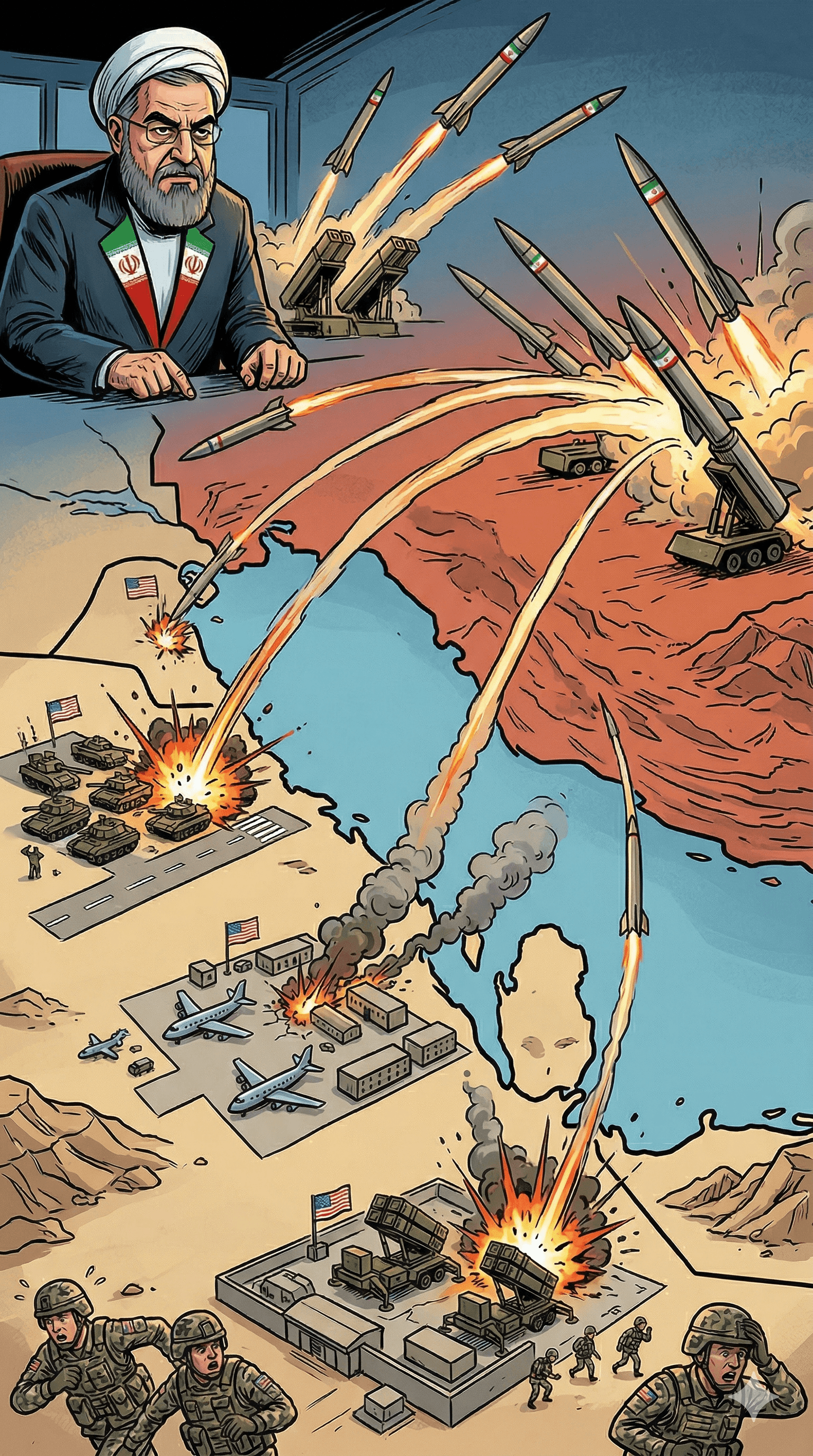
The ongoing 2026 Middle East war has reached a critical new phase as a barrage of Iranian drones and ballistic missiles continues to pound American military installations across the Gulf. Reports confirm that US bases in Kuwait, Qatar, and Saudi Arabia hit in fresh Tehran strikes have sustained unprecedented damage. The systematic bombardment has transformed the operational landscape for the United States Central Command (CENTCOM), forcing the relocation of thousands of troops and fundamentally altering the strategic balance in the region.
Background: The Catalyst of the 2026 US-Iran War
To understand the current wave of Iranian missile strikes, it is essential to examine the origins of this rapidly expanding conflict. The war began on February 28, 2026, when the United States—under the administration of President Donald Trump—and Israel launched a coordinated surprise military campaign. Dubbed "Operation Epic Fury" by the US and "Operation Roaring Lion" by Israel, the initial airstrikes targeted Iran's nuclear facilities, military infrastructure, and top leadership.
The assassination of Iran’s Supreme Leader, Ali Khamenei, during these initial strikes acted as the primary catalyst for Tehran's fierce retaliation. Rather than collapsing the Iranian government, the decapitation strike triggered a massive, sustained counter-offensive. Iran’s Islamic Revolutionary Guard Corps (IRGC) initiated retaliatory campaigns explicitly targeting Israel and the extensive network of US military bases hosted by allied Gulf Arab states.
Key Installations Targeted in the Gulf
The scale of the Iranian retaliation is historically unprecedented. Over the past month, Tehran has launched thousands of drones and advanced ballistic missiles, completely bypassing traditional proxy warfare in favor of direct state-on-state confrontation. The most significant development is that US bases in Kuwait, Qatar, and Saudi Arabia hit in fresh Tehran strikes are now bearing the brunt of the assault.
Kuwait: Ground Zero for Base Infrastructure Damage
Kuwait has suffered some of the most severe infrastructure damage in the region. Key US installations, including Ali Al Salem Air Base and Camp Buehring, have been repeatedly struck by Iranian drones. The strikes have penetrated base perimeters, destroying fuel storage, maintenance areas, and communications nodes. Tragically, a direct strike on Port Shuaiba destroyed a US Army tactical operations center, resulting in the deaths of six American service members.
Qatar: Pressuring CENTCOM’s Regional Hub
Despite Qatar's historical role as a regional mediator and its pragmatic diplomatic ties with Iran, the country has not been spared. Al Udeid Air Base—the largest US military installation in the Middle East and the forward headquarters of CENTCOM—has faced multiple ballistic missile barrages. The strikes have reportedly damaged critical early-warning radar systems, heavily complicating air defense coordination for US forces. Iran views the Qatari facilitation of American military aircraft as complicity in the war, prompting strikes that have also severely damaged Qatar's vital liquefied natural gas (LNG) sector at Ras Laffan.
Saudi Arabia, Bahrain, and the UAE
The Iranian offensive has been geographically expansive. In Saudi Arabia, the Prince Sultan Air Base in Al-Kharj has seen its refueling tankers and communications systems damaged by incoming projectiles. Similarly, US naval facilities in Bahrain, home to the US Fifth Fleet, and air bases in the United Arab Emirates have suffered direct hits. The widespread nature of these attacks demonstrates a coordinated Iranian strategy to degrade the entire American logistical network simultaneously.
Operational Disruptions: A Fragmented Force Posture
The effectiveness of the Iranian missile strikes has forced a drastic shift in American military posture. According to recent defense reports, at least 13 US military bases across the Middle East have been rendered "all but uninhabitable." The structural damage to troop housing, radar facilities, and maintenance depots is so severe that standard operations are no longer practical.
As a result, CENTCOM has been forced to disperse its personnel. Thousands of American troops have relocated to alternative sites, including civilian hotels and leased office spaces in the host countries. While US forces continue to project power and maintain combat operations from surviving runways, military analysts warn that operating out of fragmented, expedient centers inherently degrades command-and-control capabilities. This shift into a "remote war" dynamic highlights a glaring vulnerability: forward-deployed forces in static, well-known bases are highly susceptible to saturation attacks from low-cost drones and precision missiles.
Economic Impact: The Strait of Hormuz and Global Markets
Beyond military targets, Tehran has heavily weaponized its geographic advantage to retaliate economically. Iran has effectively asserted control over the Strait of Hormuz—a vital maritime chokepoint where roughly 20% of the world's traded oil and liquefied natural gas usually passes.
By heavily restricting access and reportedly operating the strait as a "de facto toll booth" that charges passage fees in Chinese Yuan, Tehran has roiled the global economy. The resulting supply chain disruptions and the targeting of energy infrastructure across the Gulf have led to a massive spike in global oil prices. The economic fallout is placing immense pressure on both the US and international markets, creating a secondary front in the 2026 Middle East war that goes far beyond the battlefield.
Political Context and Ceasefire Negotiations
Diplomatic efforts to halt the violence remain highly volatile. President Donald Trump has recently paused planned US military strikes against Iranian energy infrastructure, extending a deadline to April 6 to allow for ongoing ceasefire negotiations. A 15-point peace framework, reportedly similar to proposals from May 2025, is currently being mediated through diplomatic backchannels, including Pakistan and Oman.
However, Washington and Tehran remain at a severe impasse. The United States demands an end to Iranian missile programs and regional aggression, alongside the immediate reopening of the Strait of Hormuz. Conversely, Iranian officials have dismissed the US proposals as "one-sided and unfair," issuing their own demands that include war reparations and continued sovereignty over the Strait. For Iran, merely surviving the onslaught of "Operation Epic Fury" and inflicting consistent damage on US bases and the global economy is viewed internally as a strategic victory.
Impact and Regional Outlook
The fact that US bases in Kuwait, Qatar, and Saudi Arabia hit in fresh Tehran strikes are facing such severe degradation represents a watershed moment in Middle Eastern geopolitics. The vulnerability of American installations is forcing Gulf Arab states to reconsider the security guarantees provided by Washington. As their own civilian and energy infrastructure suffers collateral damage, countries like Qatar, Kuwait, and Saudi Arabia face an agonizing dilemma: maintaining their vital security alliances with the US while bearing the brunt of Iranian retaliation.
If diplomatic channels fail to produce a ceasefire by the April 6 deadline, the conflict risks spiraling into a total regional war, with devastating consequences for the global energy supply. The 2026 war has already proven that the era of uncontested US military basing in the Middle East has ended, reshaping the future of global power projection for decades to come.