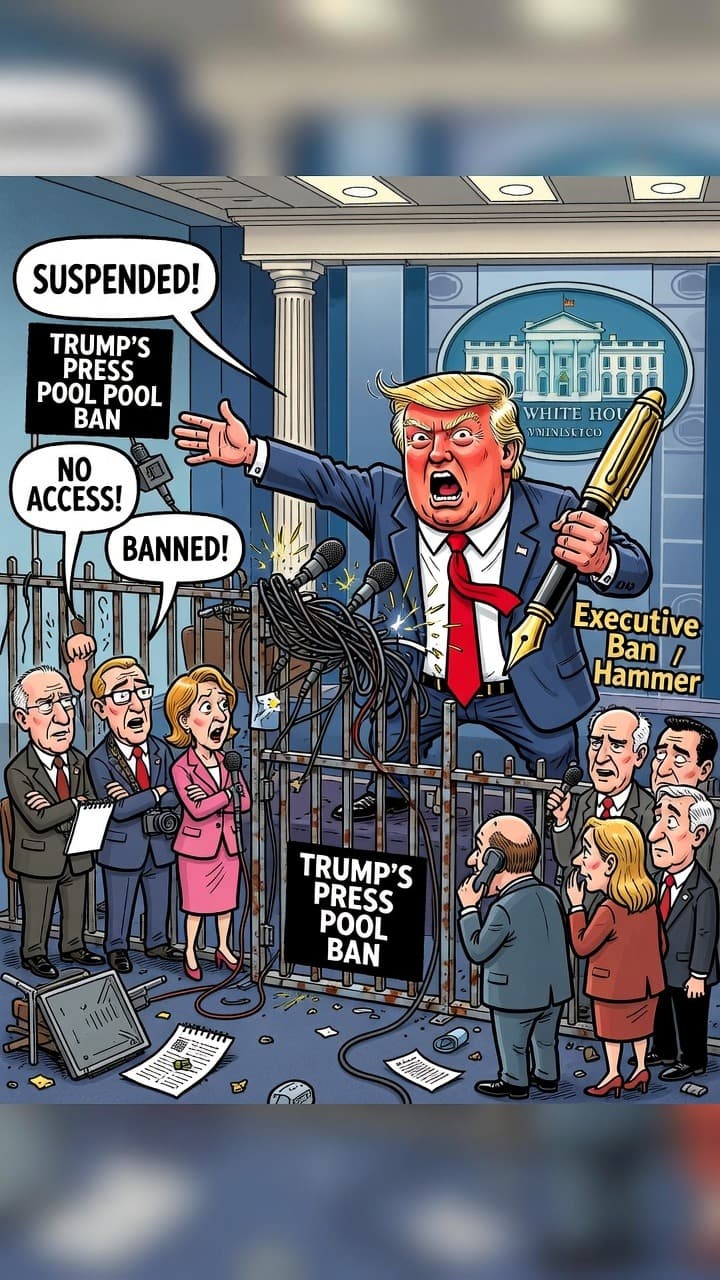
In an unprecedented move demonstrating unified opposition, five major U.S. television networks have suspended their shared video pool coverage of the White House. The decision directly follows President Donald Trump's move on Friday to strip press credentials and ban reporters from CNN, MS NOW, and Politico from the White House grounds, citing accusations of "fake news".
The suspension marks a significant escalation in ongoing tensions between the Trump administration and the press corps, fundamentally altering how the American public receives visual information about the presidency.
Unprecedented Disruption to the White House TV Pool
The White House television pool is a decades-old collaborative arrangement designed to manage the practical realities of covering the president. Because logistical and space constraints make it impossible for every news organization to send a full camera crew to every presidential event, major networks—including ABC News, CBS News, CNN, Fox News, and NBC News—share the costs and responsibilities.
They operate on a rotating schedule: the network assigned to "pool duty" provides the single camera crew and distributes the live video feed to all other pool members and broadcasters globally.
CNN was scheduled to fulfill its rotation on Monday. However, because the White House enforced its ban, CNN's crew could not access the grounds to provide the feed. In a rare display of solidarity, the remaining networks, led by Fox News Washington bureau chief Bryan Boughton (the current chair of the TV pool), opted not to provide a replacement.
“This is to advise that, effective today, the TV pool will not be covering events designated as pool coverage of the President,” Boughton wrote in an email to pool subscribers, confirming that there would be "no replacement pool put in place".
"Fake News" Accusations and First Amendment Lawsuits
The catalyst for the suspension was an announcement made by President Trump on his Truth Social platform on Friday, September 18. He stated: “I am proud to announce that, effective immediately, I am banning Fake News CNN, MSNOW... and Politico... from the White House as a result of their constant 'reporting' FAKE NEWS!”.
By Saturday, Secret Service agents at the White House gates denied entry to journalists from the three targeted organizations and confiscated their hard passes—credentials that allow regular reporters streamlined access to the complex.
In response, CNN, MS NOW, and Politico jointly filed a federal lawsuit in Washington, D.C., seeking a temporary restraining order. The organizations argue the ban constitutes viewpoint discrimination, violates their First Amendment rights to freedom of speech and the press, and was executed without due process.
President Trump defended the ban on Monday, rejecting claims of censorship. "The White House is not instituting an assault on the Free Press, something which I cherish. It is instituting an assault on the FAKE NEWS," he posted on social media. He later told reporters in the Oval Office that he has the right to exclude outlets that he believes "write false stories all the time," adding, "I don't have to let them into the people's house".
Immediate Impact on Public Access
The suspension of the pool feed had immediate, visible consequences for global news coverage. On Monday, President Trump traveled to New York for the United Nations General Assembly and inaugurated a new White House helipad. Without the pool camera, there was no shared live television broadcast of these events.
The networks emphasized that their decision is rooted in democratic principles rather than network allegiance. "The public has a vital interest in receiving accurate, independent information about its government," read a joint statement from ABC, CBS, CNN, Fox News Media, and NBC News. "No administration should restrict a news organization because it objects to its reporting."
The suspension applies strictly to presidential events governed by the pool. Standard coverage of other Washington events, including Congress, remains unaffected. Furthermore, television networks have not stopped covering the Trump administration; they simply refuse to participate in the shared pool arrangement while the ban remains in effect.
Broader Implications for Press Freedom
This clash represents one of the most severe tests of wills between a presidential administration and the Washington press corps in recent history. The White House Correspondents’ Association (WHCA) has long maintained that the press pool is an essential mechanism for providing a daily, independent record of the presidency. Pool members are expected to act as surrogates for the entire press corps, ensuring transparency during moments of national and global significance.
Legal experts, including Bruce D. Brown, president of the Reporters Committee for Freedom of the Press, have warned that banning journalists based on the content of their coverage is "flatly unconstitutional". The upcoming federal court hearings will likely establish critical legal precedents regarding a president's authority to restrict press access based on favorable or unfavorable reporting.
Outlook: A Standoff With No Clear Resolution
As the legal battle heads to federal court, the practical reality is a significant reduction in the independent visual documentation of the U.S. presidency. Until the courts rule on the temporary restraining order—or the administration reverses its stance—the traditional model of White House broadcasting remains paralyzed. The standoff highlights a growing fracture in the symbiotic relationship between the commander-in-chief and the press corps tasked with covering him.