A Strategic Shift in US Arms Sales and Regional Defense
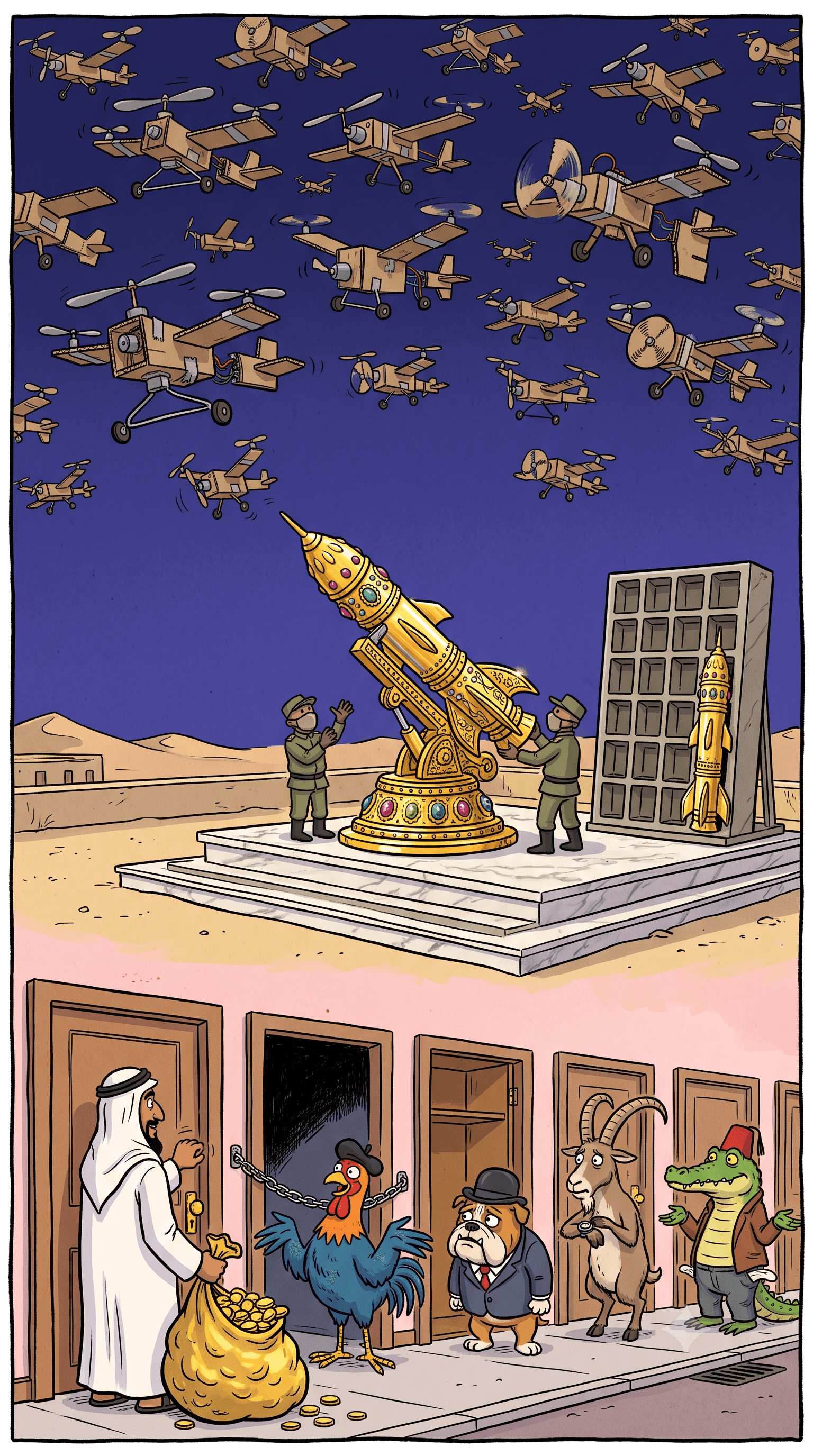
In a sweeping geopolitical decision, the United States administration has officially bypassed standard congressional oversight to greenlight a massive military package. The US has approved $8.6 billion in arms sales to Israel and other Gulf states, including Qatar, Kuwait, and the United Arab Emirates (UAE). The State Department’s sudden announcement, executed through the invocation of emergency executive powers, arrives as the Middle East navigates a fragile ceasefire following intense recent hostilities involving the US, Israel, and Iran.
This fast-tracked approval highlights the administration's pivot toward rapidly bolstering allied defense systems in a volatile region. However, the decision to bypass the customary legislative review process has immediately sparked significant domestic political debate, raising questions about executive authority, transparency, and the long-term implications of injecting billions of dollars of advanced weaponry into the Middle East.
Breakdown of the $8.6 Billion Arms Sales
The newly approved military packages are distributed among four key US allies, tailored to enhance their respective air defense and precision-strike capabilities. The $8.6 billion arms sales are allocated as follows:
Qatar ($5.01 Billion): The largest portion of the package is directed to Qatar. This includes $4.01 billion for the replenishment of Patriot air and missile defense systems and an additional $992.4 million for Advanced Precision Kill Weapon Systems (APKWS).
Kuwait ($2.5 Billion): Kuwait is set to receive a state-of-the-art integrated battle command system, aimed at modernizing its defensive networking and threat-response infrastructure.
Israel ($992.4 Million): Israel's package consists entirely of Advanced Precision Kill Weapon Systems (APKWS), designed to convert unguided rockets into precision-guided munitions.
United Arab Emirates ($147.6 Million): The UAE will also receive a specialized package of the APKWS technology.
To fulfill these massive orders, the State Department identified several principal defense contractors. BAE Systems is the primary contractor for the APKWS sales destined for Israel, Qatar, and the UAE. Meanwhile, major aerospace and defense conglomerates RTX, Lockheed Martin, and Northrop Grumman will spearhead the Patriot system replenishment and the integrated battle command systems for Qatar and Kuwait.
Invoking the Emergency Waiver: How the US Bypassed Congress
Under standard US legislative procedures, the Arms Export Control Act requires the executive branch to notify Congress of major foreign weapons sales, initiating a 15- to 30-day review period. During this window, lawmakers have the authority to scrutinize, delay, or block the transfer.
However, the law includes an emergency provision. US Secretary of State Marco Rubio invoked this specific waiver, determining that an "emergency existed that required immediate sales" to these Middle Eastern allies. By officially declaring a national security emergency, the State Department effectively skipped the congressional review period, allowing the defense contracts to proceed without legislative friction.
While rare, bypassing congressional review for arms sales is not entirely unprecedented. The authority has been utilized by previous administrations during times of perceived international crisis, including in 2019 for sales to Saudi Arabia and the UAE, and more recently to expedite munitions to Ukraine and Israel in 2022 and 2023.
Geopolitical Context: The 2026 Middle East Conflict
The primary justification for the emergency declaration is the severe escalation of regional instability. These arms sales come exactly nine weeks after the outbreak of a direct conflict that began in late February 2026 involving the US, Israel, and Iran.
Following joint US-Israeli strikes on Iranian targets, Tehran responded with retaliatory strikes against Israel and various Gulf states that host American military bases. The resulting conflict drastically shifted the security dynamics of the region, leading to significant infrastructure damage and mass displacement.
Currently, a fragile ceasefire has been in effect for over three weeks. The swift approval of the $8.6 billion arms sales to Israel and Gulf states is viewed by defense analysts as a calculated move by the administration to reinforce deterrence, replenish depleted munitions, and ensure that regional allies maintain a qualitative military edge should the ceasefire collapse.
Lawmaker Backlash and Oversight Concerns
The decision to bypass Congress has not gone unchallenged. Lawmakers from across the political spectrum have voiced deep concerns over the administration's use of the emergency waiver, framing it as an erosion of democratic checks and balances.
Lack of Transparency
Representative Gregory Meeks, Ranking Member of the House Foreign Affairs Committee, strongly condemned the maneuver. He argued that the administration disregarded longstanding congressional prerogatives and failed to provide adequate justification or documentation for the emergency declaration. Critics emphasize that advanced weapons transfers require rigorous oversight to prevent them from fueling prolonged conflicts or contributing to potential human rights violations.
Production Timelines and "Urgency"
Defense analysts and lawmakers have also pointed out a logistical contradiction: while the administration cited an "urgent emergency" to bypass Congress, many of the approved weapons—such as the complex integrated battle command systems and specific precision munitions—have not yet been manufactured. Because defense contractors like Lockheed Martin and BAE Systems face extended production timelines, critics argue the waiver was utilized to avoid political scrutiny rather than to meet immediate battlefield needs.
Taxpayer Funding
Further compounding the domestic frustration is the financial structure of the deals. Lawmakers like Senator Bernie Sanders and Senator Chris Van Hollen have highlighted that the sales to Israel will be heavily subsidized by Foreign Military Financing (FMF)—a US program that provides billions in annual military aid. Critics argue that bypassing Congress to authorize sales funded by American taxpayers further removes the public from critical national security decisions.
Strategic Impact and Geopolitical Outlook
The US approving $8.6 billion in arms sales to Israel and Gulf states while bypassing congressional review sets a complex precedent for future foreign policy. In the short term, it signals unwavering US support for its Middle Eastern partners, reinforcing security architectures in Qatar, Kuwait, the UAE, and Israel during a highly precarious ceasefire.
Economically, the deals solidify billions of dollars in revenue for the American defense industrial base, ensuring long-term manufacturing contracts for companies like RTX and Northrop Grumman.
However, the long-term strategic outlook remains tense. By heavily arming multiple regional actors simultaneously, the US risks accelerating a regional arms race. Furthermore, the continued utilization of emergency waivers threatens to permanently strain the relationship between the executive branch and Congress regarding foreign policy oversight. As the Middle East waits to see if the current ceasefire holds, these multibillion-dollar defense packages will undoubtedly reshape the balance of power in the region for years to come.