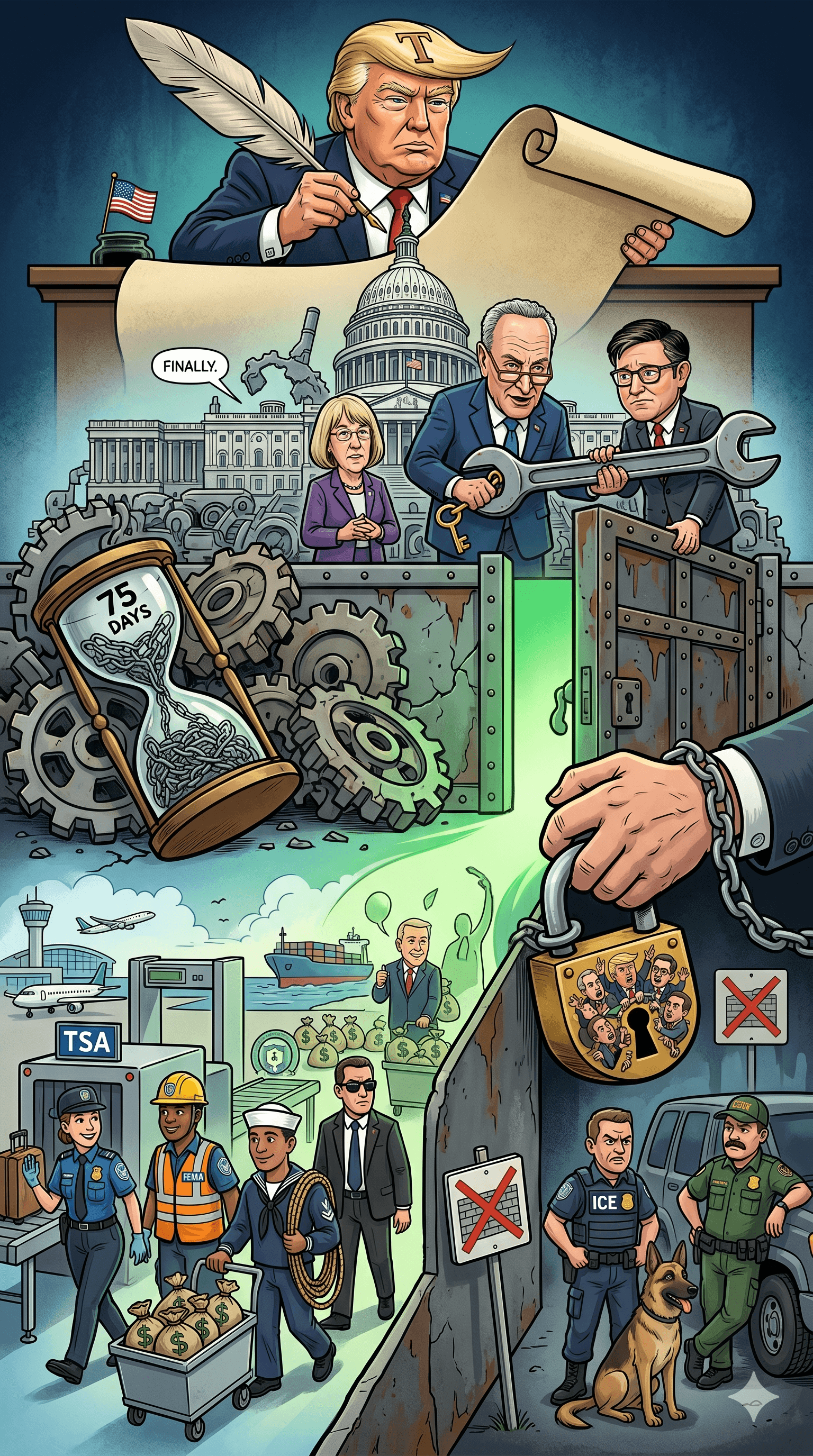
The United States Congress on Thursday approved funding for most of the Department of Homeland Security (DHS), successfully navigating a bitter partisan divide. This legislative action brings an end to a record-breaking partial government shutdown that disrupted key federal agencies for 75 days. The bill, which was previously approved by the Senate, cleared the House of Representatives and is now heading to President Donald Trump for his signature.
While the measure restores normal operations and funds major DHS agencies through September 30, it deliberately excludes new funding for immigration enforcement agencies. This exclusion leaves the deep political dispute that triggered the shutdown unresolved, setting the stage for future legislative battles.
The Scope of the Homeland Security Funding
The newly passed legislation provides crucial resources to reopen and maintain several vital federal agencies. The departments that will receive restored normal operations and funding include:
Transportation Security Administration (TSA)
Federal Emergency Management Agency (FEMA)
United States Coast Guard
Cybersecurity and Infrastructure Security Agency (CISA)
United States Secret Service
However, Immigration and Customs Enforcement (ICE) and parts of the Border Patrol were explicitly left out of the agreement.
Background: What Caused the 75-Day DHS Shutdown?
The Department of Homeland Security had been partially shut down since February 14, 2026, making it the longest funding lapse of its kind in American history. The standoff began after federal officers fatally shot two protesters in Minneapolis at the start of the year.
Following the incident, Democratic lawmakers refused to pass a funding bill for DHS unless it included new guardrails and restrictions on federal immigration agents. These demands included limits on raids in sensitive locations and restrictions on the use of masks by officers. Republicans rejected these conditions entirely, arguing they would impede the Trump administration's immigration enforcement agenda, and instead demanded full funding for border enforcement operations.
Real-World Impacts: Airport Chaos and TSA Worker Strain
The prolonged funding lapse severely affected federal workers and everyday operations across DHS agencies. During the shutdown, the following impacts were widely observed:
Thousands of DHS employees were forced to work without pay for weeks.
More than 1,000 TSA employees are believed to have resigned during the shutdown, throwing air travel into chaos.
Airports struggled with massive understaffing; on a single Wednesday, more than 11 percent of scheduled TSA employees (over 3,120 workers) missed work.
Multiple airports experienced greater than 40 percent callout rates of TSA workers, leading to hours-long security lines.
Preparations for major events, including upcoming FIFA World Cup matches scheduled in US cities this summer, faced growing disruptions due to staffing shortages and funding uncertainty.
In March, President Trump signed an executive action to pay TSA employees using existing funds in an effort to ease the long security lines at the nation's airports. Later, Homeland Security Secretary Markwayne Mullin warned lawmakers that emergency payroll funds were nearly exhausted, which added significant pressure to pass the current bill.
Political Maneuvering and Stakeholder Reactions
The passage of the bill exposed deep divisions and strategic shifts within the government. The Senate had unanimously passed the same funding bill five weeks prior. According to Senator Patty Murray, the top Senate Democrat overseeing government funding, "Speaker of the House Mike Johnson extended the DHS shutdown for over a month for no reason at all". She added that it is a "very good thing" the bill is finally on track to become law after Republicans blocked disaster relief and TSA funding. House Democrats also noted that the final bill closely mirrors legislation introduced by Ranking Member Rosa DeLauro in February.
Conversely, House Republicans framed the resolution differently. House Budget Committee Chairman Jodey Arrington released a statement arguing that Democrats had kept DHS shut down for 75 days. "Today, House Republicans acted to end this reckless shutdown and restore critical operations to DHS, while using reconciliation to fund ICE and CBP for the next three years," Arrington said. Moderate Republicans, such as Congressman Nick Langworthy, publicly urged Johnson to move forward with the Senate bill to avoid further political damage ahead of midterm elections, thanking Trump for "agreeing and demanding action".
The GOP's Next Move for Immigration Enforcement
The result is a split funding strategy for the department. While most DHS agencies are now temporarily funded through regular legislation, the battle over border control continues. Republican leaders plan to separately pursue tens of billions of dollars for ICE and Border Patrol through the budget reconciliation process. This legislative maneuver would allow them to bypass Democratic votes in the Senate. The proposed funding for these agencies could cost around $75 billion.
Despite the lack of immediate congressional funding in the newly passed bill, immigration enforcement agencies have largely maintained normal operations during the shutdown. This continuity was supported by funds from a tax cuts bill signed into law by Trump the previous year, which funneled billions of dollars in extra funds to DHS, including $75 billion for ICE operations.
Outlook and Future Implications
The end of the 75-day DHS shutdown provides immediate relief to thousands of federal workers and restores stability to essential services like airport security and disaster management. However, the broader political battle over immigration enforcement remains fundamentally unresolved.
As Republicans push for up to $70 billion in additional funding for ICE and Border Patrol through the remainder of Trump's presidency, Democrats continue to demand tighter oversight and restrictions on enforcement practices. With thin GOP margins in both chambers and an upcoming election, the success of a partisan budget reconciliation bill remains highly uncertain. The ongoing political polarization guarantees that border control and DHS funding will remain central, highly contested issues in the upcoming election cycle.