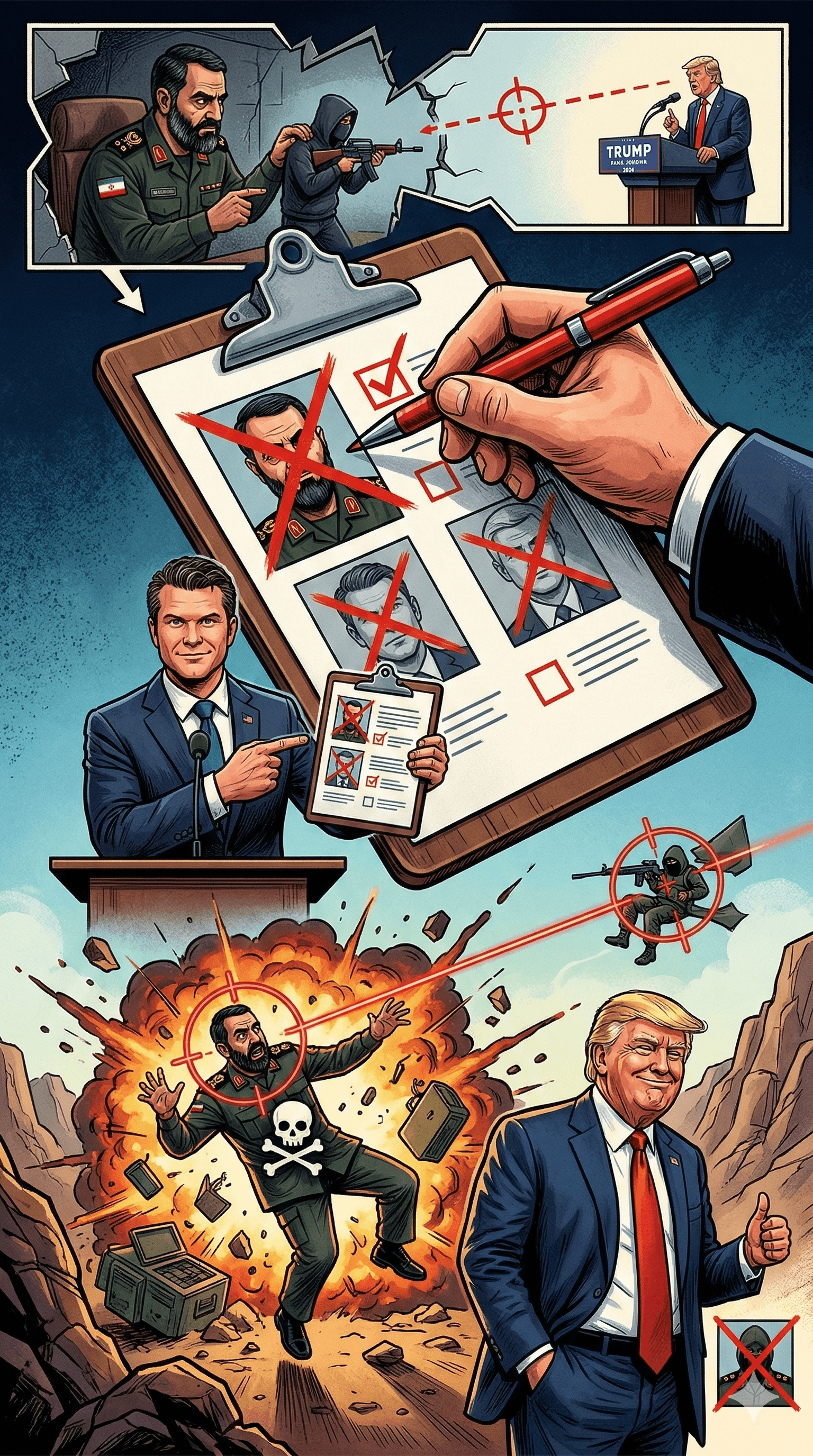
WASHINGTON — Amid a sweeping and unprecedented joint U.S.-Israeli military campaign against Iran, U.S. Defense Secretary Pete Hegseth announced that American forces have hunted down and eliminated an Iranian leader responsible for coordinating an attempted assassination plot against President Donald Trump. The targeted strike occurred as part of a broader, ongoing offensive dubbed "Operation Epic Fury," marking a significant escalation in the already volatile Middle East.
The Targeted Strike: "Added to the Target List"
During a recent Pentagon press briefing alongside Joint Chiefs of Staff Chairman Gen. Dan Caine, Defense Secretary Pete Hegseth provided a stark update on the U.S. military's progress. Hegseth confirmed the death of the unnamed Iranian official who commanded a unit tasked with assassinating the U.S. president.
"Yesterday, the leader of the unit who attempted to assassinate President Trump was hunted down and killed," Hegseth stated. While acknowledging that the prevailing focus of the U.S. campaign remains on neutralizing Iran's broader military infrastructure—specifically its missile systems and launchers—Hegseth emphasized that achieving justice for the plot against Trump was a distinct priority.
"While that was not the focus of the effort by any stretch of the imagination, I ensured, and others ensured, that those who were responsible for that were eventually part of the target list," Hegseth explained. He noted that the U.S. military acted from the air when the tactical opportunity arose, adding, "Iran tried to kill President Trump, and President Trump got the last laugh."
The Pentagon has thus far declined to release the specific identity of the eliminated official or the precise operational details of the strike, citing ongoing security protocols.
Background: Decades of Tension and Assassination Plots
The elimination of this Iranian leader is deeply rooted in years of escalating hostilities and explicit threats against American officials. The animosity traces back to January 2020, when President Trump ordered a drone strike in Baghdad that killed Qasem Soleimani, the powerful commander of the Islamic Revolutionary Guard Corps (IRGC) Quds Force. Following Soleimani's death, Iranian leadership repeatedly vowed severe retaliation.
Throughout 2024, U.S. intelligence agencies detected multiple, credible Iranian plots targeting Donald Trump and other former national security figures. In July 2024, intelligence regarding these threats prompted the Secret Service to implement heightened security measures around Trump during his campaign. By November 2024, the U.S. Department of Justice officially charged multiple individuals, including an Afghan national named Farhad Shakeri, whom the FBI identified as an Iranian government asset tasked by the IRGC with surveilling and ultimately assassinating Trump.
Iran has historically denied involvement in these assassination plots, dismissing the U.S. Department of Justice’s accusations as baseless. However, the latest U.S. military actions demonstrate that the administration views the ongoing threat as both credible and actionable.
'Operation Epic Fury': The Broader U.S.-Israel Military Campaign
The targeted killing of the assassination plot leader is just one facet of a massive, multi-front military conflict. "Operation Epic Fury" is a joint U.S. and Israeli initiative designed to systematically dismantle Iran's ability to project power across the region.
According to Gen. Dan Caine and Secretary Hegseth, the U.S. military has already struck over 2,000 targets. The campaign has heavily degraded the Iranian Navy—with reports indicating the sinking of over 20 Iranian warships, including a prized vessel named the Soleimani—and severely crippled Iran's air defense networks. U.S. B-2 stealth bombers, B-1s, and B-52s, alongside fighter jets and drones, have maintained a relentless operational tempo dropping heavy munitions.
"We are targeting and eliminating Iran's ballistic missile systems to prevent them from threatening the U.S. forces, partners, and interests in the region," Gen. Caine noted. Hegseth further underscored the administration's maximalist approach, asserting that U.S. and allied forces will soon obtain "complete control of Iranian skies."
Domestic Reactions and Geopolitical Implications
The scale of the U.S. intervention has triggered immediate geopolitical and economic shockwaves. Global energy markets remain on edge as the conflict expands into the Indian Ocean and the Persian Gulf, key arteries for international oil shipments.
Domestically, the sweeping use of military force has prompted deep scrutiny from Congress. Senate lawmakers are preparing to vote on war powers resolutions aimed at reining in the president's ability to order further strikes without explicit congressional consent. Meanwhile, key administration officials, including Secretary of State Marco Rubio, CIA Director John Ratcliffe, and Secretary Hegseth, are scheduled to brief the full membership of both chambers of Congress to outline the strategic objectives and intelligence underlying the offensive.
While some lawmakers, such as Senator Mark Warner, have questioned whether the threat to the U.S. was imminent enough to justify the scale of the pre-emptive attacks, the administration maintains that the campaign is a necessary reality check against a regime that has targeted American citizens for decades.
A Stance of Deterrence
The administration's message to Tehran is unequivocal. President Trump recently warned that any Iranian retaliation would be met with "a force that has never been seen before." The White House has stated that there are currently no plans to deploy ground troops inside Iran, though press secretary Karoline Leavitt declined to completely rule out the option, keeping it on the table as strategic leverage.
Impact and Outlook
Moving forward, the Middle East faces an extremely precarious period. The elimination of high-ranking Iranian officials, combined with the systematic destruction of Iran's military infrastructure, severely limits Tehran's conventional response capabilities. However, intelligence analysts warn that Iran may increasingly rely on its network of proxy militias—including Hezbollah in Lebanon and the Houthis in Yemen—to launch asymmetric attacks against U.S. embassies, regional bases, and allied soft targets. As "Operation Epic Fury" shifts to targeting inland military-industrial bases, the international community must brace for a prolonged, multi-week conflict that is rapidly reshaping the balance of power and security architecture of the region.
#News #Geopolitics #USPolitics #Iran #OperationEpicFury #DonaldTrump #PeteHegseth #MiddleEastConflict #NationalSecurity #MilitaryStrategy #ForeignPolicy