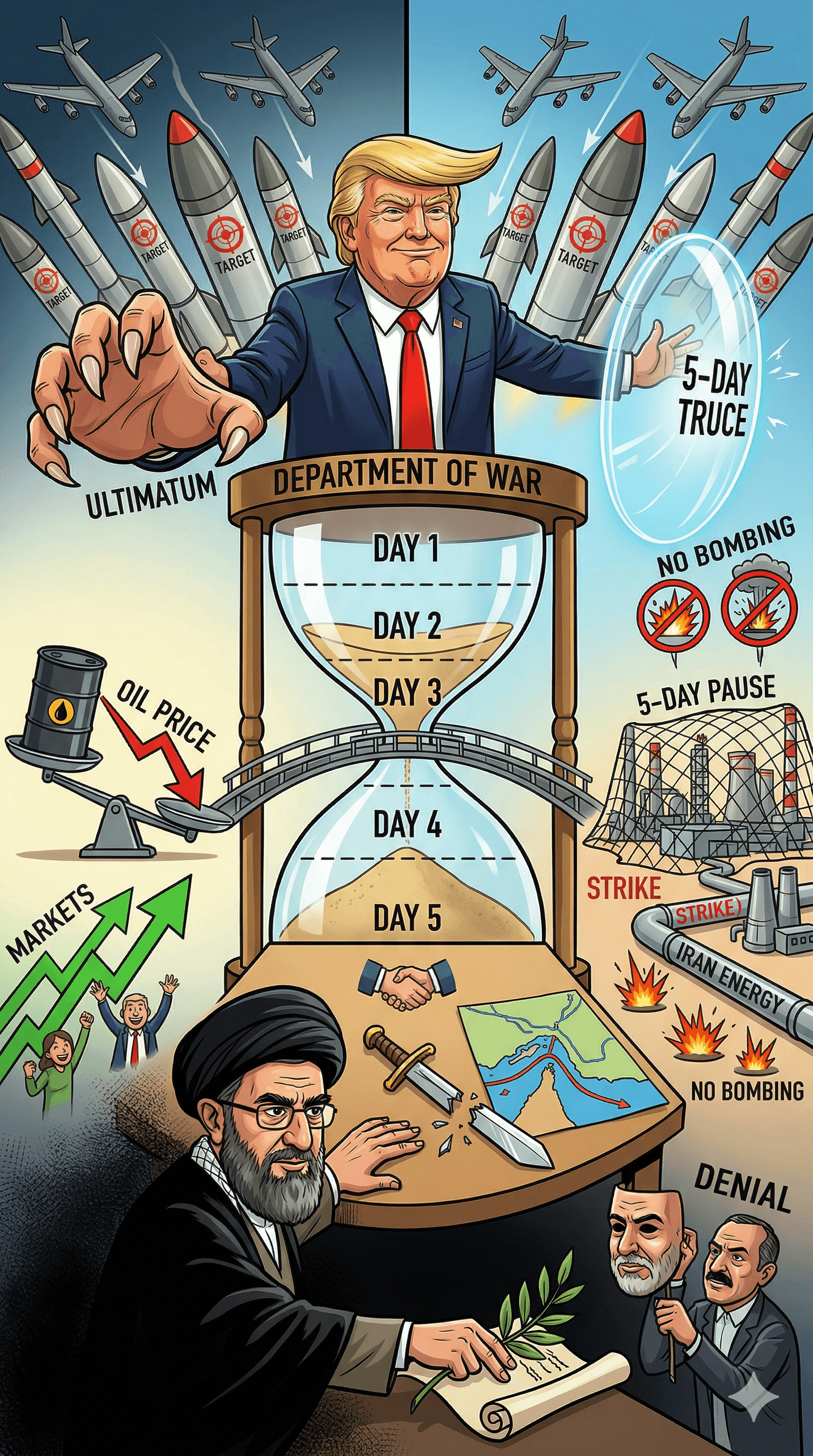
The devastating three-week-old war between the United States, Israel, and Iran took an unexpected diplomatic turn this week. US President Donald Trump announced a five-day pause on planned military strikes against Iranian energy infrastructure. The sudden policy shift comes amid reports of back-channel peace negotiations with Tehran’s newly appointed Supreme Leader, Mojtaba Khamenei. While the White House claims the discussions have been "productive" toward a total resolution of hostilities in the Middle East, Iranian officials have publicly denied direct contact, framing the pause as a tactic to soothe global oil markets.
The 5-Day Energy Truce: Trump’s Unexpected Reversal
Over the weekend, tensions reached a boiling point when President Trump issued a strict 48-hour ultimatum. He warned that the US military would "obliterate" Iran's power plants and critical energy infrastructure unless Tehran immediately reopened the Strait of Hormuz to international shipping. The blockade of this vital maritime chokepoint—through which roughly a fifth of the world's global oil supply passes—has triggered a severe global energy crisis and disrupted international trade.
However, hours before the deadline expired, Trump took to his social media platform, Truth Social, to announce a sudden reversal. He stated that he had instructed the Department of Defense to postpone any strikes on Iranian energy facilities for a five-day period. Trump attributed this delay to "very good and productive conversations" regarding a comprehensive end to the Middle East conflict. The president emphasized that the five-day energy truce remains conditional, heavily dependent on the success of ongoing negotiations throughout the week.
Behind the Ultimatum and the Strait of Hormuz
The standoff over the Strait of Hormuz sits at the very core of the current geopolitical and economic crisis. Following a joint US-Israeli military offensive that began in late February 2026, Iran retaliated by aggressively disrupting maritime traffic and launching missile and drone strikes across the region. The US administration’s primary goal in these early negotiations is the immediate unblocking of the strait to stabilize global markets, though Trump has also indicated that broader issues—such as Iran's nuclear program and highly enriched uranium stockpile—are firmly on the negotiating table.
Mojtaba Khamenei's Leadership and Conflicting Claims of Peace Talks
The political landscape in Tehran has shifted dramatically since the conflict began. Following the death of former Supreme Leader Ali Khamenei in the initial waves of the US-Israeli offensive, his son, Mojtaba Khamenei, was swiftly elevated to the position of Supreme Leader. Surrounded by hardline factions of the Islamic Revolutionary Guard Corps (IRGC), Mojtaba Khamenei's administration faces the immense pressure of a severely degraded military infrastructure alongside a crippled domestic economy.
According to President Trump, his administration—reportedly utilizing special envoys like Steve Witkoff and Jared Kushner—has engaged in high-level diplomacy with Iranian representatives. Trump suggested that the talks could ultimately lead to Iran abandoning its nuclear weapons ambitions in exchange for lasting peace and the preservation of what remains of its infrastructure.
Iran's Official Stance: Denial and Defiance
Despite Washington's optimistic tone, Tehran has fiercely disputed the narrative of a bilateral diplomatic breakthrough. The Iranian Foreign Ministry and prominent political figures, including parliamentary speaker Mohammad Baqer Qalibaf, categorically denied any direct or indirect communications with the Trump administration.
Iranian state media labeled the five-day energy truce a "psychological warfare" tactic. Officials argued that the US simply backed down from its ultimatum out of fear of Iran's reciprocal threats. Prior to the truce, Tehran warned it would target critical water, economic, and energy infrastructure across the Persian Gulf, including facilities in neighboring US-allied nations, if American forces struck Iranian power plants.
Economic Relief: Markets React to the De-escalation Hopes
The immediate economic impact of the five-day energy truce was overwhelmingly positive. Since the war began, the disruption of the Strait of Hormuz and the heavy sanctions placed on regional oil had pushed global energy prices to historic highs, sparking fears of widespread economic pain.
Following Trump’s announcement, financial markets rallied aggressively. Investors banked on the hope that the blockade might soon end, preventing further macroeconomic fallout. International benchmark Brent crude oil tumbled by approximately 10 percent, dropping to near $100 a barrel—its lowest point since the crisis intensified. Major US stock indices, including the S&P 500 and the Dow Jones Industrial Average, also saw significant gains, reflecting a collective sigh of relief from the global financial sector.
Ongoing Hostilities: Israel Continues Strikes Amid US Pause
While the United States has temporarily halted its crosshairs on Iranian power plants, the broader war is far from over. Within an hour of Trump’s energy truce announcement, the Israel Defense Forces (IDF) launched a fresh wave of airstrikes targeting military infrastructure across Tehran.
The IDF confirmed that it struck several military bases, IRGC intelligence sites, and air defense headquarters. However, in an apparent coordination with the US diplomatic window, Israeli forces notably spared Iranian energy and nuclear infrastructure. The continuing bombardment underscores a fragile reality: while an energy truce is in effect, the underlying military conflict remains highly active, with casualties continuing to mount on the ground.
Impact and Future Outlook: Will the Truce Hold?
The next five days are critical for the trajectory of the Middle East. If the alleged back-channel negotiations between US envoys and Mojtaba Khamenei’s government yield tangible results—namely, the reopening of the Strait of Hormuz and a concrete framework for nuclear de-escalation—the region could see a viable pathway out of a devastating war. However, if talks collapse and Iran maintains its maritime blockade, the US has explicitly reserved the right to execute its delayed strikes on the country's grid. For now, the global economy breathes a temporary sigh of relief, though the shadow of a wider, uncontrollable regional conflict still looms large over the Persian Gulf.