March 15, 2026 — As the devastating war involving the United States, Israel, and Iran enters its third week, the geopolitical landscape of the Middle East faces an unprecedented crisis. In a rapidly developing situation, the Israeli government has officially approved a sweeping $827 million emergency military funding package to replenish rapidly depleting combat stocks.
With constant exchanges of ballistic missiles, drone swarms, and heavy airstrikes, the US-Israel-Iran conflict shows no signs of de-escalation. This article breaks down the recent military funding approval, the current state of the war, and the sweeping economic implications currently shaking the globe.
Israel Greenlights $827 Million in Emergency Defense Procurement
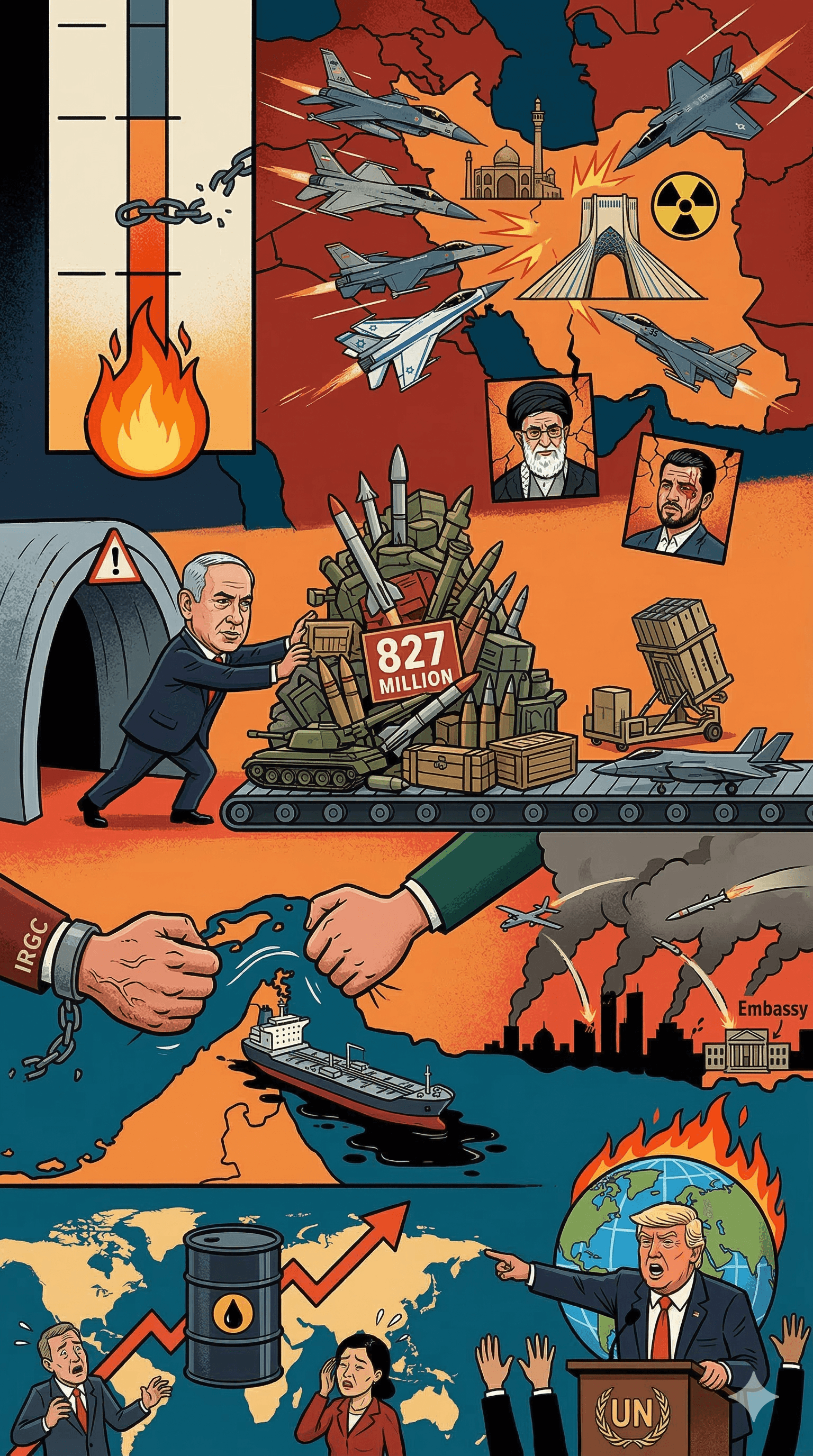
Over the weekend, Israeli cabinet ministers convened via a special telephone referendum to approve an immediate transfer of 2.6 billion shekels (approximately $827 million) to the Defense Ministry. The emergency budget allocation is explicitly earmarked for "classified defense procurement" and the urgent need to "renew critical combat stocks."
According to finance ministry documents circulated to Israeli ministers, the exceptional emergency decision was made solely to address the immediate logistical requirements of the ongoing fighting.
Why is the Funding Needed Now?
The intensity of the US-Iran war has placed a severe strain on Israel’s defensive and offensive military inventories. Key drivers for this emergency funding include:
Replenishing Interceptors: Israel has relied heavily on its advanced missile defense systems, such as the Arrow 3, to intercept barrages of Iranian ballistic missiles. Reports indicate that Washington was informed of a critical depletion in Israel's ballistic missile interceptor stockpiles.
Acquisition of Munitions: Since the joint US-Israeli campaign began, coalition forces have dropped over 11,000 weapons on Iranian targets. The newly approved funds will secure immediate ammunition shipments for the Israeli Air Force to sustain these high-tempo operations.
Advanced Weapons Systems: The budget will facilitate the rapid procurement of new, advanced combat technologies necessary to counter evolving Iranian drone and missile threats.
The $827 million package will be drawn from Israel's broader $222 billion state budget, which was recently approved on March 12 and is expected to be formally adopted by the Knesset by the end of the month.
Background: The War Enters Its Third Week
The current US-Israel-Iran conflict ignited on February 28, 2026, when coordinated US and Israeli forces launched sweeping airstrikes across Iran. The initial strikes resulted in the death of Iran’s Supreme Leader, Ayatollah Ali Khamenei, sending shockwaves through the region and triggering an immediate, massive regional confrontation.
Now in its third week, the war has transitioned into a brutal war of attrition.
Iranian Retaliation and Daily Strikes
Since the initial bombardments, Israel has been subjected to daily retaliatory fire. Security officials report that Iran has fired at least 250 ballistic missiles at Israeli territory since the war began. Just this Sunday, the Iranian army announced it had deployed powerful suicide drones targeting key Israeli security centers, specifically claiming strikes on the "Lahav 433" police unit and the "Gilat Defence" satellite communications center.
Iranian missile fragments have also reportedly struck a residential building used by the US consul in Israel. Meanwhile, US President Donald Trump has maintained a hardline stance. In recent statements, President Trump noted that the US is not ready to agree to a deal to end the Iran war on current terms, emphasizing that Washington will continue to press for better conditions and may continue striking strategic Iranian assets.
Regional Escalation and Global Economic Fallout
The war has long spilled past the borders of Israel and Iran, drawing in neighboring Gulf states and severely rattling the global economy.
The Strait of Hormuz and Energy Markets
Iran has threatened to widen its campaign by targeting economic infrastructure linked to the US and its allies. The conflict has effectively restricted movement through the Strait of Hormuz, a critical maritime chokepoint responsible for roughly a fifth of the world's daily oil supply.
This weekend, a vital oil terminal in Fujairah, United Arab Emirates, was attacked just as an Indian-flagged vessel was loading crude oil. Furthermore, Iraq’s oil exports have plunged by 70%, dropping to just 1.3 million barrels per day, as the Gulf remains entirely disrupted.
Gulf States on High Alert
The threat of a wider regional war is an immediate reality for neighboring nations. Bahrain, Saudi Arabia, and the United Arab Emirates have all reported intercepting incoming projectiles. Following Iran's warnings for civilians to evacuate major UAE ports, US President Donald Trump has urgently called upon global allies—including Japan, South Korea, Britain, and France—to deploy warships to secure the Strait of Hormuz and protect the global oil lifeline.
Outlook and Impact
As the US-Iran war enters its third week, Israel’s $827 million emergency military funding highlights the sheer unsustainable material cost of the conflict. The rapid depletion of interceptors and munitions underscores a dangerous reality: if the conflict becomes a protracted war of attrition, supply chain logistics will dictate the survival and success of the involved nations.
The immediate outlook remains grim. With diplomatic channels currently frozen—and Israeli Foreign Minister Gideon Saar confirming there are no plans for direct talks with the Lebanese government or Iranian proxies—the military escalation is expected to continue. The global economy will likely face mounting inflationary pressure as oil prices react to the instability in the Gulf, leaving international markets bracing for the long-term impact of a destabilized Middle East.
#USIranWar #IsraelNews #MiddleEastConflict #Geopolitics #GlobalEconomy #DefenseFunding #MilitaryNews #OilPrices #StraitOfHormuz #WorldNews