Tensions in the Middle East have reached a boiling point as the United States military launched a fresh wave of extensive strikes on Iranian missile systems and military infrastructure around the highly contested Strait of Hormuz. Executed late Sunday night and stretching into early Monday, the aggressive US military operations are a direct response to recent Iranian attacks on commercial shipping in the critical maritime corridor. This sudden spike in hostilities severely threatens an already fragile interim peace agreement between Washington and Tehran, raising global concerns over the security of international energy supply chains and the looming threat of a broader regional conflict.
The Catalyst: Assault on the M/V GFS Galaxy
The latest escalation was triggered over the weekend when forces from Iran’s Islamic Revolutionary Guard Corps (IRGC) attacked the M/V GFS Galaxy, a Cyprus-flagged container ship transiting the Strait of Hormuz. According to the US Central Command (CENTCOM), the strike caused a severe onboard fire and extensive engine room damage, forcing the crew to abandon the vessel. Tragically, one civilian crew member remains missing following the incident.
In a statement broadcasted by the state-run Islamic Republic of Iran Broadcasting (IRIB), the IRGC claimed responsibility for the interception. The paramilitary organization asserted that several foreign vessels had attempted to navigate the strait using "unauthorized routes" while deliberately ignoring Iranian warnings. The IRGC stated that the commercial vessel was brought to a halt after jeopardizing maritime security. Following this armed confrontation, Iranian naval forces controversially declared the Strait of Hormuz "closed until further notice," effectively attempting to choke off one of the world’s most vital commercial transit routes.
Extensive US Military Strikes and Regional Retaliation
In immediate retaliation to the assault on civilian shipping, US forces initiated what CENTCOM described as an intensive military campaign to degrade Iran’s ability to threaten civilian mariners. President Donald Trump authorized the strikes to hold Iranian forces accountable, bluntly stating on Sunday, "We bombed the hell out of them last night," while insisting that the maritime strait remains open to global shipping traffic.
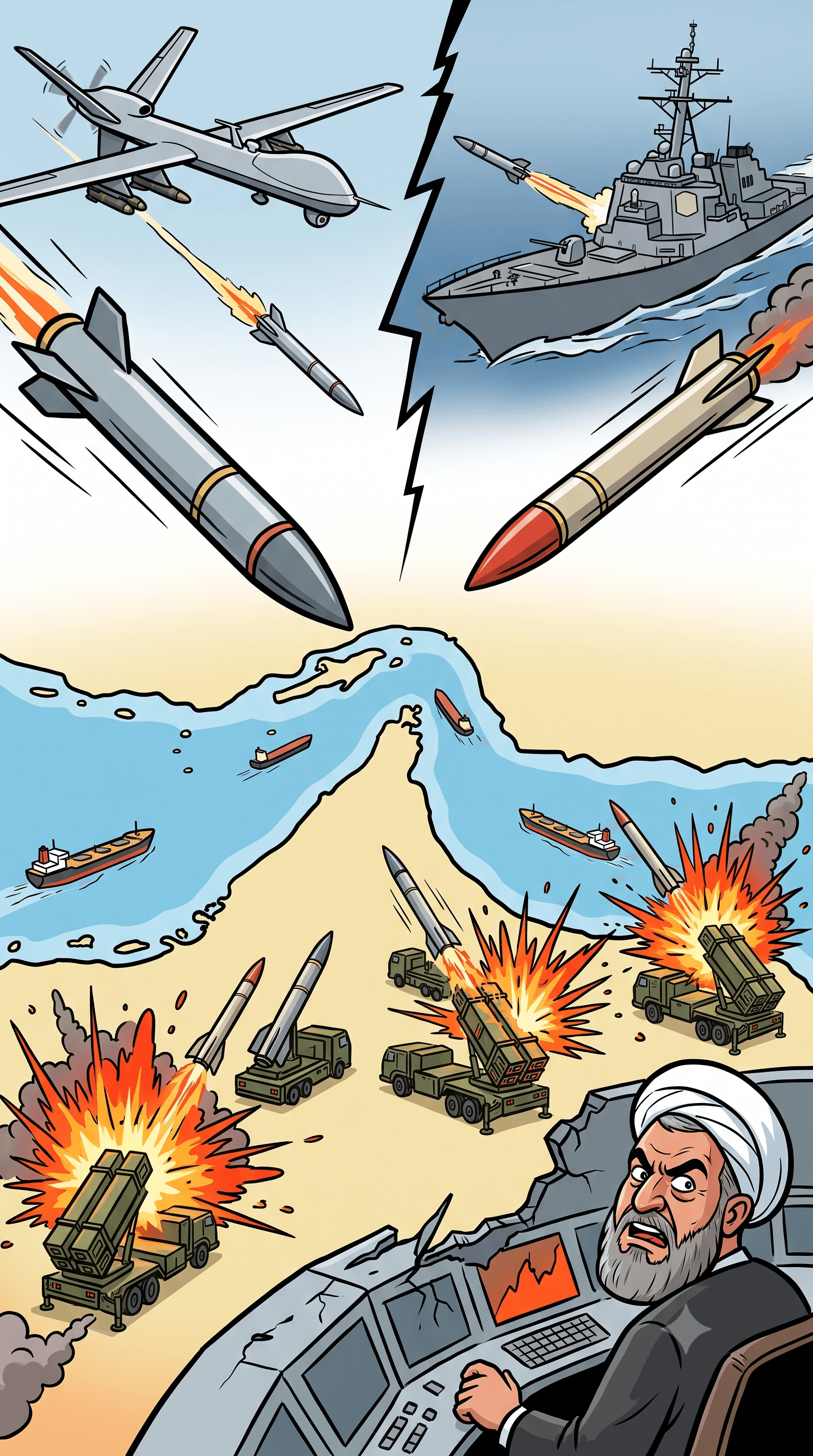
According to US defense officials, American forces struck approximately 140 Iranian military targets over the weekend. These precision strikes—carried out by land- and sea-based fighter jets, drones, and naval vessels—targeted surface-to-air missile launchers, drone storage facilities, maritime surveillance radars, communication networks, and small paramilitary attack boats. Iranian state media corroborated the massive scale of the offensive, reporting multiple heavy explosions across southern coastal regions, including the port cities of Bandar Abbas, Jask, Sirik, and Qeshm Island, all of which directly overlook the Strait of Hormuz.
The US military strikes, however, have not gone unanswered. Iran rapidly launched a series of retaliatory missile and drone attacks targeting nations hosting US military forces across the Gulf. The Jordanian military reported intercepting four Iranian ballistic missiles that breached its airspace, while the IRGC later confirmed it had specifically targeted Jordan’s Prince Hassan Air Base. Furthermore, Kuwait’s armed forces reported responding to hostile aerial targets that ultimately damaged northern land border posts and an offshore oil drilling platform. Retaliatory strikes were also reported in Bahrain, Qatar, and Oman, dramatically widening the geographic scope of the US-Iran war.
Diplomatic Fallout: A Fragile Truce on the Brink
The renewed warfare has all but dismantled the diplomatic progress made in recent months. The fierce fighting severely undermines the interim US-Iranian truce agreement signed just last month, which was specifically designed to halt the devastating regional war that originally erupted in late February 2026.
The political landscape in Tehran has also hardened significantly. Following the recent death of Iran's Supreme Leader Ali Khamenei, his successor and son, Mojtaba Khamenei, vowed to extract revenge against the United States, declaring that retaliation "must inevitably be carried out." This uncompromising rhetoric has severely limited the political bandwidth for diplomatic off-ramps.
The international community has reacted with alarm to the failing peace talks. UN Secretary-General Antonio Guterres issued a stark public warning regarding the deteriorating situation, expressing deep concern over the escalating cycle of violence. Guterres emphasized that a return to full-scale hostilities would yield "catastrophic consequences" for regional stability and the global economy, urgently pleading for both Washington and Tehran to resume diplomatic negotiations.
Economic Impact: Global Oil Prices Surge
The economic implications of the escalating US-Iran conflict are immense. The Strait of Hormuz is widely considered the world's most important energy chokepoint, facilitating the transit of roughly one-fifth of all globally traded oil and natural gas. Any sustained disruption or military threat to this maritime route inevitably triggers immediate shockwaves throughout international financial markets.
Following Iran's declaration that the strait was closed and the subsequent heavy exchange of military fire, global energy markets reacted swiftly and violently. When futures trading opened on Monday in Tokyo, the US benchmark West Texas Intermediate (WTI) crude jumped by over 3.5%, surging past $74 a barrel. Energy analysts warn that if the vital trade route remains a contested warzone, prolonged supply bottlenecks will predictably lead to skyrocketing shipping insurance premiums, significant transit delays, and stubbornly high global inflation rates that could impact consumer economies worldwide.
Outlook: A Volatile Strategic Chokepoint
Despite Iran’s formal declaration closing the waterway, US Central Command maintains that the Strait of Hormuz remains physically navigable. The US military reported that over 140 vessels had safely transited the corridor over the past week, though multinational monitoring bodies concede that maritime traffic is currently proceeding at notably reduced volumes due to the security risks.
Looking ahead, the situation remains a highly volatile military standoff. The United States has made it unequivocally clear that it will continue imposing heavy costs on Iranian missile systems and naval forces to protect commercial navigation, while Tehran appears fully committed to leveraging its geographic control over the strait to exact economic and political pressure. Without a swift and effective diplomatic intervention, this strategically critical corner of the globe is poised for further destabilization, carrying profound long-term consequences for the international community.